Written by: Liyipackaging Packaging Team
Published: November 18, 2026
Last Updated: November 18, 2026
Regulatory information reviewed: November 18, 2026
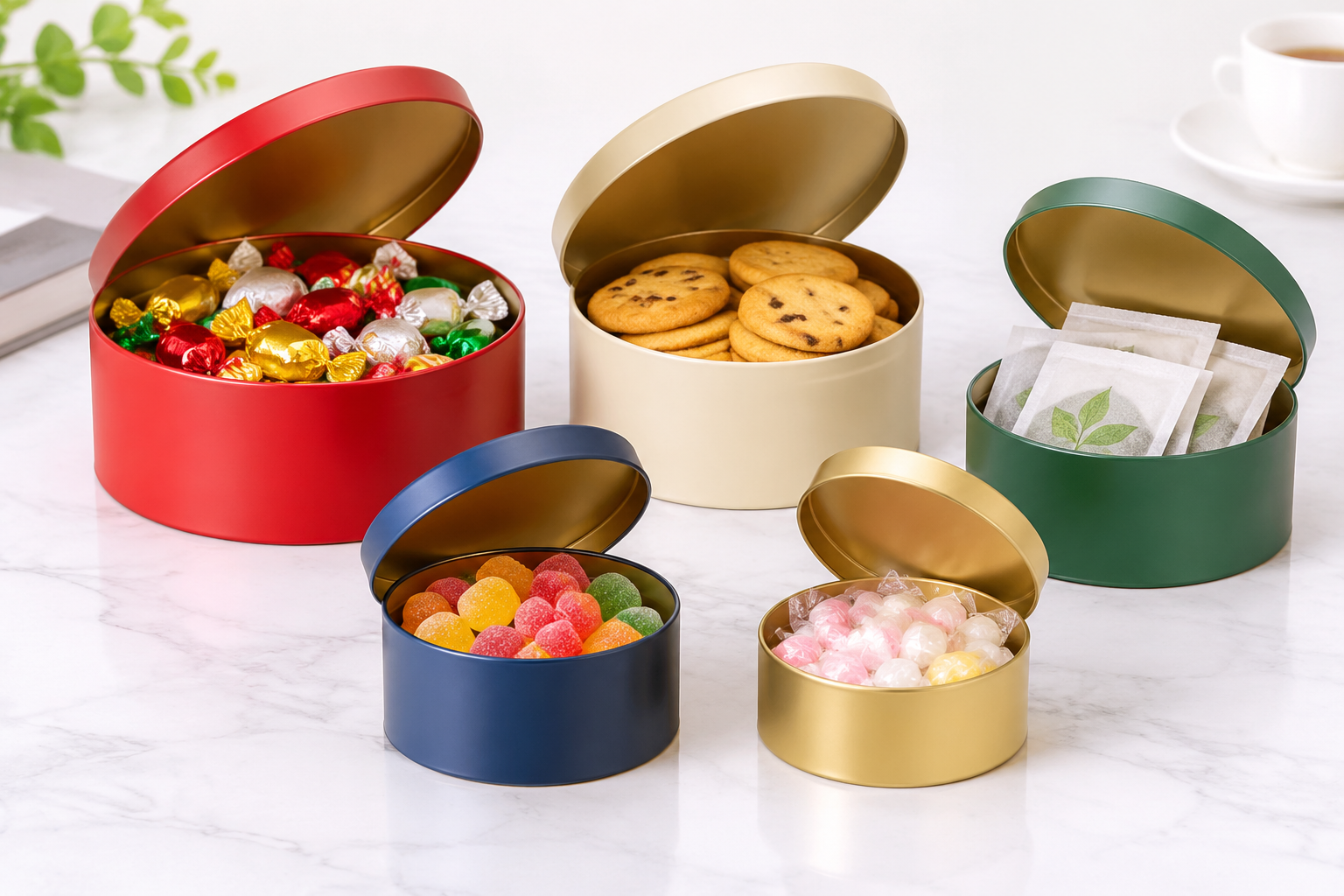
Round tin containers are usually chosen for how they look. The better question is how the product sits inside one. A round interior has no corners, so it suits some products very well and wastes space with others.
This guide shows how to test that fit before you commit to a diameter, which products suit a round footprint, and what to confirm before you ask for a quote. For product-specific sizing, it points to our detailed guides rather than repeating them.
Quick takeaway
- A round tin fits round or disc-shaped products, small loose pieces, and gift sets arranged around a center.
- It wastes space with rectangular products packed in rows. A rectangular block needs a round interior as wide as the block’s diagonal.
- Test fit with the diagonal rule below before you choose a diameter, then confirm with a physical sample.
- Pricing and minimums depend on structure and printing. See our cost, MOQ and lead time guide.
What Makes a Round Tin Container Different?
A round tin has one continuous wall and a lid centered on the opening. That brings three practical effects:
- Small pieces settle naturally. Loose candies or mints fill a curved interior without leaving the sharp dead corners of a square tin.
- Straight-edged products leave gaps. Anything with corners, such as a bar or a rectangular sachet, cannot reach the curved wall.
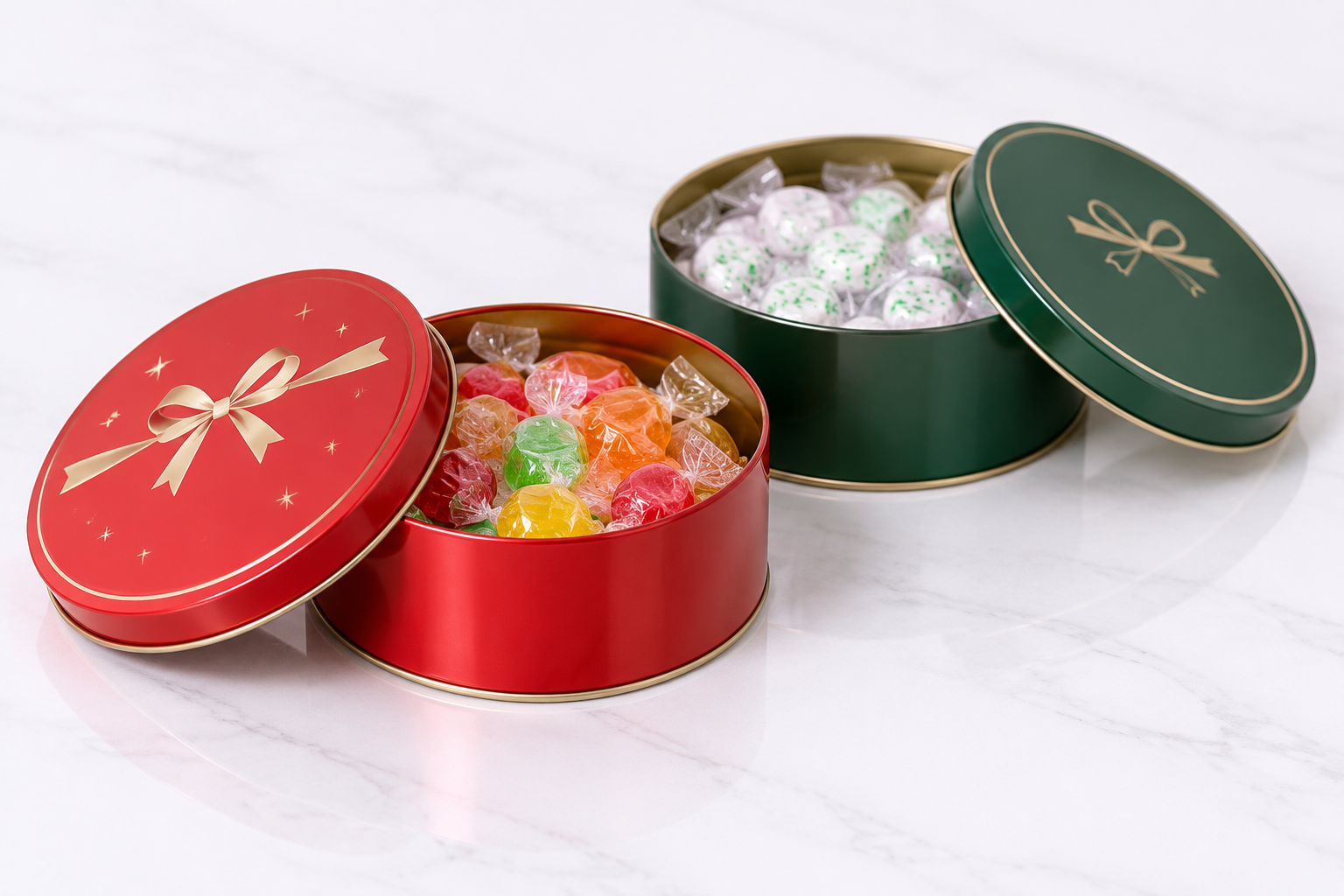
- The lid becomes the main branding surface. A round lid suits a single centered motif, and the sidewall can wrap the design around the body.
Which Products Suit Round Tin Containers?
| Product shape | Fit in a round tin | Where to read more |
|---|---|---|
| Small loose pieces (mints, wrapped candies) | Good | Candy tin guide, mint tin guide |
| Round or disc-shaped items (cookies, biscuits) | Good | Round cookie tin guide |
| Loose-leaf tea with an inner pouch | Good | Tea tin guide |
| Mixed items around a center piece (gift sets) | Good, with an insert | Tin storage boxes guide |
| Rectangular products in rows (bars, flat packs) | Wastes space | Rectangular tin box size guide |
If your product is a rectangular block, see our guide to rectangular tins with lids before you settle on a round shape.
Round, Square or Rectangular: Which Footprint Fits Your Arrangement?
Choose the footprint from how the product is arranged, not from which tin looks better in a catalog.
| Product arrangement | Round | Square | Rectangular |
|---|---|---|---|
| Loose pieces poured in | Fits well | Fits well, corners stay empty | Fits well, corners stay empty |
| Rows of rectangular pieces | Gaps at the sides | Fits square blocks | Best match for long blocks |
| Round or disc items stacked | Best match | Corners stay empty | Corners stay empty |
| One centered hero item with accessories around it | Natural fit | Works | Works |
For square and rectangular structures, see our square tin box and rectangular tin box pages.
How Much Space Does a Round Tin Waste? A Worked Example
A rectangular block inside a round tin has to fit across the circle’s diameter. That makes the block’s diagonal the minimum internal diameter.
Example: six wrapped bars, each 60 × 30 mm, laid flat in a 2 × 3 block.
- Block size: 120 × 90 mm.
- Diagonal: √(120² + 90²) = 150 mm. The round interior must be at least 150 mm wide, before any clearance.
- Compare footprints. A round interior of 150 mm covers about 17,671 mm². A rectangular interior of 124 × 94 mm, which allows 2 mm clearance per side, covers about 11,656 mm².
| Option | Interior size | Interior footprint | Block fills |
|---|---|---|---|
| Round | 150 mm diameter | about 17,671 mm² | about 61% |
| Rectangular | 124 × 94 mm | about 11,656 mm² | about 93% |
For this product, the round interior is about 52% larger for the same six bars. The round tin also needs more carton space and gives the contents more room to shift.
The opposite case: seven round items of 40 mm diameter sit in a hexagonal cluster inside a 120 mm interior diameter, with the outer six touching the wall evenly. Round is not about holding more. A 120 mm square interior would hold nine in a grid. It is about a snug, stable fit and a balanced look. For circle-packing layouts of discs such as cookies, see our round cookie tin guide.
These figures are geometry only. Rolled edges, lid overlap and inserts reduce the usable interior, so confirm the final diameter on a physical sample.
What Do Diameter and Height Each Control?
Diameter and height solve different problems.
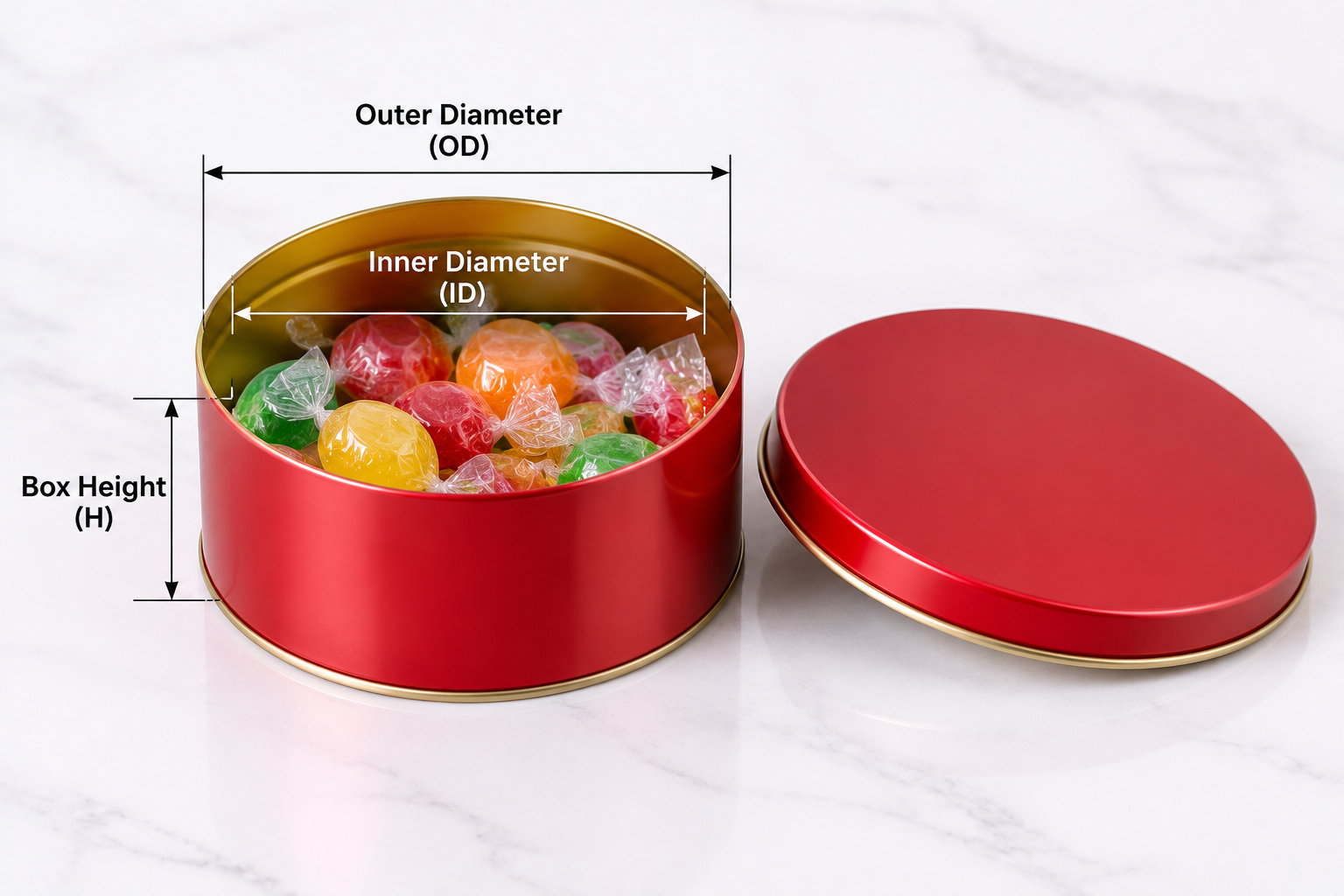
- Diameter sets how much fits across the base. Use the diagonal rule above for rectangular products.
- Height sets the number of layers and the clearance under the lid.
A wider tin is not automatically better. If the product is small, extra width lets it slide in transit. Extra height without a plan for layers leaves empty space under the lid.
External dimensions do not tell you the usable interior. The rolled edge, the lid overlap and any tray or insert all reduce it.
Which Lid Suits a Round Tin Container?
Round tins commonly use a slip lid that pulls straight off, or a screw lid that turns on. A slip lid is quick to open and suits gift and confectionery packs. A screw lid closes more firmly and suits products customers open repeatedly. Your sample decides how well either one closes, so check that the lid sits flat without pressing on the contents.
For a closer look at lift-off, slip and hinged structures, read our lid types guide.
How Does Printing Work on a Round Tin?
A round tin has two print areas: the lid and the sidewall. Before you finalize artwork, check two round-specific points:
- Sidewall wrap. A design that wraps around the body must join cleanly where the ends meet.
- Seam position. Many round tin bodies have a side seam. Confirm where it falls on the die-cut template before you place a logo or barcode on the sidewall.
We supply mockup and die-cut templates for artwork preparation. Colors, finishes and file requirements are covered in our custom printed tin packaging guide.
Do Round Tins Need an Inner Bag or Tray?
It depends on the product. Loose or powdery products usually need an inner pouch or bag. Fragile or individually arranged pieces usually need a tray or divider so they stay in position.
If food touches the metal directly, confirm the interior coating for your product and destination market:
- For the US, food-contact packaging falls under FDA requirements.
- For the EU, check Regulation (EC) No 1935/2004 and Regulation (EC) No 2023/2006.
- For interior coatings on metal packaging, check Regulation (EU) 2024/3190 on bisphenols.
Transition periods differ by article, so confirm the current position for your product. Our food tin container guide covers coatings and inner packaging in more detail.
What Should You Confirm Before Ordering Custom Round Tins?
A clear brief and an approved sample matter more than any single dimension. Prepare this information before you request a quotation:
| What to prepare | What to include |
|---|---|
| Product dimensions | Length, width and height of the packed product, as it will be sold |
| Packing quantity and arrangement | Pieces per tin, layers, and whether they must stay in rows |
| Diagonal or footprint | Block size if the product is rectangular |
| Target tin size | Diameter and height, if you already have them |
| Lid type | Slip, screw or another structure |
| Inner packaging | Pouch, tray, divider or direct filling |
| Artwork | Lid and sidewall files, logo, finish requirements |
| Destination market | Country of sale and applicable food-contact rules |
If you do not have a tin size yet, send a physical product sample or clear photos with measurements, and the team can suggest a starting specification.
Check the sample with the real product. The planned quantity should fit, pieces should come out easily, and the lid should close without touching the contents. Review the printing under normal lighting before mass production.
For the stages from brief to mass production, read our custom tin packaging process guide. For minimums and lead times, see the cost, MOQ and lead time guide and our FAQ.
Start Your Custom Round Tin Project
Liyipackaging is a Dongguan-based tin packaging manufacturer with more than 25 years of industry experience, a 3,000㎡ facility and a monthly capacity of up to 2 million units. Share your product dimensions, quantity and artwork, and our team can check whether a round footprint fits before sampling begins.
Browse our custom round tin boxes or contact us with your project details. You can also learn more about Liyipackaging.
Frequently Asked Questions About Round Tin Containers
What products suit round tin containers best?
Small loose pieces, round or disc-shaped products, loose-leaf tea in an inner pouch and gift sets arranged around a center item. Rectangular products packed in rows usually fit better in a rectangular tin.
How do I find the minimum diameter for a rectangular product?
Measure the block of packed pieces, then calculate its diagonal: the square root of length squared plus width squared. The round interior must be at least that wide, before clearance for the rolled edge and lid.
Is a round or square tin better for gifts?
It depends on the arrangement. Round suits centered layouts and a single lid motif. Square or rectangular suits rows and regular grids. Compare footprints before you choose.
Do round tin containers need an inner bag or tray?
Loose or powdery products usually need an inner bag. Fragile or arranged pieces usually need a tray or divider. Confirm any direct food contact with the interior coating for your destination market.
What do I need to get an accurate quote?
Product dimensions, packing quantity, a target diameter and height if you have them, lid type, inner packaging, artwork and destination market. A physical sample helps most. Minimums and lead times are explained in our cost, MOQ and lead time guide.