Written by Liyipackaging Packaging Team
Last Updated: September 2026
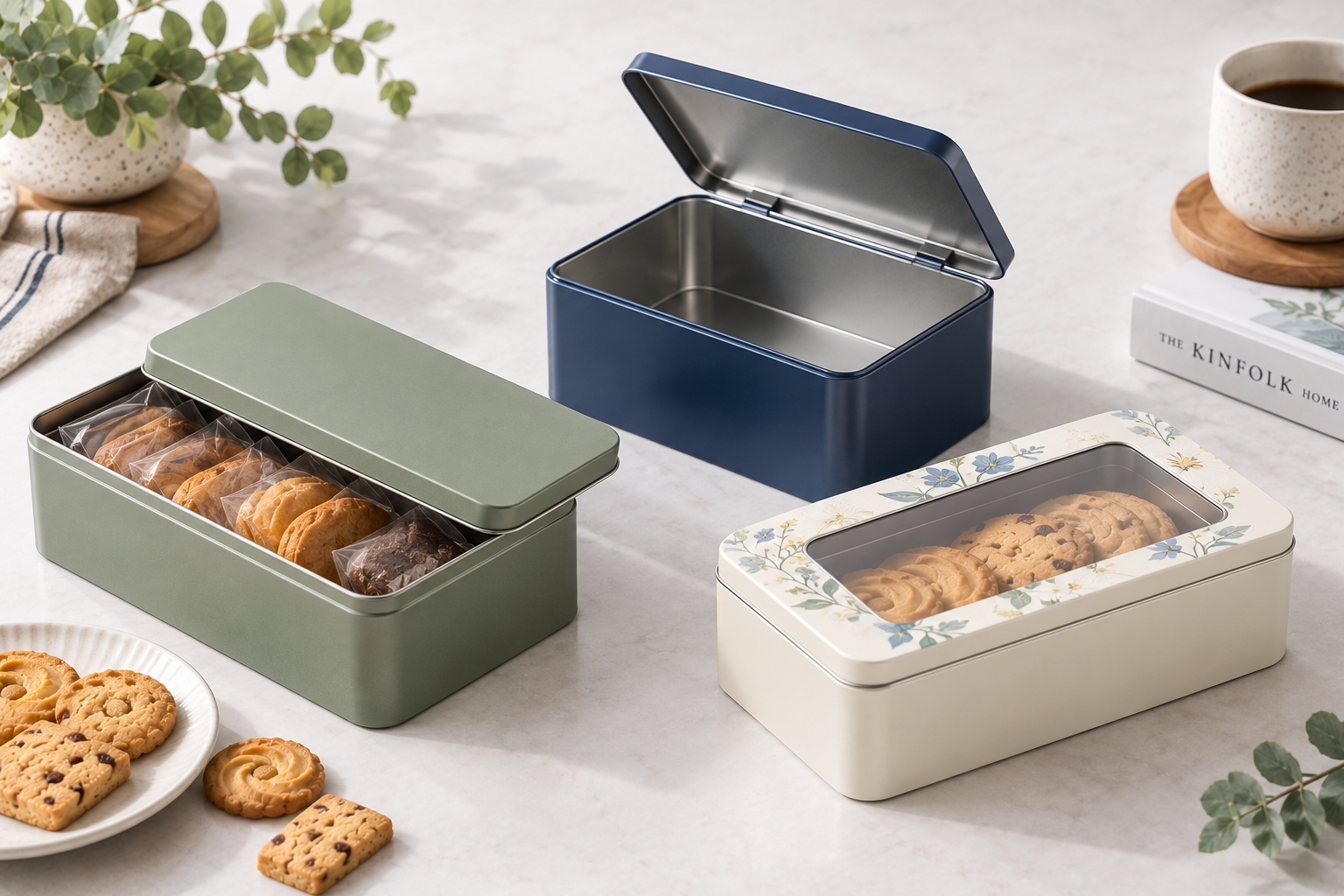
As a custom tin packaging manufacturer, we often receive inquiries that start with a simple requirement: “We need a rectangular tin with a lid.”
The difficult part usually comes after that. How large should the tin be? What type of lid fits the product? Does the package need a window or a hinged structure? And how can you confirm that the finished tin will work before placing a production order?
The answer is not to choose a tin from an outside dimension alone. The better approach is to start with the product, packing arrangement and intended use, then develop the rectangular tin structure around those requirements.
This guide explains the key decisions without going too deeply into specialized hinge engineering or lid-tolerance troubleshooting. If you are preparing a new project, you should be able to finish this article knowing what information to give your manufacturer and what to check before approving a sample.
What Should You Decide First When Choosing Rectangular Tins with Lids?
Start with the product and how it will be used. The lid structure should support the packing arrangement and opening experience rather than being selected independently.
Start with the product
Before discussing the final tin size, establish:
- Product length, width and height
- Number of products per tin
- How the products will be arranged
- Whether an insert or divider is needed
- Whether customers will repeatedly open the package
- Whether the contents need to be visible
For example, suppose a brand wants a rectangular tin for 12 individually wrapped cookies. The useful starting information is not simply “rectangular tin.” It is the cookie dimensions, the 12-piece arrangement and the desired presentation inside the tin.
That information gives the manufacturer a practical basis for developing the structure.
Define the opening experience
Next, consider how the customer will interact with the package.
A tin opened once for a gift presentation has different requirements from one that will be opened repeatedly and reused.
The lid should therefore be considered together with the product rather than treated as a separate decorative component.
Which Lid Structure Fits Your Rectangular Tin?
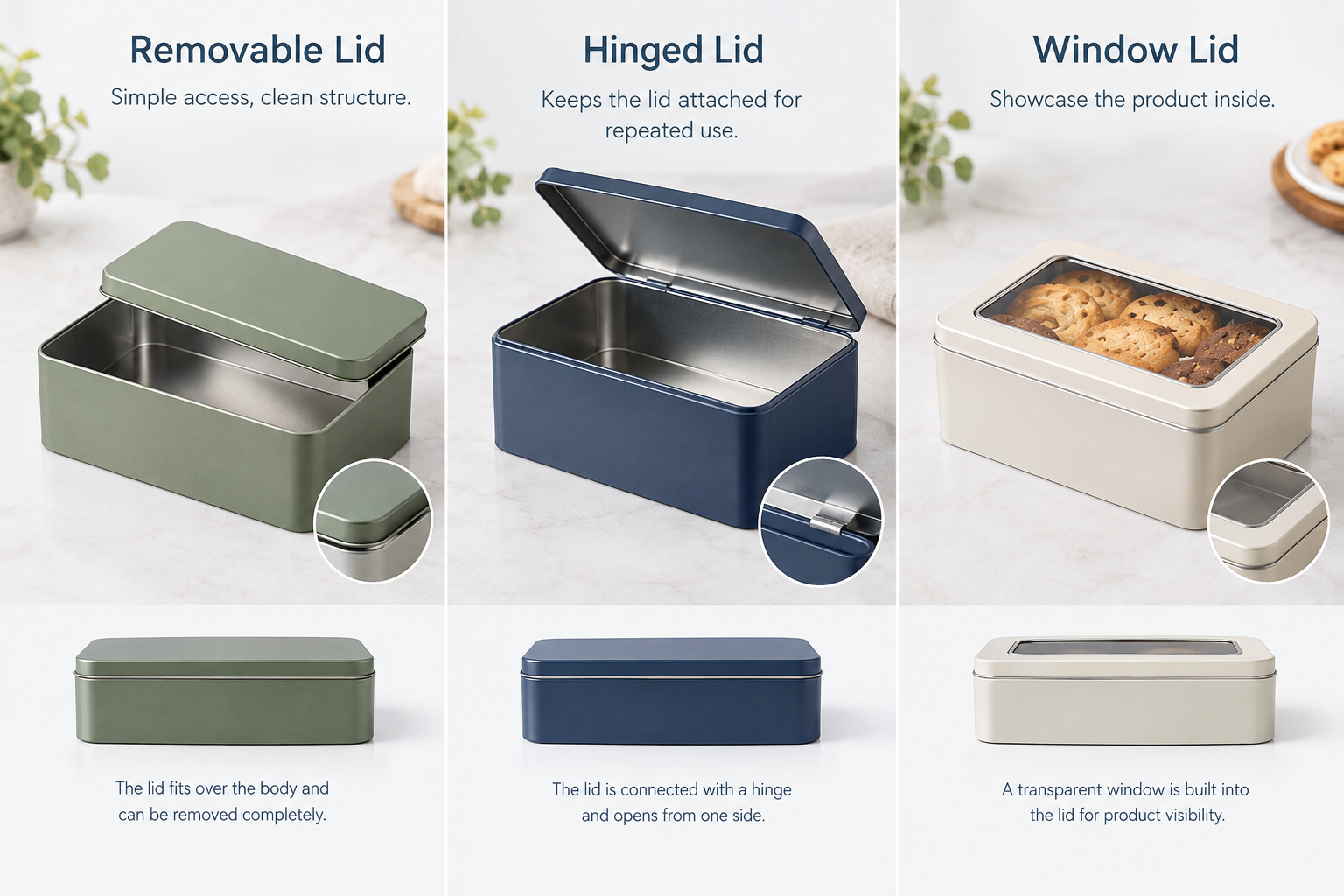
The right lid structure depends mainly on how the product will be accessed and presented. For most rectangular tins, the choice starts with three practical options: a removable lid, a hinged lid, or a window lid.
Removable lids for straightforward access
A removable lid provides a simple way to open the package and can work well when the contents do not need to be accessed repeatedly.
It also keeps the structure relatively straightforward.
For this type of rectangular tin, the main practical check is whether the lid and body provide a consistent fit on the finished sample.
Hinged lids for repeated opening
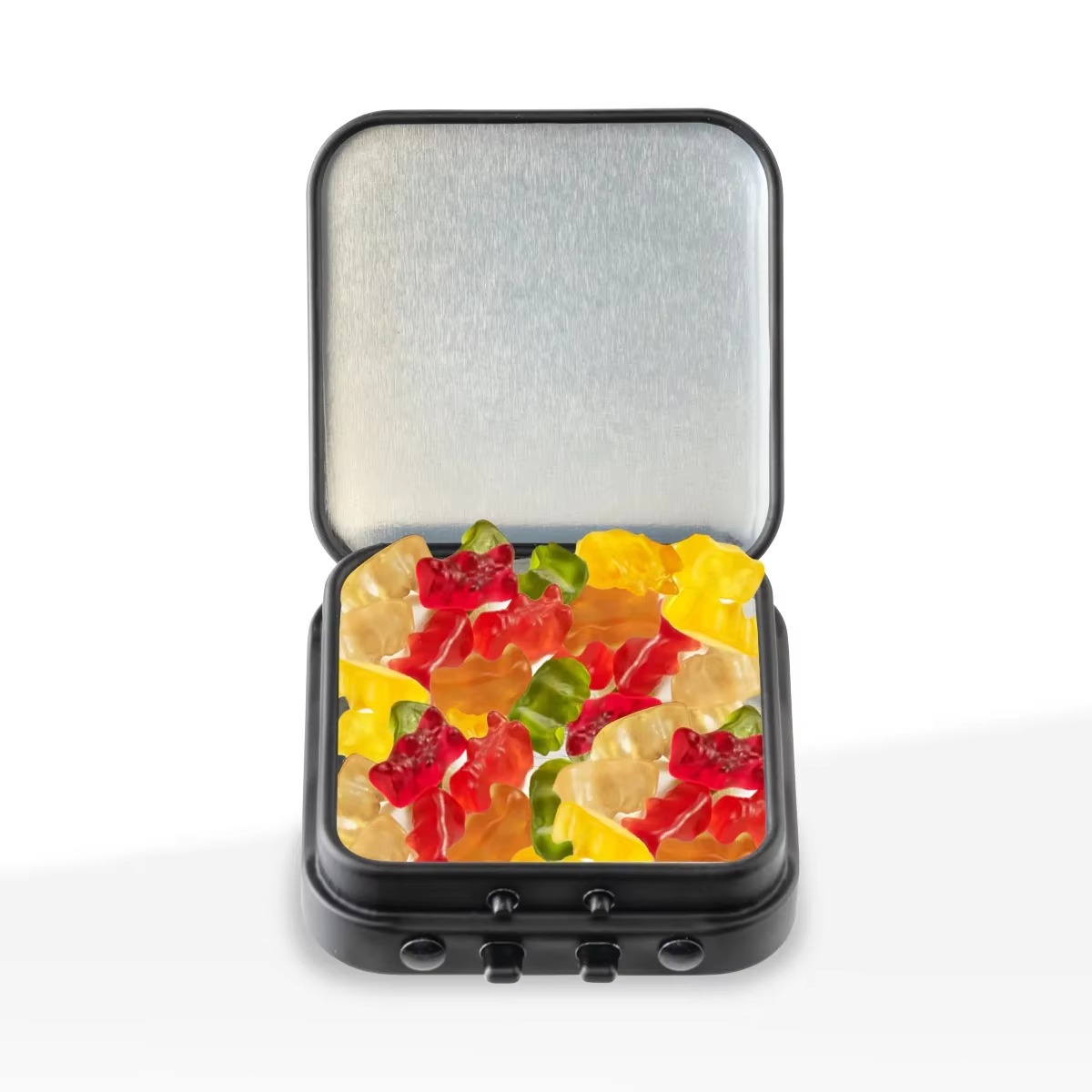
A hinged lid keeps the top attached to the tin, making it suitable for products that may be opened and closed repeatedly. The opening direction and internal product arrangement should be considered together during sample development.
If you are specifically considering this structure, see our rectangle hinged lid tin box options for reference.
Window lids when product visibility matters
A window allows the customer to see part of the contents without opening the tin.
This can be useful for retail products where the appearance or arrangement of the product contributes to the purchase experience.
The important point is that the window should be considered during structural development, rather than added only after the lid and artwork have already been finalized.
How Should You Approach the Size of a Rectangular Tin?
The right size comes from the product arrangement inside the tin, not from the external dimensions alone.
Measure the packed product
Start with the actual product dimensions and determine how many units need to fit inside.
For example:
Product: 80 × 50 × 20 mm
Quantity: 6 pieces
Arrangement: 2 × 3
The manufacturer can then evaluate the required internal space and suitable tin proportions.
These numbers are only an example. The final dimensions depend on the actual product, packing method, material and structure.
Consider the space the package actually needs
Do not make the tin unnecessarily tight simply to reduce its external size.
At the same time, excessive empty space can make the package larger than necessary.
The practical sequence is:
Product → Packing arrangement → Internal space → Tin structure → External dimensions
That sequence gives both the buyer and manufacturer a clearer basis for sampling.
Confirm the size with a physical sample
A drawing can confirm dimensions, but a sample confirms whether the package works with the actual product.
Place the product inside, close the lid and check whether the contents sit as intended.
That simple test can reveal problems that are difficult to see from a specification sheet.
What Can You Customize on Rectangular Tin Packaging?
Once the basic structure is clear, customization should focus on the elements that affect brand presentation and product protection.
Dimensions and proportions
The length, width, height, and overall proportions can be developed around the product and packing arrangement. Explore our rectangular tin box can options to see how the structure can be customized for different products.
Printing and surface finish
The lid, body, sides and corners all form part of the finished package.
Artwork should be developed from the actual tin structure so that important branding elements are positioned correctly after forming.
Liyipackaging’s public product information lists options including CMYK printing, Pantone matching, matte or glossy finishes, embossing and engraving.
Inserts and internal accessories
If the product needs to remain separated or positioned, discuss the insert at the same time as the tin.
Liyipackaging lists options such as EVA, sponge, foam, PET sheets, trays and other accessories for custom packaging.
This matters because an insert takes up usable internal space and can affect the final tin dimensions.
If you are developing a tin specifically for cookies, our guide to rectangular cookie tins covers product arrangement, presentation and customization in more detail.
Give Your Manufacturer These 7 Details Upfront
A good inquiry does not need to contain every technical specification. It needs to give the manufacturer enough information to understand the project.
Provide:
- Product: What will go inside the tin?
- Product dimensions: Length × width × height.
- Quantity per tin: How many units need to fit?
- Preferred lid: Removable, hinged or another structure.
- Window requirement: Whether the contents need to be visible.
- Estimated order quantity: Stock, sampling or custom production.
- Artwork status: Existing artwork, concept or no artwork yet.
For example:
“We need a rectangular tin for six products, each approximately 80 × 50 × 20 mm. The tin should have a printed lid and enough internal space for an insert.”
That is already enough to start a productive discussion.
You do not need to solve every structural detail before contacting the manufacturer.
What Should You Check Before Approving a Sample?
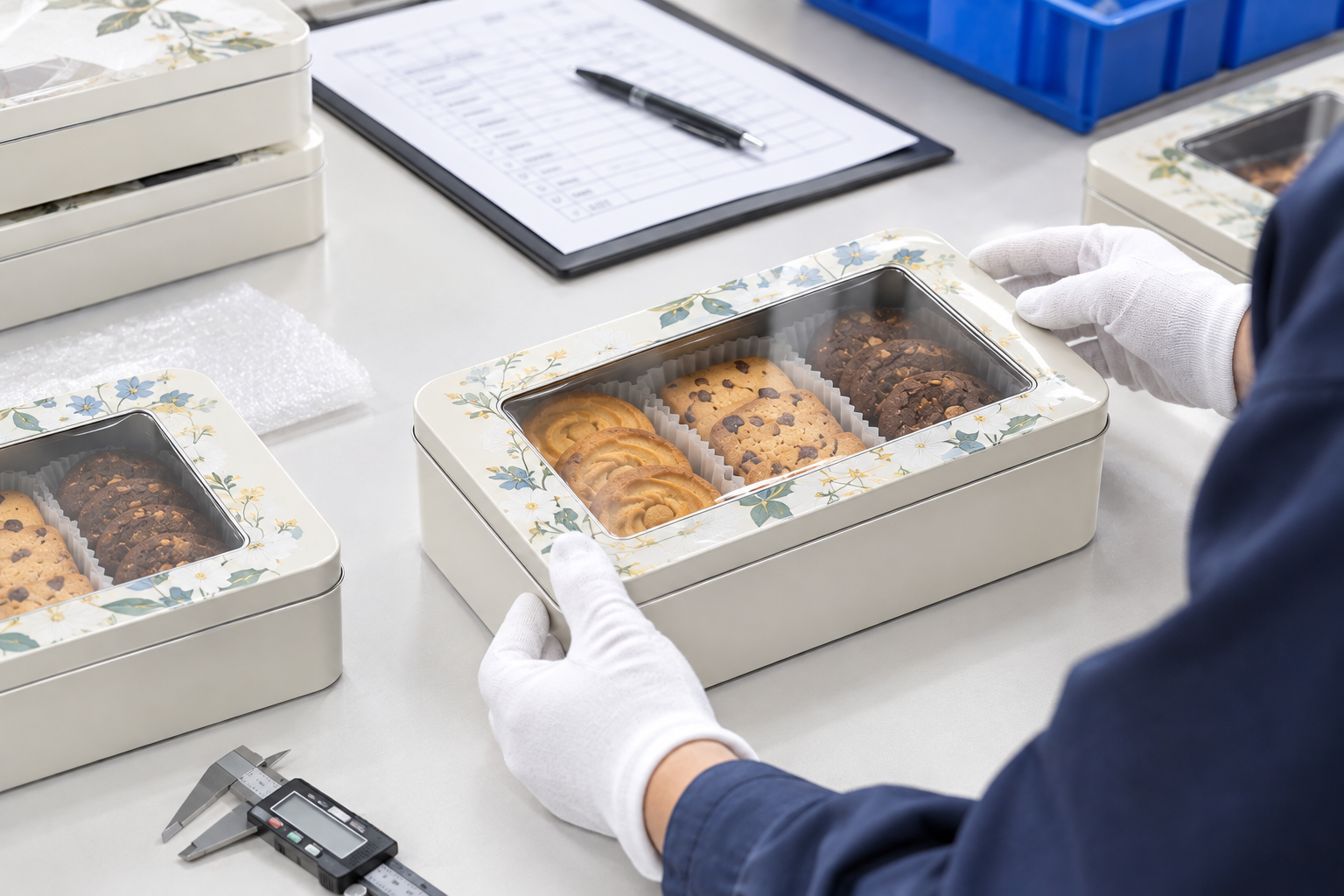
The sample should be treated as a functional checkpoint, not just a visual proof.
Check the product fit
Put the actual product, or a representative mock-up, inside the sample.
Check whether it can be inserted and removed naturally and whether the contents remain in the intended position.
Check the lid and overall appearance
Open and close the tin several times.
Then inspect:
- Lid operation
- Product fit
- Overall proportions
- Artwork position
- Corners and edges
- Surface finish
- Internal arrangement
You are not looking for perfection based on a theoretical drawing. You are checking whether the physical package performs as expected.
Confirm the approved sample
Once the structure, product fit and appearance are accepted, keep the approved sample as the physical reference for production communication.
This is particularly useful when several specifications are involved, because both buyer and manufacturer can refer back to the same approved structure.
Sample approval checklist: Product Fit → Lid Operation → Artwork → Appearance → Internal Arrangement → Final Approval
What Happens After the Rectangular Tin Structure Is Confirmed?
The development process becomes much easier once the basic structure has been approved.
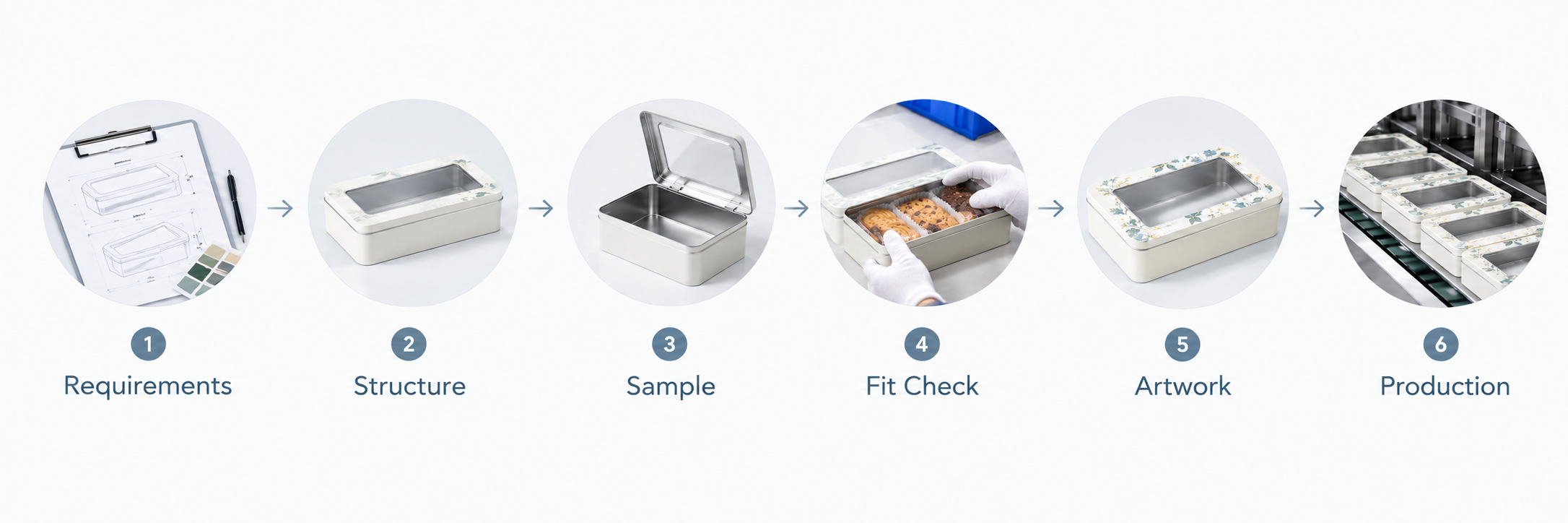
A practical sequence is:
Product Requirements → Structure → Sample → Product Fit → Artwork Approval → Production
This order prevents artwork and production decisions from moving ahead before the physical package has been checked.
For new custom projects, sampling also gives the buyer an opportunity to confirm details that are difficult to judge from a drawing alone.
How Can Liyipackaging Support a Custom Rectangular Tin Project?
A custom tin supplier needs to coordinate more than printing. The structure, product fit, artwork, sampling and production requirements all need to stay consistent.
Liyipackaging describes its business as a tin packaging manufacturing operation with more than 25 years of industry experience, a 3,000㎡ facility and production capacity of up to 2 million units per month. Its public company information also states that the company handles design and development through production and pre-shipment quality control.
For more information about our tin packaging manufacturing capabilities, production facilities, and quality control process, visit our About Us page.
For a buyer, the practical benefit is having the structural discussion, sample development and production communication handled through one supplier rather than treating each stage separately.
The company also states that it provides samples before ordering and custom development support.
If you are requesting a quotation, the most useful information to send is therefore not just “rectangular tin.” Include the product dimensions, packing quantity, preferred lid structure, artwork status and estimated quantity so the supplier can evaluate the project from the beginning.
What Is the Right Development Sequence for Rectangular Tins with Lids?
The key is to make the structural decision before the project becomes dependent on artwork or mass production.
For most custom projects, the process can be kept straightforward:
1. Define the product requirements
2. Select the basic rectangular tin structure
3. Confirm approximate dimensions
4. Develop and inspect the sample
5. Test the product fit
6. Approve artwork and final specifications
7. Move into production
This gives rectangular tins with lids a clear development path without turning one packaging project into several disconnected decisions.
If you already have the product dimensions and target quantity, the next step is to send those details to a manufacturer and discuss the appropriate structure before finalizing the artwork.
FAQ
What are rectangular tins with lids used for?
They can be used for cookies, confectionery, gifts, tea, promotional products and other retail packaging applications where a rigid metal container is suitable.
Can the size of a rectangular tin be customized?
Yes. Custom dimensions can be developed according to the product, packing arrangement and required internal space. A physical sample is useful for confirming the final fit.
Should the lid structure be decided before the artwork?
Yes. The basic structure and dimensions should be established first so the artwork can be prepared against the correct tin layout.
Do I need a sample for a custom rectangular tin?
For a new custom structure, a sample allows you to check product fit, lid operation and appearance before committing to production.
What should I include in a rectangular tin quotation request?
Send the product dimensions, quantity per tin, preferred lid structure, window requirement if applicable, estimated order quantity and artwork status. Product photos or drawings are also useful.
When requesting a quotation, provide the product dimensions, quantity per tin, preferred lid structure, estimated order quantity, and artwork status. If you need more information about MOQ, samples, production lead times, or other common tin packaging questions, see our Tin Packaging FAQ.
Ready to develop a rectangular tin with a lid?
If you already have your product dimensions and target quantity, contact our team to discuss the appropriate tin structure, lid type, and sample requirements before final artwork.