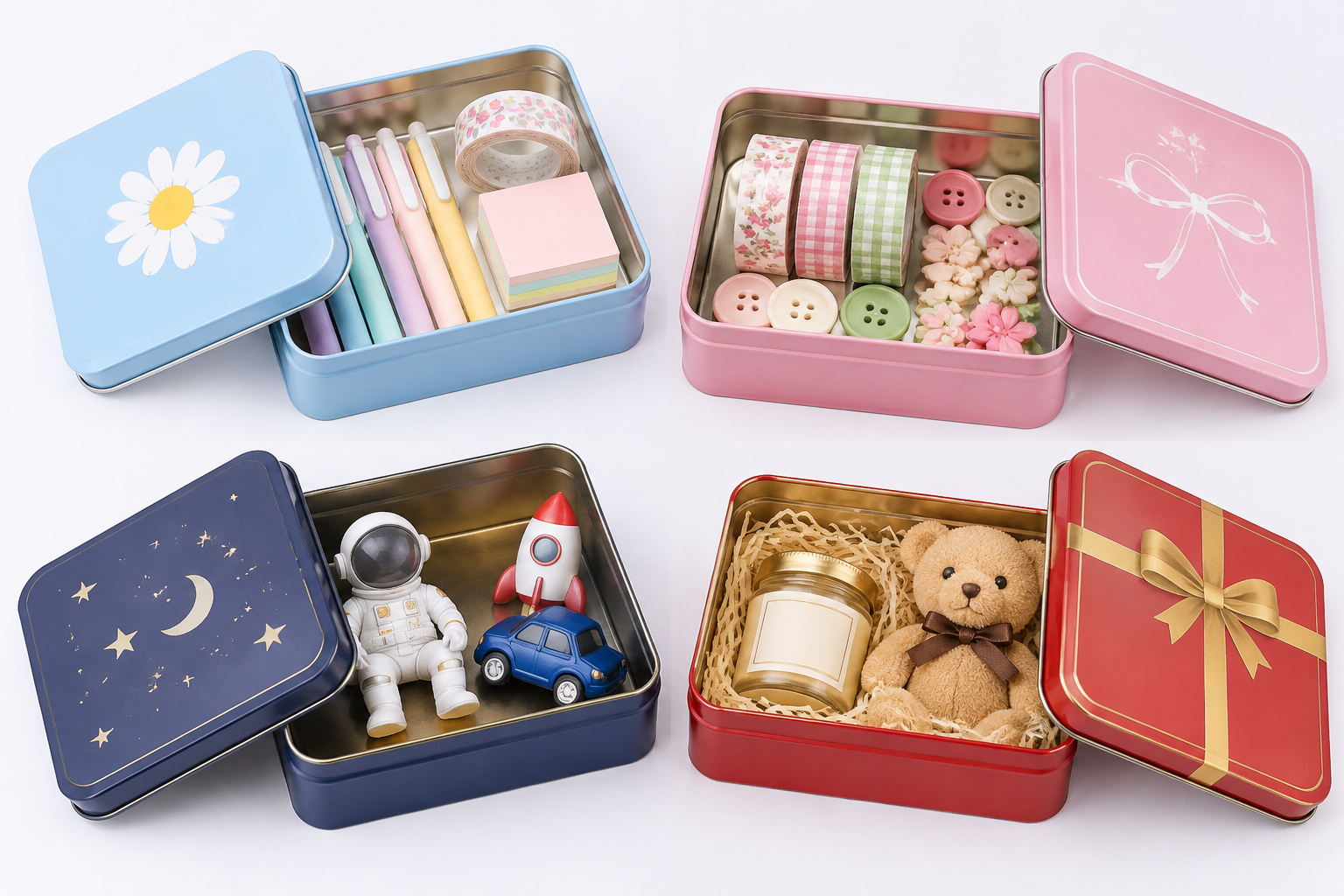
By Liyipackaging Packaging Team | Published: November 9, 2026
Most problems with tin storage boxes do not come from the design. They come from the inside: products that fit on paper but not in practice, lids that press on the contents, or inserts that take more room than expected. This guide focuses on one question: how much usable space do you actually need, and how do shape, height and inserts change the answer?
If you are still at the early stage of choosing a packaging format, start with our custom tin packaging guide and come back here once you know what will go inside the tin.
Quick Takeaway
- Plan the box around the product layout, not around an estimated capacity.
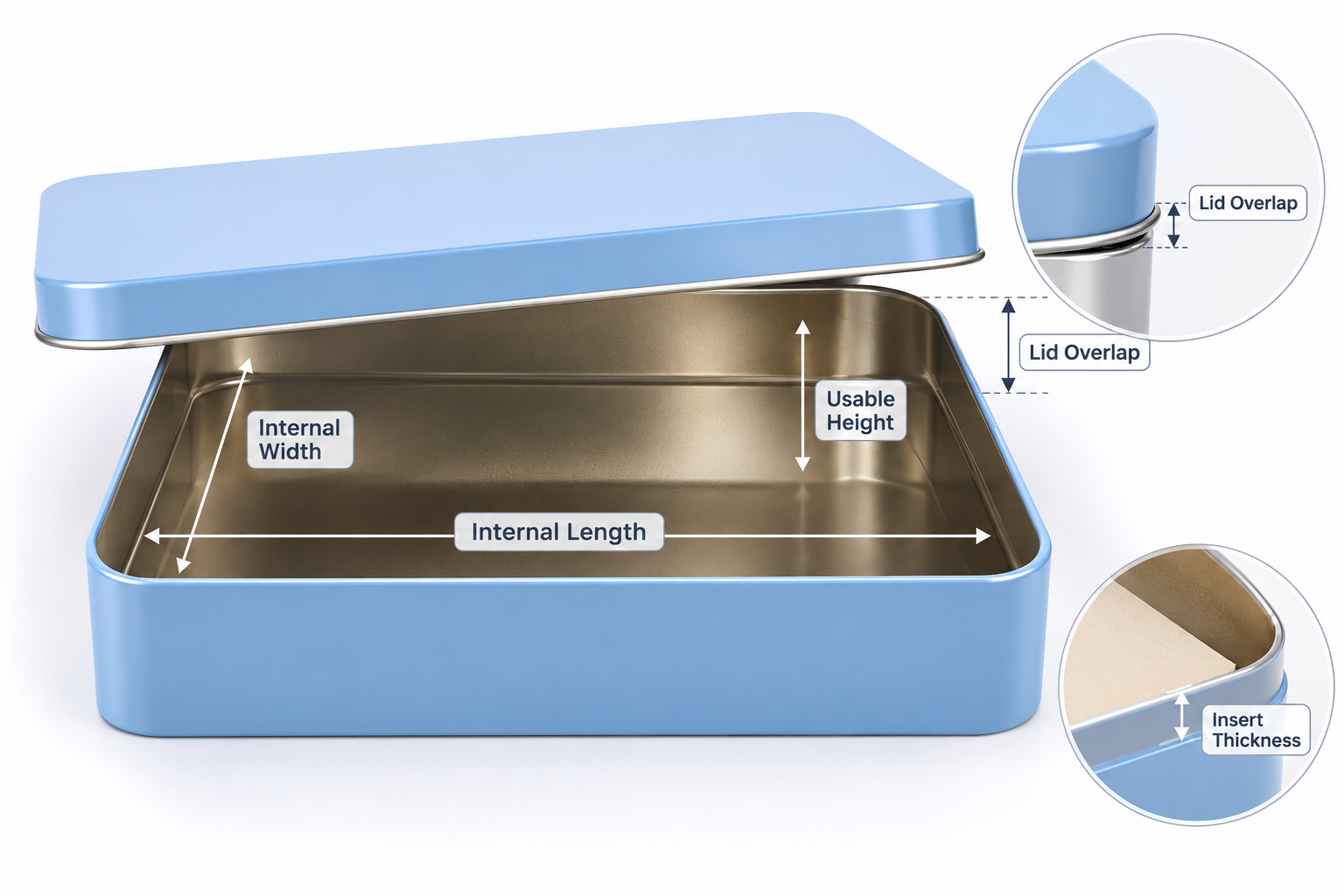
- External dimensions are not usable dimensions. Walls, folded edges and the lid overlap all reduce the space inside.
- Two layouts with the same number of items can need very different box sizes.
- Standard tinplate storage boxes are not automatically airtight or waterproof. If the contents are moisture-sensitive, plan for an inner bag or another barrier.
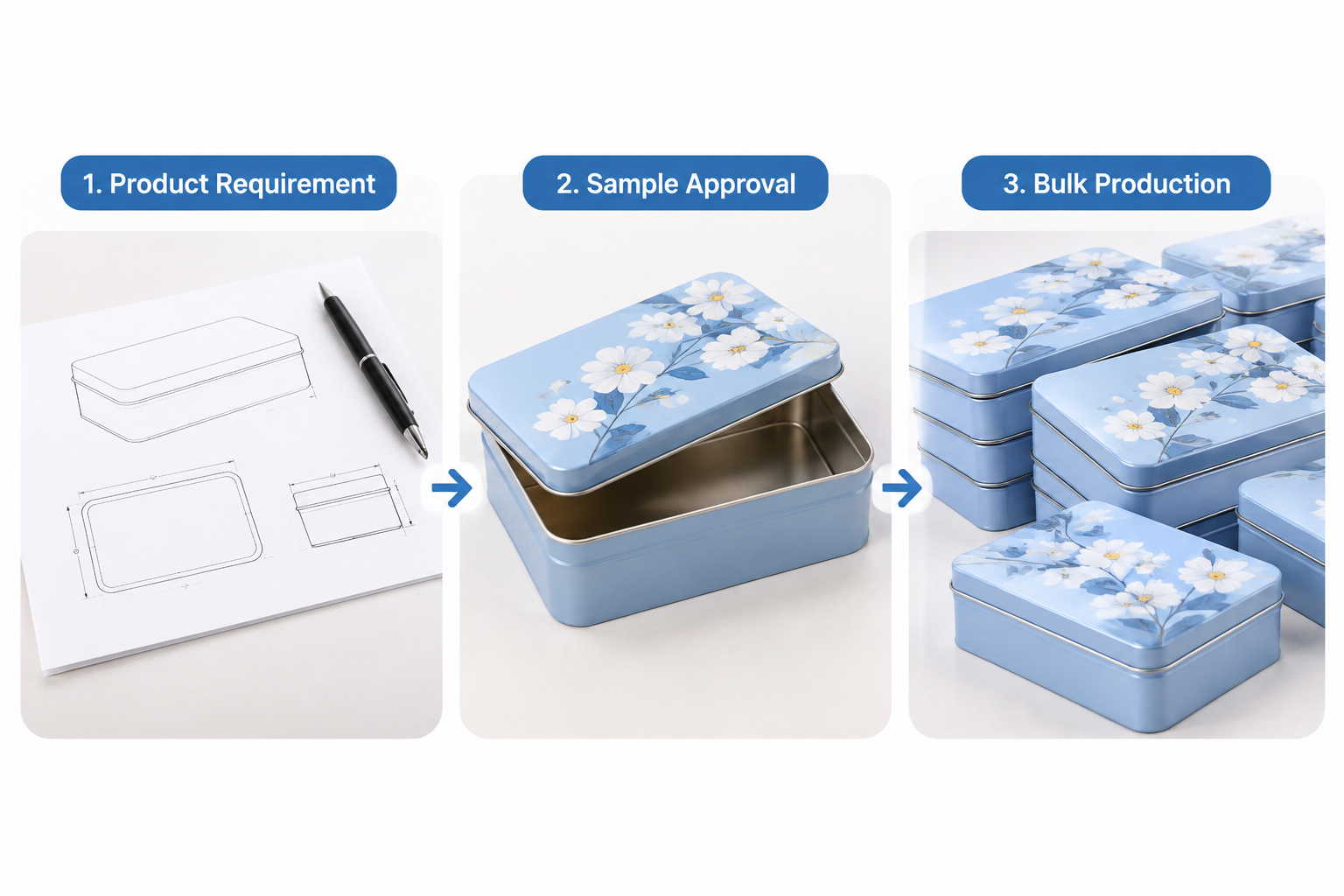
- Test a fully packed sample before approving production.
What Do You Need to Measure for Different Contents?
The measurements that matter depend on what the box will hold.
| Contents | What to measure | What often gets missed |
|---|---|---|
| Small accessories (beads, clips, pins) | Length, width and height of the largest piece | Space for fingers to pick items out |
| Stationery (pens, erasers, rulers) | Longest item length and total stack height | Length of the longest item, which sets the minimum internal length |
| Collectibles and keepsakes | Full dimensions including any display card or sleeve | Sleeves or cases that add thickness |
| Gift sets with mixed items | Each item separately, then the planned arrangement | Gaps between items and the thickness of dividers |
For food products, material and coating questions come first. See our guide to food tin containers before fixing the dimensions.
Start With the Product Layout, Not the Box
The same quantity can need very different internal dimensions depending on how it is arranged.
Take a worked example. A brand wants to pack 24 small accessories, each measuring 30 mm × 30 mm and 12 mm high. Assume a 2 mm gap between pieces and 2 mm of clearance along each inner wall.
| Layout | Calculation (length × width) | Minimum internal footprint |
|---|---|---|
| 6 columns × 4 rows | (6 × 30 + 5 × 2 + 4) × (4 × 30 + 3 × 2 + 4) | 194 mm × 130 mm |
| 8 columns × 3 rows | (8 × 30 + 7 × 2 + 4) × (3 × 30 + 2 × 2 + 4) | 258 mm × 98 mm |
Both layouts hold 24 pieces and use almost the same floor area, yet one is a compact rectangle and the other is a long, narrow box. Which one is better depends on the shelf, the carton and how the customer will open it. This is why a clear product drawing or the actual product helps more than a request for “a box for 24 items”.
The figures above are an illustration of the method. Your own gap and clearance values depend on the product and should be confirmed during sampling.
How Does Shape Change the Space You Need?
Shape affects how efficiently the interior can be used. Using the same 24-piece block (194 mm × 130 mm):
| Shape | What happens with this layout | Best suited to |
|---|---|---|
| Rectangular | Follows the layout closely, with little unused space | Items arranged in rows, elongated products |
| Square | Works when the layout is close to equal on both sides | Regular grids and compact sets |
| Round | The block must fit inside the circle, so the diagonal sets the size: about 234 mm across | Items that are naturally circular or arranged around a center |
| Irregular | Space depends on the outline and must be checked against the layout | Products where the shape itself is part of the appeal |
The round box in this example is far wider than the block it holds, which is why round tins suit round or loosely arranged contents better than rows of rectangular pieces.
You can browse the available structures here: round tin boxes, square tin boxes, rectangular tin boxes. If you need a special outline, read our guide to special shape tins first, because the outline reduces usable space and may require additional tooling.
Check Internal Height and Lid Clearance
Height is the dimension most often underestimated. Use this simple check:
Required internal height = product height + insert or base layer + clearance under the lid
In the example above, a 12 mm product, a 2 mm paper base layer and 2 mm of clearance give a minimum internal height of about 16 mm.
The external height is always larger than this, because the lid and body overlap and the material has thickness. Ask for the usable internal height on the drawing instead of working back from the outside measurement. For how different lid structures change opening and closing, see our guide to lid types.
Inserts, Dividers and Inner Bags
Internal accessories improve organization, but each one takes space from the layout.
| Option | Helpful when | Effect on space |
|---|---|---|
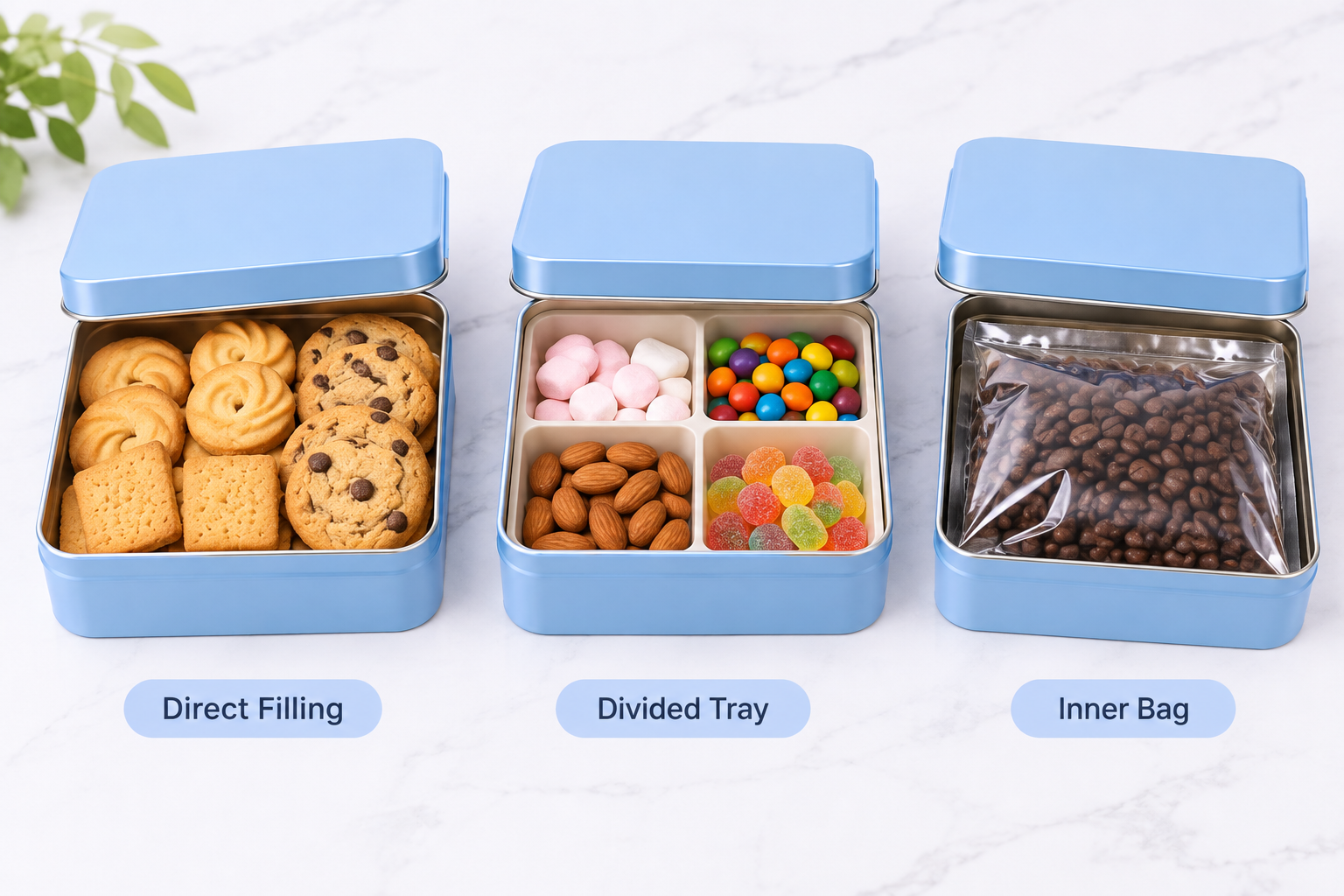
| Direct filling | Contents are uniform and will not scratch each other | Uses the full interior |
| Divider or tray | Items vary in size or must stay in position | Reduces length, width or height depending on the design |
| Inner bag | Contents need an extra layer of protection or separation | Adds thickness and can make removal tighter |
Always evaluate the insert and the tin together. Adding a divider after the box size is fixed often means going back to adjust the dimensions.
Run a Loading Test Before You Approve the Sample
A physical sample shows what a drawing cannot. When the sample arrives:
- Load the real products in the planned arrangement, including any insert or inner bag.
- Close the lid and check that nothing presses against it.
- Open and close the lid several times to see whether the fit stays comfortable.
- Remove the products one by one to check there is enough room to pick them out.
- Check the printed surface and edges for defects, then record the approved sample as the production reference.
If artwork is part of the project, review it at the same time. Our printed tin packaging guide explains how artwork behaves on curved surfaces and folded edges.
What to Include in Your Inquiry
A useful quote request lets the manufacturer check the fit before making a sample.
| Information | What to provide |
|---|---|
| Contents | What will be stored, and any sleeves or packaging around it |
| Product dimensions | Length × width × height of the largest piece |
| Quantity per box | Number of items and the preferred arrangement |
| Shape and lid | Round, square, rectangular or special shape; removable or hinged lid |
| Internal accessories | Direct filling, divider, tray or inner bag |
| Artwork | Logo, artwork files and preferred finish |
| Order quantity and market | Estimated quantity, destination and target date |
You do not need every detail before you ask. A product sample or a rough sketch is enough to start the conversation. For current minimum order quantities and lead times, refer to our FAQ page.
About Liyipackaging
Liyipackaging is a custom tin packaging manufacturer with more than 25 years of industry experience, a 3,000 ㎡ facility and a monthly production capacity of up to 2 million units. Our team supports projects from structure development and sampling through production and pre-shipment inspection. You can learn more on our About Us page, or contact us with your product dimensions to discuss a suitable tin storage box.
Frequently Asked Questions About Tin Storage Boxes
How do I choose the right size for a tin storage box?
Start with the actual product dimensions and the number of pieces, then decide on the arrangement. Add the gaps, any insert thickness and the clearance under the lid, and confirm the usable internal dimensions on the drawing before sampling.
Is the external size the same as the usable size?
No. Material thickness, folded edges and the lid overlap all reduce the space inside, so the usable size is always smaller than the outside measurement.
Are tin storage boxes airtight or waterproof?
Not automatically. Standard tinplate boxes are rigid and durable, but airtight or moisture-resistant performance depends on the full structure. If the contents are moisture-sensitive, discuss an inner bag or another barrier with your manufacturer.
When do I need an insert or divider?
When items can move, scratch each other or need to stay in a fixed arrangement. Remember that an insert takes up space, so include it in the size calculation from the start.
What is the minimum order quantity for custom tin storage boxes?
It depends on the structure, tooling and customization. Custom tin packaging with Liyipackaging generally starts from 3,000 pieces, and the current figures for your project are listed on our FAQ page.