Written by: Liyipackaging Packaging Team
Published: November 6, 2026
Last Updated: November 6, 2026
Regulatory information reviewed: November 6, 2026
A storage tin is a metal container that customers can open repeatedly and keep after the first purchase. That reuse changes how the tin should be planned: the internal size must fit the contents, the lid must suit how often it is opened, and the inner packaging must protect the product between uses.
Dongguan Liyi Packaging Products Co., Ltd. is a professional tin packaging manufacturer with more than 25 years of industry expertise and a 3,000㎡ facility. This guide covers the decisions that are specific to storage tins. For the general process of choosing a tin shape, supplier and order plan, see our Custom Tin Packaging Guide.
Quick takeaway
- Size a storage tin from the packed contents, not from the outside of the product alone.
- Choose the lid by how often customers will open the tin.
- Do not assume a fitted lid makes the tin airtight or moisture-proof.
- Confirm the food-contact status of the coating before approving a sample.
What Makes a Storage Tin Different From Other Tin Packaging?
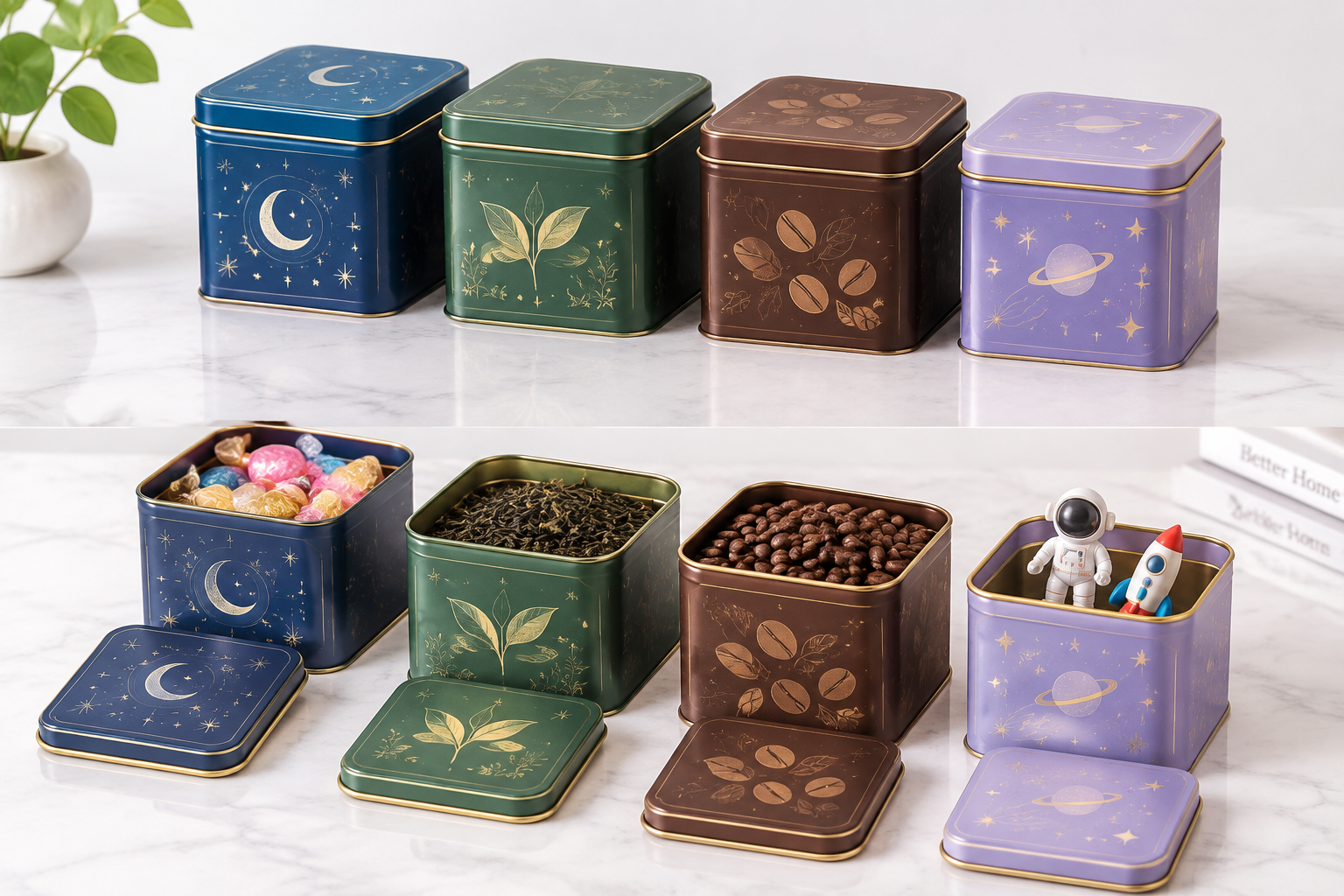
Any tin can hold a product, but a storage tin is designed to keep doing that job after the first opening. The customer returns to it for the next piece, the next scoop or the next cup, and may later reuse it for something else.
This matters for three reasons:
- Access: the opening and closing action is repeated many times, so the lid is part of the daily experience.
- Protection between uses: the contents are exposed to air and handling every time the tin is opened.
- Presentation over time: the printed surface stays visible at home or in the workplace, so scratch resistance and artwork quality carry more weight.
A tin made only for one-time gift presentation can prioritize appearance. A storage tin has to balance appearance with everyday use.
What Can You Store in a Storage Tin?
Storage tins suit dry products and small items that customers use in portions. Each category has its own sizing and protection questions, covered in a dedicated guide:
- Candy and wrapped sweets: see custom candy tins.
- Tea: see custom tea tins.
- Coffee: see custom coffee tins.
- Cookies and biscuits: see round cookie tins.
- Cards, keepsakes and small collectibles: see playing card tins and collectible tins.
How Do You Size a Storage Tin by Its Contents?
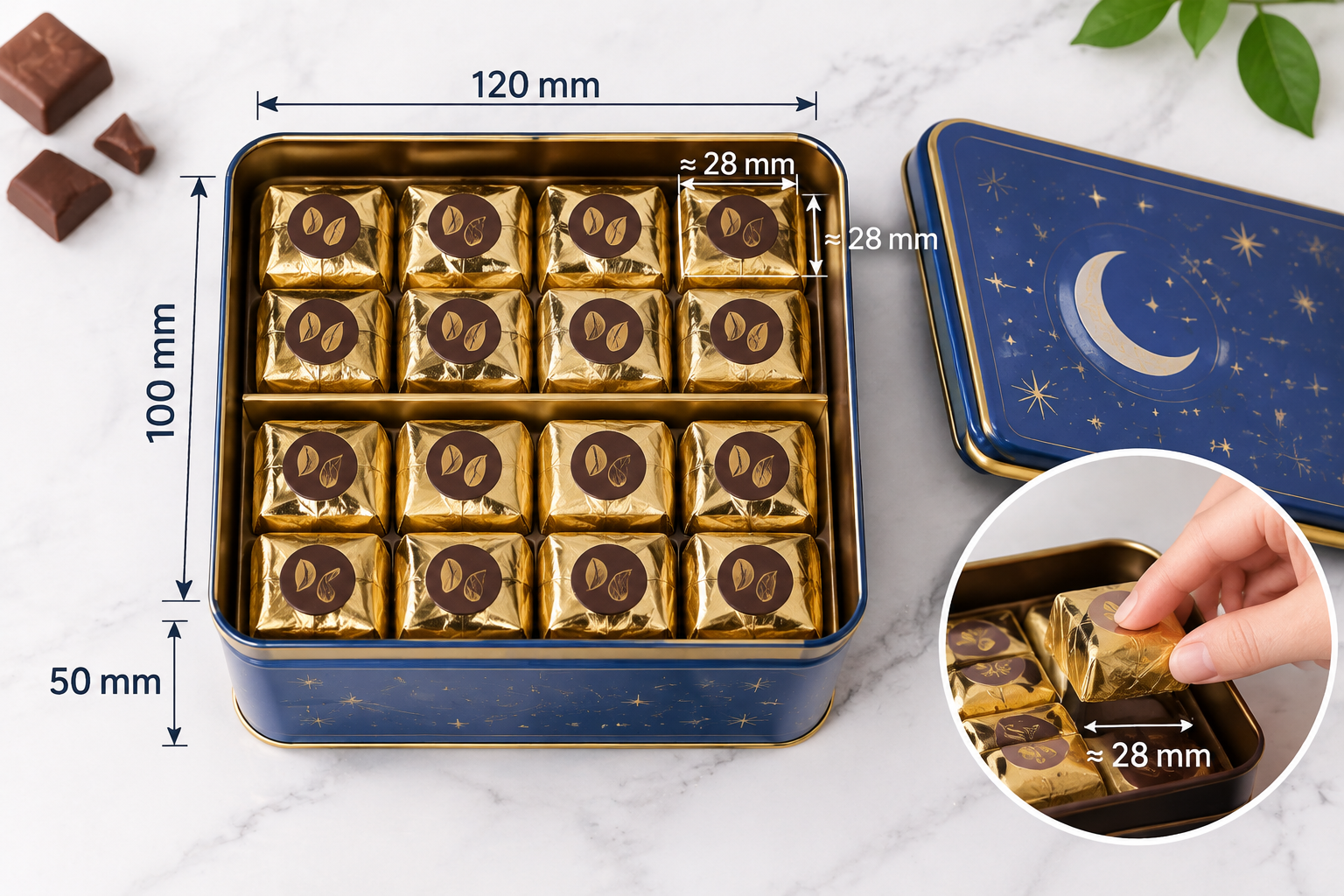
Start with the contents as they will actually be packed, including any wrapper, pouch or tray. Then work out how they will sit inside the tin.
Take this illustrative example: 24 individually wrapped chocolates, each measuring 40 × 25 × 12 mm.
- Layout: two layers of 12 pieces, arranged 4 × 3 in each layer.
- Footprint: 4 × 40 mm = 160 mm long and 3 × 25 mm = 75 mm wide.
- Height: 2 layers × 12 mm = 24 mm, plus a few millimeters of headroom below the lid.
- Starting point for the internal size: about 165 × 80 × 28 mm, before adjusting for the tray wall, finger access and the lid structure.
This is a planning calculation, not a standard size. The final internal dimensions depend on the tin structure, the wall thickness and how easily customers need to lift the pieces out. Multiplying the volume of one piece by 24 will not give a usable result, because gaps and finger space are part of the design.
Confirm the layout with a physical sample loaded with your actual product. For sizing logic specific to gift sets, see our Gift Tin Box Size Guide.
Which Lid Works for Repeated Opening?
Choose the lid by how often and how easily customers need to open the tin.
- Daily access: products customers take from every day need a lid that opens and closes with one hand and does not wear out the edge.
- Occasional access: tins that mainly sit on a shelf or serve as gifts can use a structure that prioritizes appearance.
- Portion removal: if customers remove one piece at a time, check that the opening is wide enough and that the lid does not interfere with taking the product out.
For a comparison of lift-off, slip and hinged structures on rectangular tins, see our Rectangular Tin Lid Types guide. To see the full range of shapes and lid structures available, browse our round, square, rectangular and irregular tin ranges.
How Do You Protect the Contents Inside a Storage Tin?
Metal construction does not by itself make a tin airtight or moisture-proof. A standard fitted lid should not be described that way unless the complete packaging has been designed and evaluated for that purpose.
Match the protection to the product:
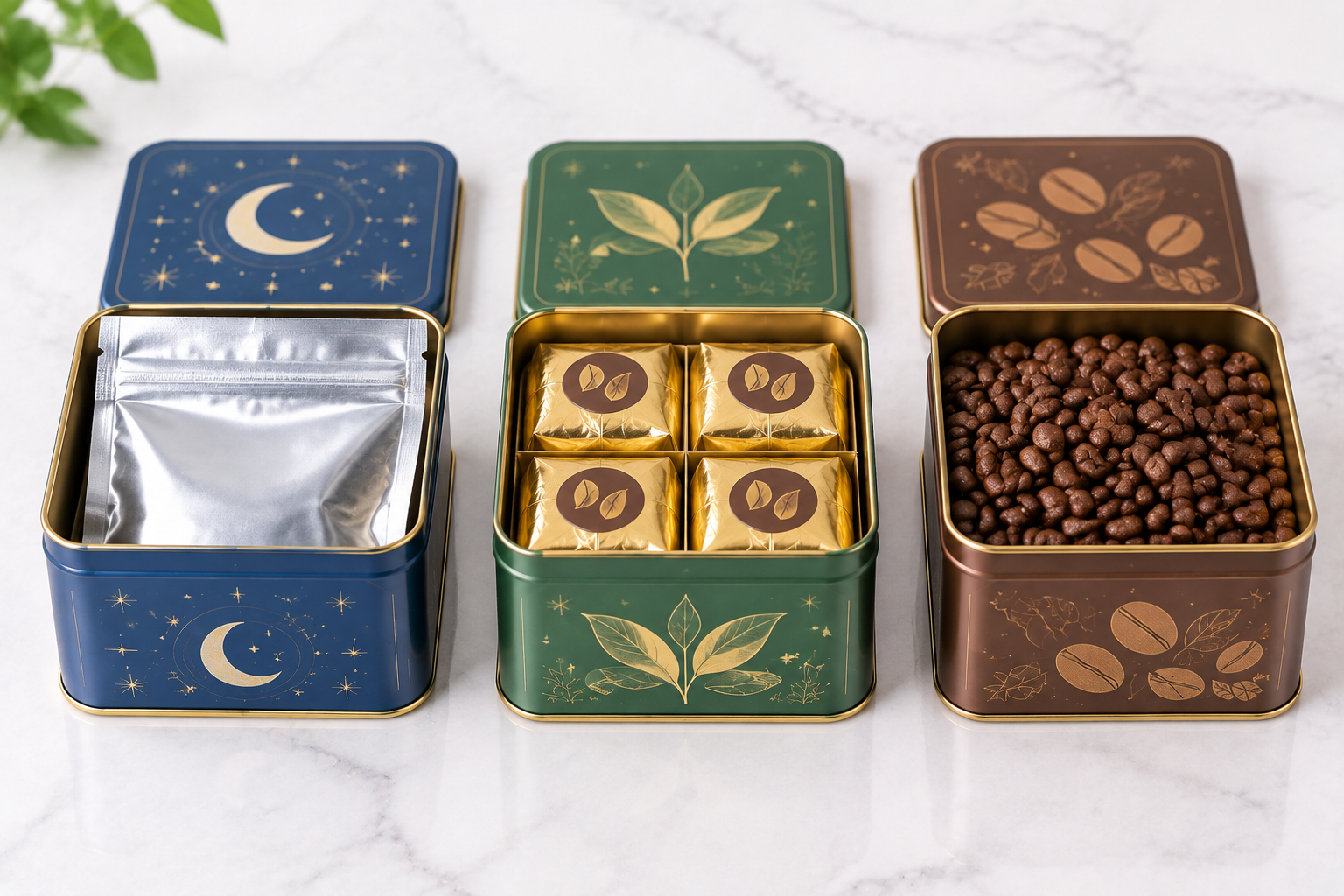
- Inner bag or pouch: useful for loose tea, coffee and other products that are sensitive to air or humidity.
- Inner tray or divider: keeps wrapped items in place and presents them neatly when the lid is opened.
- Liner or wrapper: helps with products that are oily or sticky.
- No extra packaging: individually wrapped dry products often need none.
For food products, confirm that the tin’s interior coating and materials are suitable for food contact in your target market. Requirements differ by market, for example the FDA framework in the US and Regulation (EC) No 1935/2004 and Regulation (EC) No 2023/2006 in the EU, plus the EU’s BPA rules under Regulation (EU) 2024/3190. Our Food Tin Containers guide explains the material, coating and documentation questions in detail.
Why Does Reuse Matter for Brand Packaging?
A storage tin that stays in a customer’s kitchen, desk or shelf keeps the brand visible after the contents are gone. That value depends on the tin being worth keeping: a lid that still closes well, artwork that resists everyday scratching and a size that suits a second use.
Printing and finish choices therefore deserve attention. Our custom printed tin packaging guide covers artwork files, color and finishes. If your product is designed as a keepsake or part of a series, the collectible tins guide covers that angle.
What Should You Send When Requesting a Storage Tin Quote?
Send what lets the team assess fit and structure:
- The product or a sample, with its wrapper or inner pack.
- Quantity per tin and the intended layout.
- How often customers will open the tin.
- Any inner bag, tray or divider you plan to use.
- Your target market, for food-contact requirements.
- Artwork or reference designs.
MOQ, sampling and lead time depend on the design and print requirements. Our Custom Tin Box Cost, MOQ & Lead Time guide explains how to plan them, and the FAQ page answers common questions. Ready to start? Contact Liyipackaging with your product details, or read more about our factory.
Frequently Asked Questions About Storage Tins
1. Can a storage tin keep food fresh?
A storage tin protects contents from handling and light, but a standard fitted lid is not automatically airtight. For products that are sensitive to humidity or air, add an inner bag or other protective packaging and confirm the structure with the manufacturer.
2. How do I know what internal size my storage tin needs?
Measure the packed product, decide the layout and layers, then allow for tray walls, finger access and lid clearance. A physical sample loaded with your actual product is the most reliable check.
3. Does a storage tin need an inner tray?
Not always. Individually wrapped dry products may stay organized without one, while loose or fragile items usually benefit from a tray or divider. Decide after a sample-loading test.
4. Which lid is best for a tin that is opened every day?
Choose a structure that opens and closes easily with one hand and keeps the edge durable. See the Rectangular Tin Lid Types guide for how common structures compare.
5. Where can I check MOQ and lead time for a custom storage tin?
MOQ and lead time depend on the design, printing and order quantity. See the cost, MOQ and lead time guide and the FAQ page, then confirm the figures for your project with the team.