By Liyipackaging Packaging Team | Published and updated: October 12, 2026
Quick takeaway: Size a round cookie tin from the cookie, not the tin. Measure the cookie diameter and thickness, work out how many fit in one circular layer, add a loading allowance, then set the depth from the number of layers. Because round cookies pack less efficiently into a circle than into a rectangle, check the layout before you settle on the shape. Confirm the final fit with a filled sample.
Round cookie tins fail in three ways: the cookies do not fit the quantity planned, they shift and break in transit, or the butter and oil in the cookies affect the tin’s interior over time. All three can be avoided by working out the layout first. This guide covers how to size a round tin for cookies, how to choose a layer arrangement, what to check on lid fit and food contact, and what to send in a quote request.
Round or Rectangular: Which Suits Your Cookies?
Round tins are the natural choice for round cookies, gift assortments, and products where a classic, reusable container is part of the appeal. Their drawback is geometry. Circles packed inside a circle leave unused gaps along the wall.
A simple comparison shows the effect. Take round cookies 60 mm in diameter:
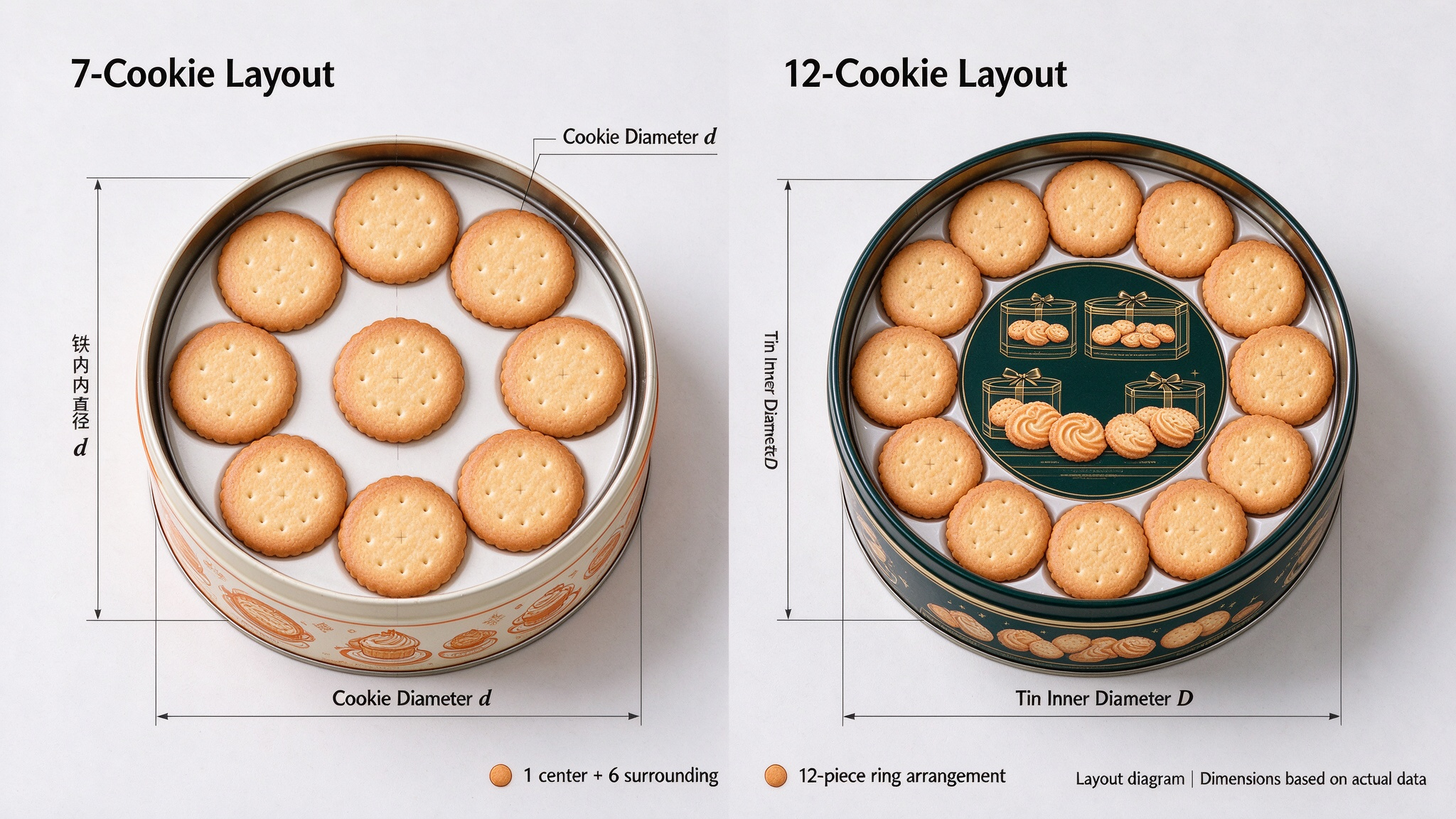
- A round tin with an internal diameter of 180 mm holds 7 cookies per layer: one in the center and six around it.
- A square tin with a 180 × 180 mm internal footprint holds 9 cookies per layer in a 3 × 3 grid.
If your priority is maximum cookie count per shipping carton, compare the layouts above with our guide to rectangular tins with lids. If your priority is presentation, gifting, or a reusable keepsake tin, round is often the stronger choice despite the unused space.
How to Size a Round Cookie Tin
Measure the cookies first
Record these for a representative batch, not a single cookie:
- Diameter, including the largest cookies in the batch
- Thickness at the center and at the edge
- Weight per piece and the target net weight per tin
- Whether cookies are bare, wrapped, or sitting in paper cups
Sandwich cookies, filled cookies, and cookies with raised decoration need extra height allowance. Individually wrapped cookies need the wrapper thickness added to both diameter and height.
Work out how many cookies fit in one layer
For equal round cookies, the smallest circle that contains them depends on how many you place in a layer:
- 7 cookies: the enclosing diameter equals 3 × the cookie diameter.
- 12 cookies: the enclosing diameter is about 4.03 × the cookie diameter.
Worked example: 60 mm butter cookies
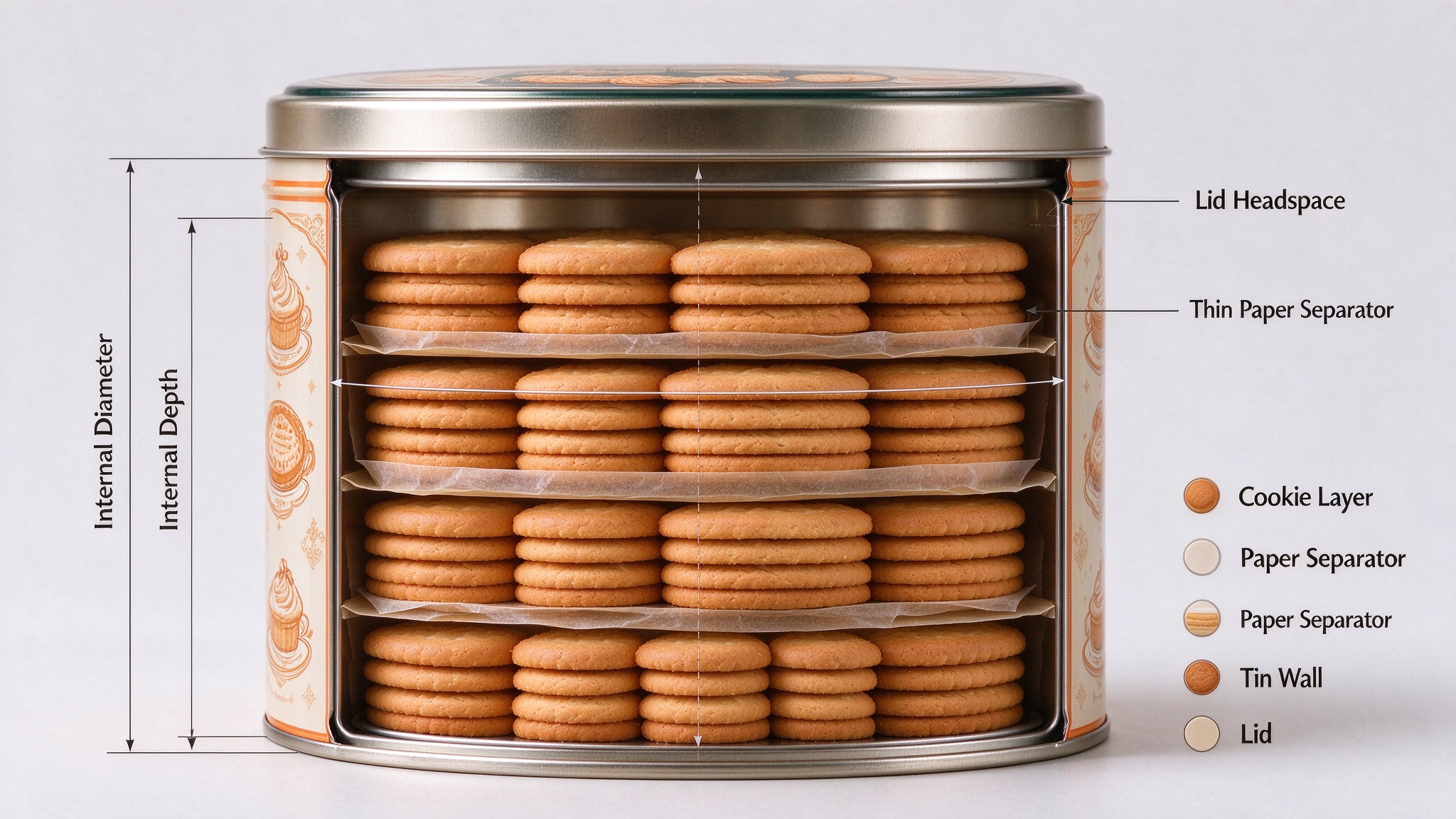
Assume 60 mm round cookies, 8 mm thick, packed 7 per layer with a paper separator between layers.
- Internal diameter: 3 × 60 mm = 180 mm for the cookies alone. Adding a 6 mm loading allowance for this example gives an internal diameter of about 186 mm.
- Internal depth for 4 layers: 4 × 8 mm = 32 mm of cookies, about 3 mm for three thin separators, and about 5 mm of headspace below the lid, giving roughly 40 mm.
- Capacity: 4 layers × 7 cookies = 28 cookies.
If the same cookies are packed 12 per layer, the internal diameter rises to roughly 242 mm before any allowance. That is a much larger tin footprint for 5 more cookies per layer. This is why the quantity per layer should be decided before the diameter.
The 6 mm allowance and the headspace figure are working assumptions for this example. The right values depend on the cookie, the filling method, and the lid structure, so they should be confirmed on a sample.
Check internal and external dimensions separately
Tin dimensions quoted by a supplier may be external. The metal walls, the lid seam, and any rolled edge reduce the usable internal space. When you send a quote request, state clearly whether your target dimensions are internal or external.
Layer Layout, Cups and Trays
The packing method changes capacity, appearance, and protection at the same time.
| Arrangement | Best for | Trade-off |
|---|---|---|
| Single layer | Decorated or fragile cookies, premium presentation | Largest footprint per cookie |
| Stacked in layers with separators | Standard butter cookies and shortbread | Cookies must tolerate light contact; separator thickness adds to the depth |
| Paper cups or small liners | Sandwich cookies and cookies that stick together | Cups take up diameter and add cost |
| Inner tray with cavities | Assortments with mixed shapes | Tray design must be set before the tin diameter |
| Individually wrapped | Hygiene, mixed flavors, e-commerce | Wrapper thickness reduces cookies per layer |
Any insert or liner that touches the cookies must be suitable for food contact. Add its thickness to the fit calculation, not just the cookies’.
Butter, Oil and Crispness
Butter cookies release fats over time. Two consequences matter for tin selection:
- Interior coating: A coated or lacquered interior helps keep oil from reaching bare metal. Ask the supplier to confirm what the interior coating is and whether it is suitable for fatty foods.
- Crispness: Cookies absorb moisture from the air. A tight-fitting lid helps keep them crisp, but how well a lid seals depends on its structure. Slip-on lids, press-fit lids, and hinged lids behave differently, so ask for the sealing characteristics of the specific structure rather than assuming airtightness.
Food-contact compliance
Tins that hold food must be made from materials and coatings that are suitable for food contact in the market where the cookies are sold. For the United States, food-contact materials fall under FDA requirements. For the European Union, the relevant rules include Regulation (EC) No 1935/2004, the good manufacturing practice rule Regulation (EC) No 2023/2006, and Regulation (EU) 2024/3190, which restricts bisphenol A and certain other bisphenols in food-contact materials, including coatings on metal articles, with transition periods. Ask your supplier for a declaration of compliance covering the specific tin, coating, and any insert before approving production.
Regulatory information reviewed: October 10, 2026.
Lid Fit and Transit Protection
Cookies break at the edges. Three checks reduce that risk:
- Fill test: Pack the complete arrangement, including separators and cups, then close the lid. The lid should seat without touching the cookies or forcing them out of position.
- Movement test: Tilt and gently shake the filled tin. Cookies should not slide or rattle, but they should not be wedged so tightly that loading chips the edges.
- Carton test: Pack filled tins in the shipping carton and check for movement between tins and against the carton walls.
For direct-to-consumer orders, ask about outer protection such as shrink wrap or a tamper-evident band, since an opened lid on arrival is a common complaint.
Printing Notes for Round Cookie Tins
Printed artwork on a round tin wraps around a curved sidewall, and a few checks are specific to that shape:
- Keep key text and logos away from the sidewall seam.
- Make sure the artwork reads the same way on the lid and on the body.
- Reserve space for the barcode, net weight, ingredients, and allergen labeling, whether printed on the tin or applied as a label.
For file requirements, color, and finishes, see the custom printed tin packaging guide and the Candy Tin Artwork & Printing Guide, whose file preparation steps apply to any printed tin.
What to Send in Your Quote Request
A quote request for custom round cookie tins is easier to price accurately when it includes:
- Cookie diameter, thickness, and shape, with a photo or sample if possible
- Target number of cookies per tin and net weight
- Layout: single layer, stacked layers, cups, tray, or wrapped
- Whether your target tin size is internal or external
- Preferred lid structure, if you have one
- Artwork files or a reference design, if available
- Estimated order quantity, destination market, and delivery deadline
Liyipackaging’s FAQ page lists a custom minimum order quantity of 3,000 to 10,000 pieces, depending on the tin structure and printing, as of October 10, 2026. Buyers working to a short timeline can also review the Hot Sale Tin Packaging range.
Ready to specify your tin? Send your cookie details through the contact page, and the team can review the layout, dimensions, and sample requirements with you.
Frequently Asked Questions
How many cookies fit in a round tin?
It depends on the cookie diameter and the layout. For equal round cookies, a layer of 7 needs an internal diameter of about 3 times the cookie diameter, and a layer of 12 needs about 4.03 times. A 180 mm internal diameter holds 7 cookies of 60 mm per layer. Multiply by the number of layers to get the total.
What size round tin do I need for 60 mm cookies?
For 7 cookies per layer, plan on an internal diameter of about 186 mm, which is 180 mm for the cookies plus a working allowance. Depth depends on thickness and layers: four layers of 8 mm cookies with separators and headspace come to roughly 40 mm. Confirm both with a filled sample.
Are round tins good for butter cookies?
Yes, provided the interior coating is suitable for fatty foods and the lid seals well enough to keep the cookies crisp. Ask the supplier about the coating and the lid’s sealing performance.
Should I choose a round or a rectangular cookie tin?
Choose round for round cookies, gifting, and a reusable keepsake. Choose rectangular when you need the highest cookie count per tin or per carton. The 60 mm example above fits 7 per layer in a 180 mm round tin and 9 per layer in a 180 × 180 mm square one.
Can round cookie tins be custom printed?
Yes. Printing options depend on the tin structure and artwork. See the custom printed tin packaging guide for file requirements and finishes.
What is the minimum order quantity for custom round cookie tins?
The Liyipackaging FAQ page lists a custom MOQ of 3,000 to 10,000 pieces, as of October 10, 2026. The exact figure depends on the structure and printing.
Summary
Start with the cookie diameter and thickness, decide how many cookies sit in each layer, and set the tin diameter from that layout. Add the loading allowance and headspace, pick an interior coating and lid suited to buttery cookies, and confirm the result with a filled sample before production. With the cookie details and delivery date in hand, the quote request can be specific from the first message.