Author: Liyipackaging Packaging Team
Published: September 24, 2026
Last Updated: September 24, 2026
Preparing artwork for a tin is different from preparing artwork for a flat paper package. The design has to work with the actual tin structure, printable areas, forming process, lid construction and required product information.
We work with brands on tin packaging development, so one of the most useful things you can do before sending artwork is to confirm the structure first. If you are still deciding the tin size, shape, lid or internal space, start with our guide on how to choose a custom candy tin.We work with brands on tin packaging development, so one of the most useful things you can do before sending artwork is to confirm the structure first.
Once the structure is approved, this guide focuses specifically on candy tin artwork, printing, finishing and artwork approval.
What Should You Confirm Before Preparing Candy Tin Artwork?
Confirm the approved tin structure and printable areas before designing the final artwork.
The artwork should be prepared around the actual tin rather than around a generic rectangle or an approximate box size.
Before your designer starts the final file, confirm:
- Tin size and shape
- Lid structure
- Printable surfaces
- Seam and forming areas
- Embossing or debossing areas, if required
- Logo position
- Required food-label information
- Barcode position, if applicable
- Surface finish
- Target market
This order matters because the artwork may need to change when the physical structure changes.
For a broader overview of custom tin structure, sizing and lid selection, see our how to choose a custom candy tin guide.
Which File Formats Should You Use for Candy Tin Artwork?
Vector artwork is preferred for logos, typography and other elements that need to remain sharp at production size.
Liyipackaging currently supports common artwork formats including AI, PDF, EPS, CDR and PSD on its product information pages.
A practical distinction is:
| File type | Typical use |
|---|---|
| AI | Preferred for editable vector artwork |
| EPS | Vector artwork and production exchange |
| Artwork review and production-ready files when properly prepared | |
| CDR | CorelDRAW artwork |
| PSD | Raster artwork or image-based elements when supplied at suitable resolution |
For logos, text and line artwork, vector files are generally easier to edit and scale.
PSD can be useful when the artwork contains photographic or raster elements, but the file should be supplied at an appropriate resolution and with editable elements where necessary. A flattened low-resolution image should not be treated as equivalent to production-ready vector artwork.
Liyipackaging also provides mockup and die-cut template formats including AI, EPS, CAD, PDF and CorelDRAW. These are template formats, not a replacement for the final artwork file.
Why Does the Tin Template Matter Before Printing?
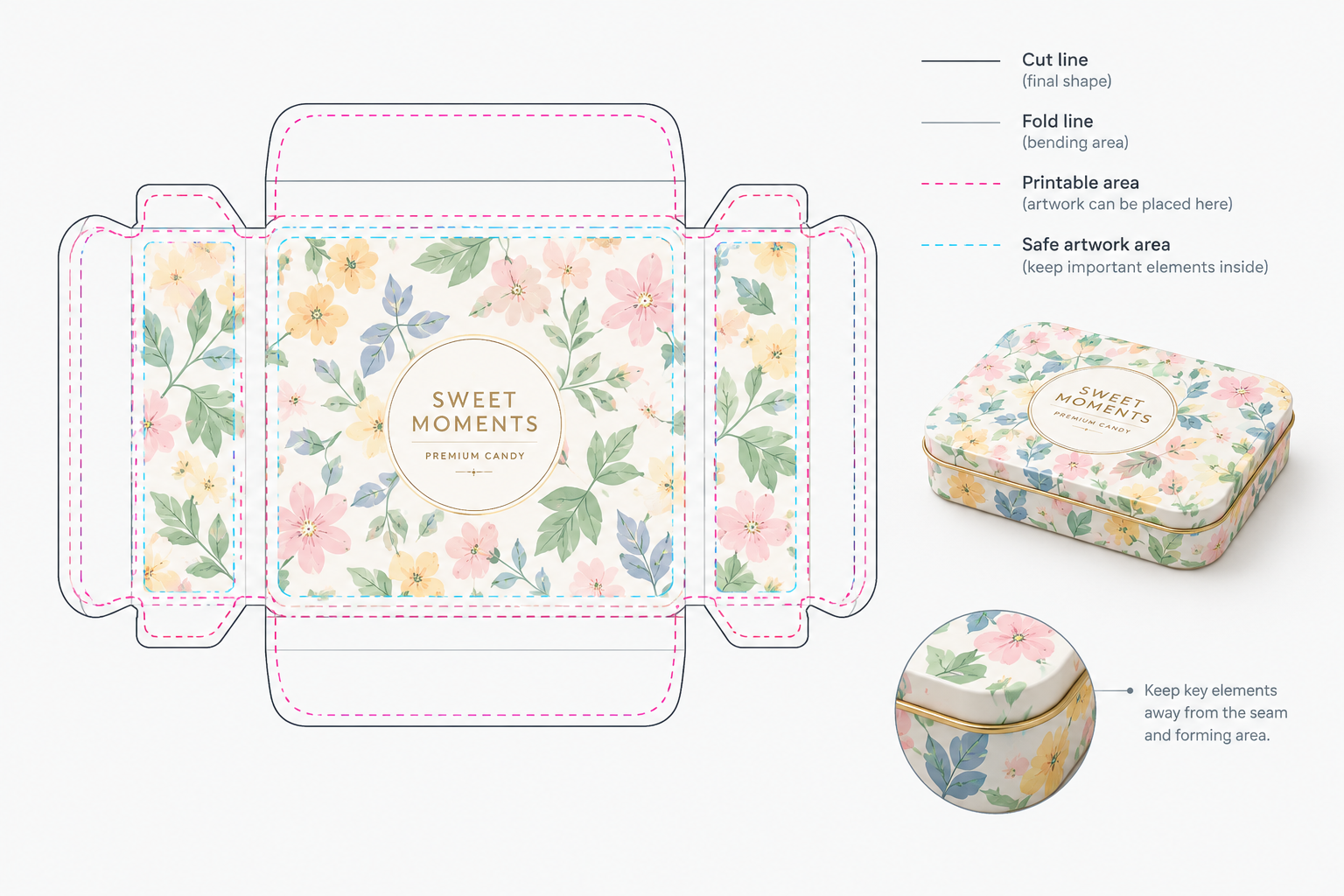
The approved production template determines where artwork can safely sit on the finished tin.
A tin is not simply a flat printed rectangle.
In our workflow, artwork is prepared for the metal sheet before the sheet is formed into the final package. Once forming takes place, edges, corners, seams and other structural areas can affect how the artwork appears on the finished product.
That is why artwork should be checked against the actual production template.
Pay particular attention to:
- Folded or formed edges
- Corners
- Lid edges
- Seams
- Buttons or opening mechanisms
- Areas reserved for embossing
- Areas that are not intended for important text
Bleed and safe-area values depend on the tin structure, so they should be taken from the approved production template for the project rather than copied from a generic packaging standard.
If the template does not show the required artwork boundaries clearly, ask the production team before final artwork approval.
How Should You Prepare CMYK and Pantone Artwork?
Choose the color method based on the brand requirements and the way the artwork will be reproduced on the tin.
Liyipackaging’s current product information lists CMYK printing and Pantone color matching among its printing options.
For a broader overview of tin printing options, finishes and ordering considerations, see our custom printed tin packaging guide.
For most projects, the important decision is not simply “CMYK or Pantone.” It is whether the brand needs:
- Full-color photographic artwork
- Consistent brand colors
- Specific spot-color matching
- A combination of process colors and brand colors
If your brand has a defined Pantone reference, include it in the artwork brief rather than relying only on a screen preview.
At the proof stage, compare the approved reference with the actual printed result. Screen colors are generated by a display, while the finished tin is a physical printed surface, so they should not be treated as identical visual references.
How Do Matte, Gloss and Embossing Change the Finished Artwork?
Finishing changes how the same artwork looks and should be considered before the final proof is approved.
Liyipackaging’s current product information lists finishes including glossy, matt, varnish, embossing and engraving.
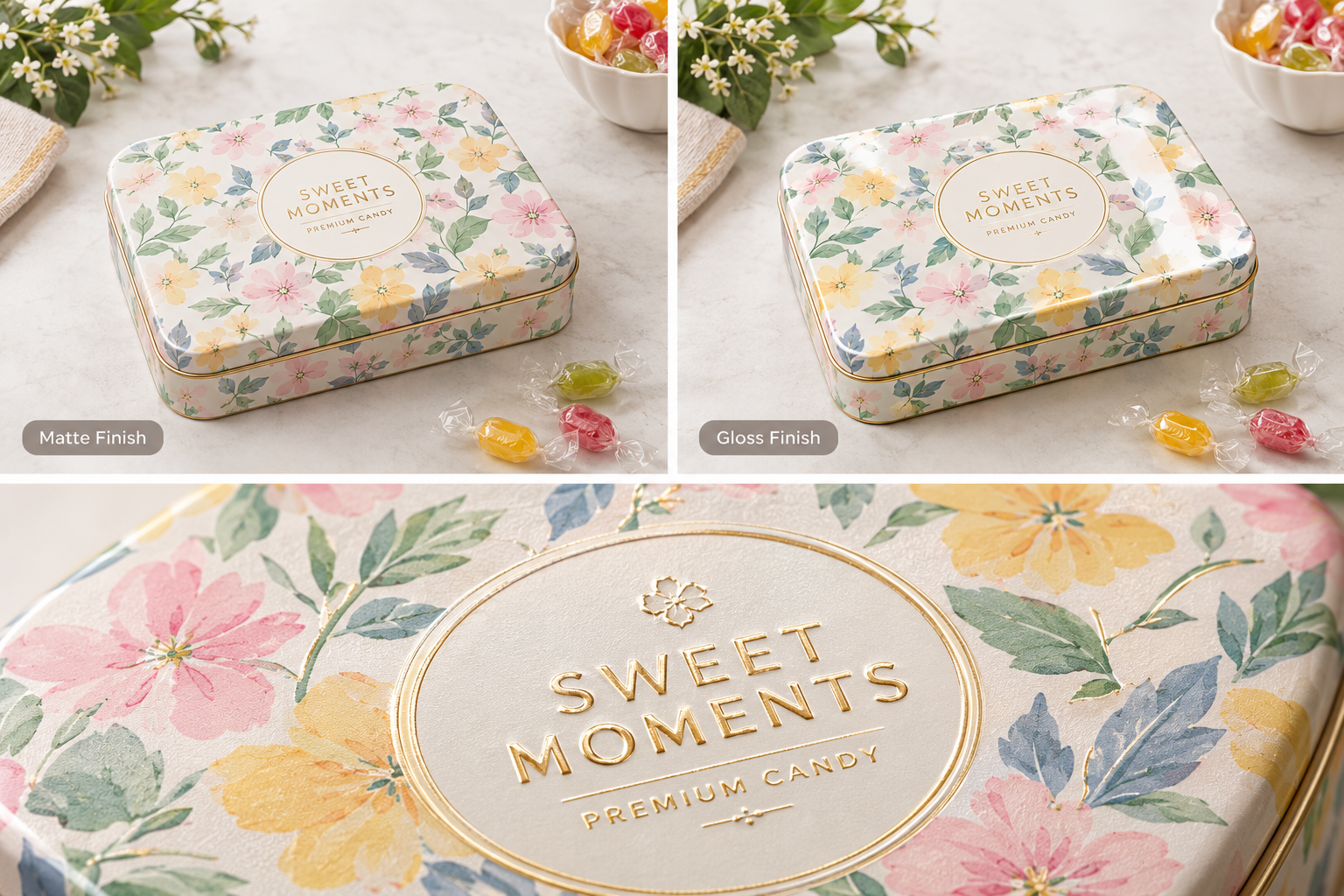
For example, the same logo can appear quite different when printed on a glossy surface versus a matte surface.
A matte finish can reduce the amount of reflected light from the surface, while a glossy finish can make colors and highlights appear more visually prominent.
Embossing is different again because it changes the physical surface rather than only the printed color.
When preparing embossed artwork, confirm:
- Which elements will be embossed
- Which elements remain printed
- The position of the embossed area
- Whether small details need to be simplified
- Whether important text is too close to a formed edge
Do not treat an embossed logo as simply another color layer. It is a structural finishing requirement and should be reviewed separately.
Where Should Important Text, Logos and Barcodes Go?
Keep critical information away from areas that may be affected by forming, seams, edges or opening mechanisms.
Brand logos and important text should normally be placed in stable printable areas rather than directly across structural features.
This becomes especially important for:
- Brand names
- Product names
- Net quantity
- Ingredients
- Allergen information
- Barcodes
- Legal or regulatory information
Barcodes deserve particular attention. A barcode needs sufficient contrast and a suitable surface for scanning. If the barcode is placed across a curved, embossed or structurally complex area, its readability should be checked before mass production.
For the same reason, do not place important small text directly across a lid edge or formed corner simply because the artwork template technically reaches that area.
What Food Label Information Should Be Planned Into the Artwork?
Reserve space for legally required food information before the artwork is finalized.
The packaging manufacturer can print the information, but the food brand or responsible food business should provide and approve the actual label content.
For products sold in the United States, FDA food-labeling requirements can include information such as:
- Product identity
- Ingredient statement
- Major allergen information
- Net quantity
- Nutrition labeling where required
- Manufacturer, packer or distributor information
The FDA currently identifies sesame as the ninth major food allergen in the United States, with the applicable requirements effective January 1, 2023.
The FDA’s Food Labeling Guide also states that its Nutrition Labeling chapter is currently under revision and directs users to newer FDA nutrition resources for current requirements. FDA guidance checked September 24, 2026.
For the EU market, Regulation (EU) No. 1169/2011 sets mandatory food-information requirements for prepacked foods, including the food name, ingredients, allergen information, net quantity, durability/use-by information, and nutrition declaration, subject to applicable exceptions.
EU rules also contain specific presentation requirements, including minimum text-height rules for mandatory information.
EU food-information source checked September 24, 2026.
The rules differ by market, so do not use a U.S. label layout as a universal template for Europe or other markets.
Most importantly, provide the approved label wording to the packaging manufacturer. The packaging factory should not decide what legally required food information your product needs to contain.
How Should You Handle Small Text on a Candy Tin?
Small text should be checked against the actual production process and project template rather than a generic number copied from another package.
Minimum text size and line weight can depend on the tin structure, printing method and artwork details.
For that reason, confirm the production requirement for your specific project before finalizing small legal or nutritional text.
This is particularly important when the tin has:
- A small printable area
- Dense ingredient information
- Multiple languages
- Fine reversed text
- Thin lines
- Small barcode elements
- Detailed decorative patterns
If your packaging needs several blocks of legal information, plan the available label space before the visual design is finalized.
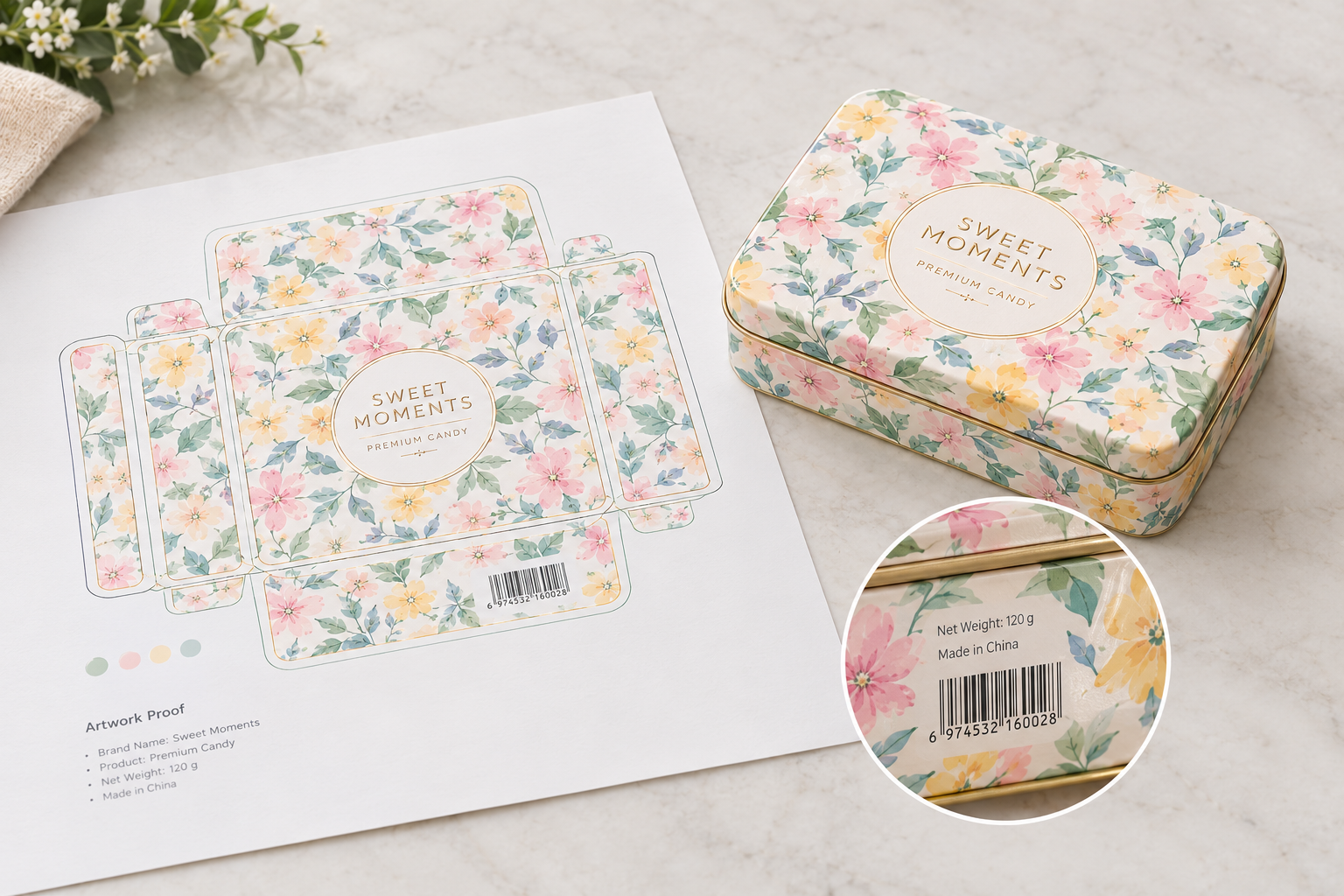
What Should You Check Before Approving the Artwork?
Use one consolidated artwork approval checklist instead of checking the same items across several separate reviews.
| Check item | What to verify | Who confirms |
|---|---|---|
| Template | Artwork matches the approved production template | Designer + Manufacturer |
| Safe area | Important elements stay within the approved area | Designer |
| Logo | Correct logo version, size and position | Brand |
| Colors | CMYK/Pantone references are correct | Brand + Manufacturer |
| Finish | Matte, gloss, varnish, embossing or engraving matches the specification | Brand + Manufacturer |
| Text | Spelling, product name and legal copy are correct | Brand |
| Food label | Ingredients, allergens, net quantity and other required information are approved | Brand |
| Barcode | Position, contrast and scanning suitability are confirmed | Brand + Manufacturer |
| Forming areas | Important artwork is clear of seams, edges and structural features | Manufacturer |
| Version | Correct V1/V2/FINAL file is being reviewed | Brand + Manufacturer |
| Sample | Physical result matches the approved artwork and finish | Brand + Manufacturer |
The most important point is to have one clearly approved final version.
Should You Approve a Physical Sample Before Mass Production?
For a new custom tin, the physical sample is the practical point where artwork and structure should be checked together.
The artwork review should focus on packaging-specific details such as:
- Artwork position
- Color appearance
- Finish
- Embossing
- Small text
- Barcode placement
- Edge and forming areas
- Lid artwork alignment
For the general product-fit test, see our how to choose a custom candy tin.
This keeps the two guides focused: the Pillar covers whether the tin works for the product, while this article covers whether the artwork works on the approved tin structure.
Can You Change the Artwork After the Sample?
Yes, but artwork changes should be finalized before mass-production approval whenever possible.
If the physical sample reveals an artwork issue, record the change clearly rather than editing the file informally.
A practical revision process is:
Sample review → artwork correction → updated proof → final approval → production
If the change also affects the tin structure, lid, forming area or tooling, the project may need another structural review.
This is why it is useful to separate:
- Structure approval
- Artwork approval
- Sample approval
- Mass-production approval
Each approval answers a different question.
How Can You Reduce Candy Tin Artwork Revisions?
The easiest way to reduce revisions is to give the manufacturer the complete artwork information before the final file is prepared.
A useful artwork brief can include:
- Approved tin structure
- Artwork file
- Logo files
- CMYK or Pantone references
- Finish requirements
- Embossing or engraving requirements
- Food-label copy
- Barcode
- Target market
- Required languages
- Artwork version
- Contact person for final approval
You do not need to decide every visual detail before contacting us.
If you already have a logo, packaging concept or existing artwork, send the available files first. We can then review them against the proposed tin structure and identify the production questions that need to be resolved.
For broader custom candy tin packaging options and tin structures, you can also explore Liyipackaging’s tin packaging solutions.
How Does Liyipackaging Support Candy Tin Artwork?
We support the artwork, template and production process as part of the wider custom tin development workflow.
Our current product information supports common artwork formats including AI, PDF, EPS, CDR and PSD, along with CMYK and Pantone printing options and finishes such as matte, gloss, embossing and engraving.
Our website also states that we provide mockups and die-cut templates in formats including AI, EPS, CAD, PDF and CorelDRAW.
Liyipackaging describes its manufacturing workflow as covering design and development through production and pre-shipment quality control, and its current company information states more than 25 years of industry experience and a 3,000㎡ factory area.
For a candy brand, the practical workflow can therefore stay straightforward:
Structure → Template → Artwork → Proof → Sample → Approval → Production
If you already have your artwork ready, send us your artwork and include the tin size, estimated quantity, target market and any required finishing.
FAQ
Can the same artwork file be used for a paper box and a tin box?
Not necessarily. The artwork may need to be adjusted for the tin’s forming areas, seams, printable surfaces and finishing requirements. Use the approved tin template rather than transferring a paper-package file without review.
Can the inside wall of a candy tin also be printed?
Some tin projects can use different inner treatments or coatings, but the available option depends on the structure and application. Discuss the inner surface requirement with the manufacturer before finalizing the artwork.
Can you guarantee an exact Pantone match?
Pantone references provide a defined color target, but the appearance of the finished color can also be affected by the printing process and surface finish. Review the approved proof or sample rather than judging the final result only from a monitor.
Do I need to provide the food-label wording?
Yes. The brand or responsible food business should provide and approve the required product information. The packaging manufacturer should use the approved copy rather than determine the legal labeling requirements for the product.