I’m part of the Liyipackaging Packaging Team, working with brands on custom tin structure, sampling and production.
For a custom cake tin with a lid, the outside size is only the starting point. The actual packaging has to accommodate the cake, wrapping, paper base or insert, while leaving enough usable space for the lid to close without affecting the product.
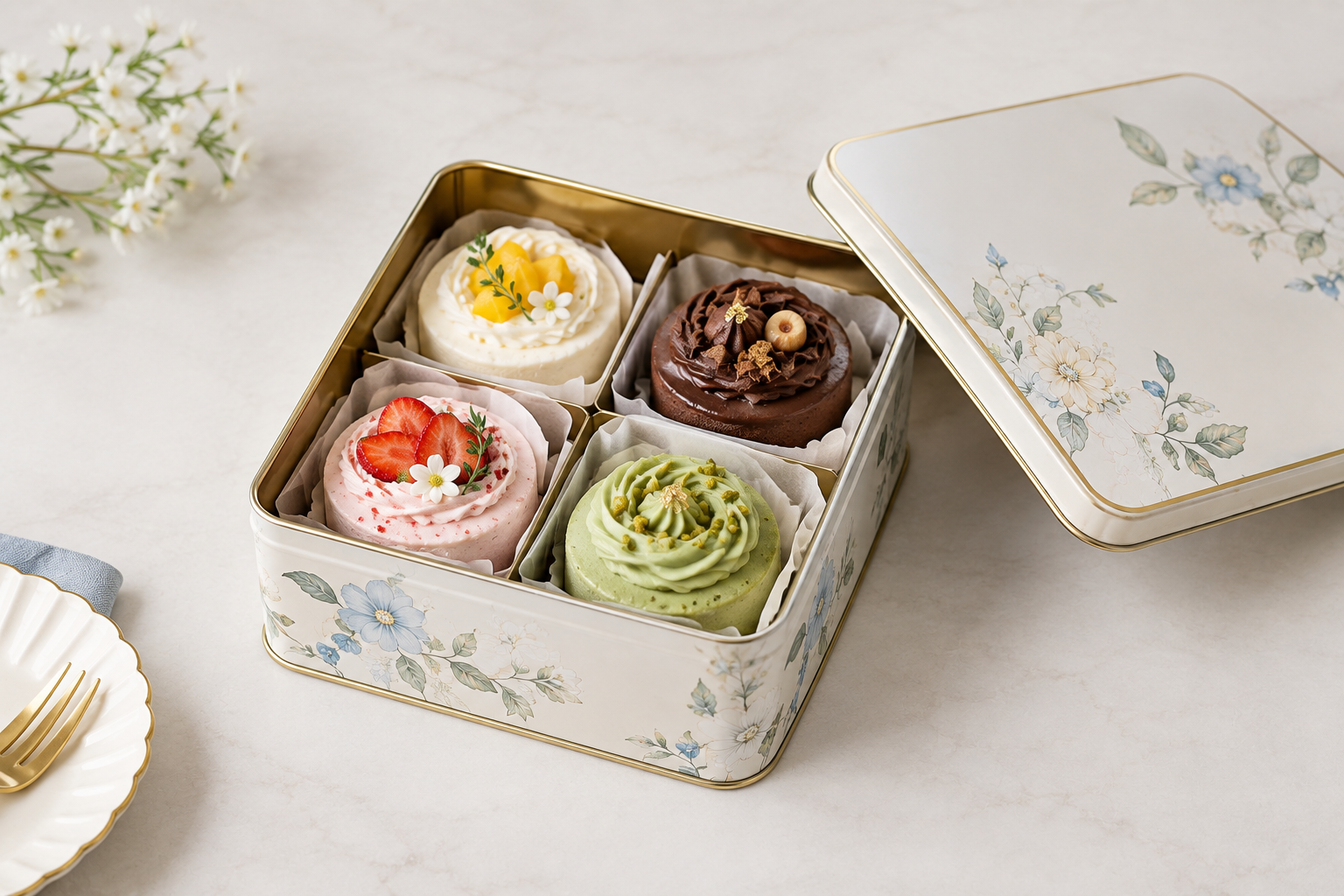
For example, if a brand wants to pack four mini cakes, each 80 mm in diameter and 45 mm high, in a 2 × 2 arrangement, the cakes alone occupy a minimum 160 × 160 mm footprint. That does not yet include wrapping, paper bases, insert walls or the clearance required by the tin structure.
So the practical starting point is:
Product dimensions → quantity → arrangement → internal space → structure → sample
This guide explains how to work through those decisions, including food-contact considerations for moist or fatty cakes.
If you already know your cake dimensions and quantity, you can use the checklist near the end of this article to prepare a more complete quotation request.
What Makes Custom Cake Tin Packaging Different?
Cake packaging needs to account for more than physical size. Moisture, oil, toppings, wrapping and storage conditions can all affect the final packaging specification.
Cake dimensions are only the starting point
For a custom project, provide the actual:
- Cake diameter or length × width
- Finished height
- Cakes per tin
- Product photos
- Individual wrapping, if applicable
The finished height matters when the cake has frosting, decoration or toppings that extend above the main cake body.
Using the same example throughout this guide:
Cake: 80 mm diameter × 45 mm high
Quantity: 4 cakes per tin
Arrangement: 2 × 2
The four cakes alone require a minimum footprint of 160 × 160 mm when arranged in two rows of two.
That immediately shows why a “100 mm cake tin” would not work for this arrangement. The calculation is based on the product layout before any allowance is made for packaging components or tin construction.
Cake composition can affect the packaging requirement
A dry cake and a moist, fatty cake do not necessarily present the same packaging conditions.
Consider whether the product contains:
- Moist fillings
- Cream or frosting
- Fruit
- Free fat or oil
- Moist toppings
The FDA’s food-contact tables specifically distinguish moist bakery products with surface free fat or oil from moist bakery products without free fat or oil, and also distinguish conditions such as room-temperature, refrigerated and frozen storage.
That information should therefore be part of the packaging brief when direct food contact is involved.
How Should You Choose the Shape and Internal Size of a Custom Cake Tin?
The tin shape should follow the cake arrangement, while the internal size should be developed from the actual packing configuration.
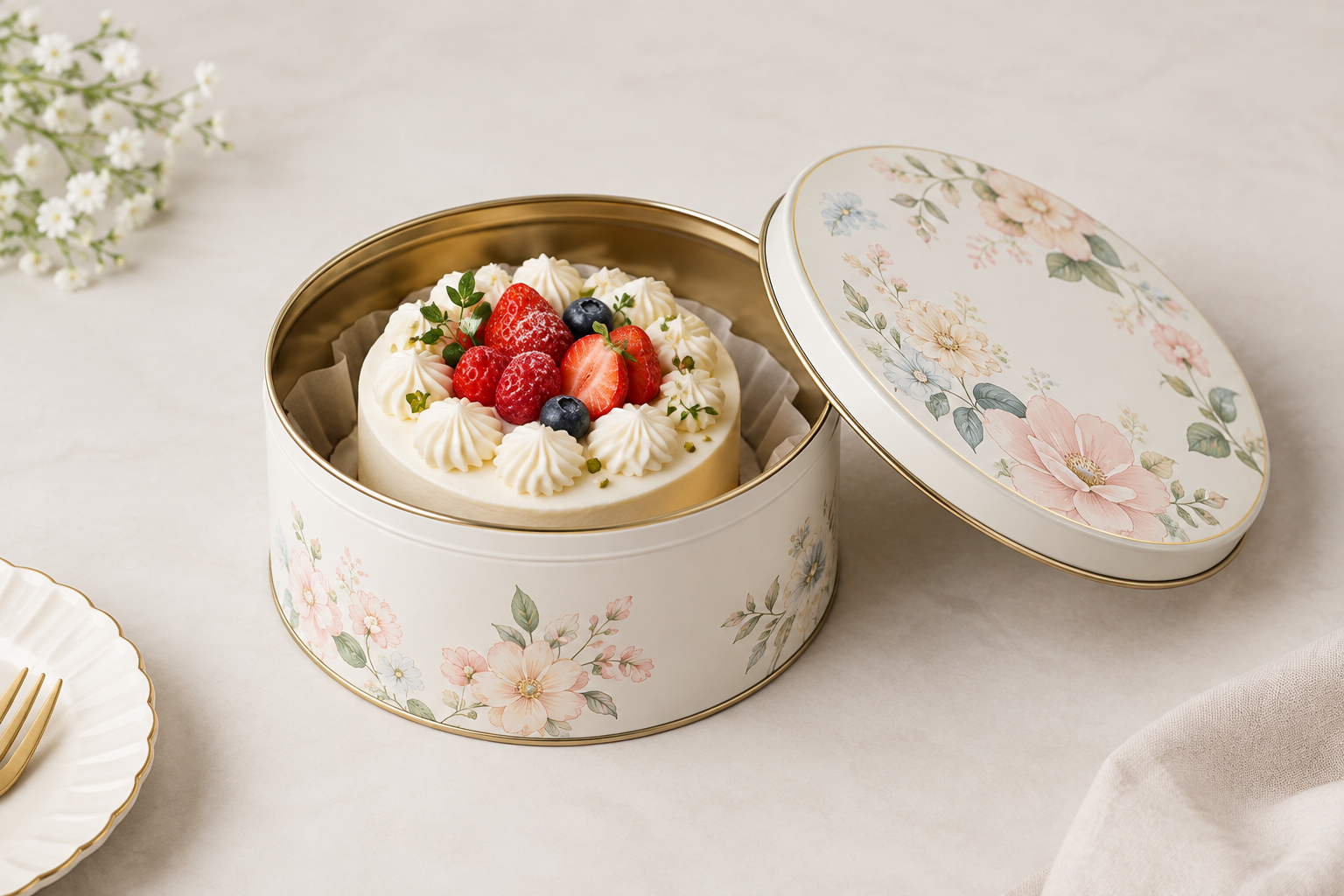
Round cake tins
A round cake tin can suit:
- Round mini cakes
- Individual cakes
- Circular products
- Single-product gift packaging
The main advantage is a natural match between the product footprint and the tin.
Square cake tins
A square structure can be practical when several cakes are arranged in rows.
Using the example above, four 80 mm diameter cakes arranged 2 × 2 create a simple 160 × 160 mm product footprint before packaging components are considered.
That makes the square format easy to visualize during the first packaging discussion.
Rectangular cake tins
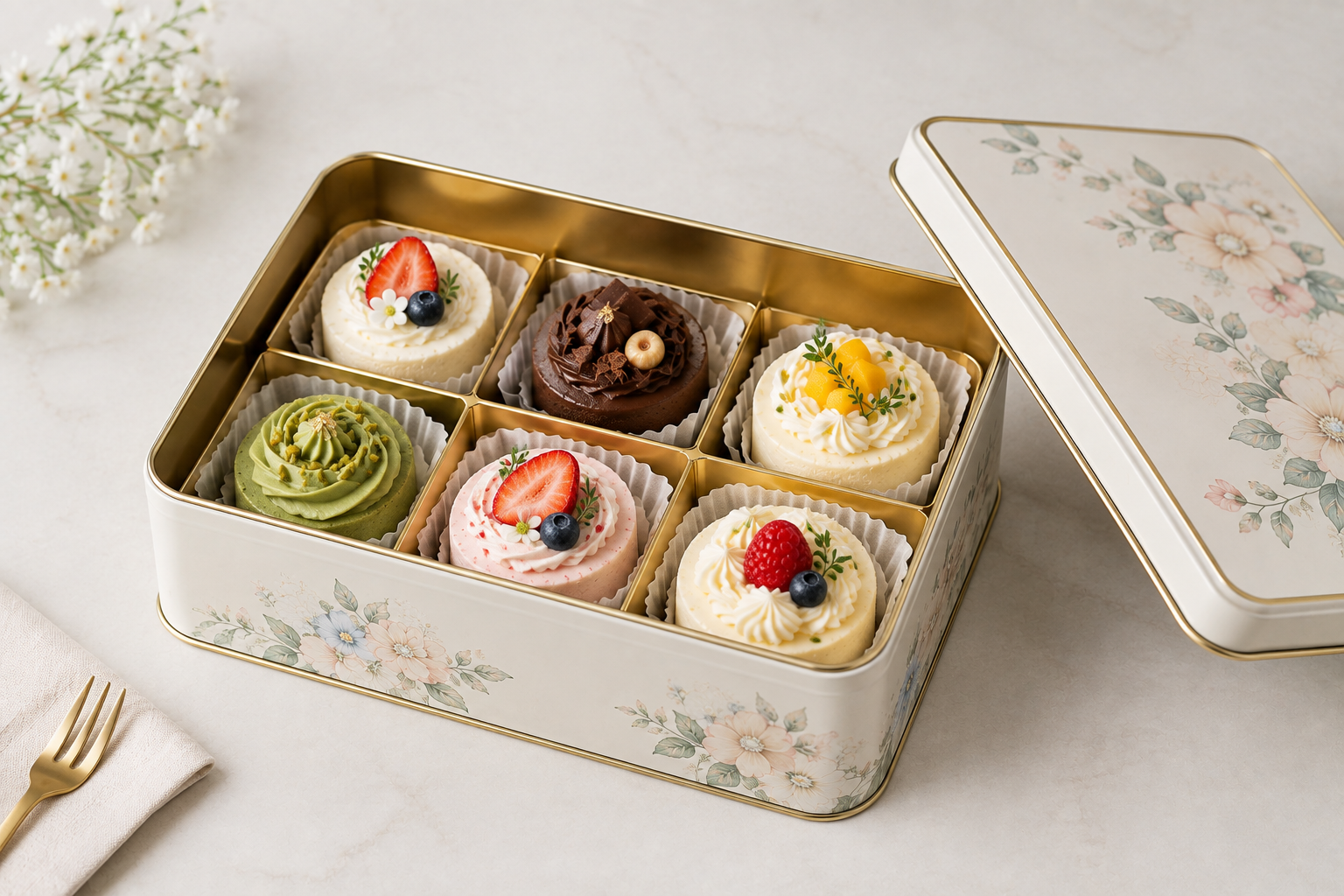
A rectangular tin can make more sense when the product arrangement is longer than it is wide.
For example, if four cakes are arranged in a single row rather than two rows, the required footprint changes. The tin should follow that arrangement instead of forcing the product into a square layout.
How should internal size be calculated?
A useful way to think about it is:
Internal size = product footprint + wrapping + insert or liner + required clearance
The exact clearance depends on the actual tin construction and packing method.
The important point is that internal size is not simply the cake size plus a fixed margin. Paper bases, wrapping, insert walls, corners, lid construction and the product arrangement can all change the usable space.
For a more general discussion of custom tin sizing, the existing custom candy tin sizing guide provides a related packaging-development framework, while this article focuses specifically on cake products.
How Should You Choose the Lid for a Cake Tin?
Choose the lid according to how the cake will be accessed and presented. The lid also needs to work with the product height and any insert inside the tin.
A removable lid can suit a gift package that is opened by completely removing the top. A hinged lid can be useful when the package is opened repeatedly. A window structure may make sense when the cake itself is part of the visual presentation.
The detailed comparison of removable, hinged and window lid structures is covered in the dedicated rectangular-tin guide.
For a cake tin, the practical check is simpler:
Can the customer open the package, access the cake and close the package without the lid interfering with the product?
For a decorated 45 mm-high mini cake, for example, the usable internal height needs to account for the actual product height and any packaging beneath or above it.
Should a Cake Tin Use an Insert, Inner Lining or Both?
An insert and an inner lining solve different problems. An insert controls product position, while an inner lining or coating relates to the food-contact surface.
When is an insert useful?
An insert can help when several cakes need to stay separated or in fixed positions.
For the four-cake example, an insert could divide the tin into four positions so that the cakes remain organized during handling.
However, the insert itself occupies space. If the product is 80 mm in diameter, the final internal arrangement has to account for the walls or dividers of the insert as well as the cakes themselves.
When does an inner lining matter?
If the cake directly contacts the metal package, the internal coating becomes part of the food-contact specification.
Liyipackaging’s FAQ states that its tinplate products can be produced with food-grade materials suitable for food packaging and that the inside can use food-grade lacquer to prevent direct contact between the tinplate and food.
For a specific project, however, the relevant coating and supporting documentation should be confirmed against the intended food, market and conditions of use.
What should U.S. buyers check?
In the United States, FDA explains that the regulatory status of a food-contact material depends on the individual substances used in the finished article and their intended conditions of use. Applicable regulatory pathways can include Title 21 CFR provisions, GRAS status, prior sanctions, exemptions or effective Food Contact Substance Notifications.
For cake packaging, useful information to provide includes:
- Type of cake
- Direct or indirect food contact
- Presence of free fat or oil
- Moisture level
- Room-temperature or refrigerated storage
- Target market
- Required compliance documentation
What should EU buyers check?
For the EU market, Regulation (EC) No 1935/2004 provides the general framework for materials and articles intended to come into contact with food, including requirements intended to prevent harmful transfer of substances into food.
EU good manufacturing practice for food-contact materials is addressed by Regulation (EC) No 2023/2006, which requires appropriate quality assurance and quality control systems for applicable manufacturing operations.
There is also an important current BPA consideration for metal packaging. Regulation (EU) 2024/3190 prohibits the use of BPA in the manufacture of covered food-contact materials and articles, with transitional provisions. For most single-use final food-contact articles, the main transition date was 20 July 2026; specific exceptions include certain articles with BPA-containing coating only on the exterior metal surface, for which a longer transition applies.
For a cake tin intended for the EU market, the practical step is to confirm the actual internal coating formulation and compliance documentation for the specific project rather than relying only on the phrase “food grade.”
Regulatory information last checked: September 28, 2026.
How Do Moisture, Oil and Condensation Affect Cake Tin Packaging?
Cake packaging needs to reflect the product’s storage conditions, especially when the cake is moist, contains free fat or oil, or is refrigerated.
Oil and fat
If the cake has a fatty filling, cream or a surface containing free oil, the food-contact surface needs to be considered during material and coating selection.
This is particularly relevant because FDA’s food-contact-use framework specifically identifies moist bakery products with free fat or oil as a separate food category.
Moisture
Moisture can affect the package differently from a dry confectionery product.
The product specification should identify whether the cake is:
- Moist or dry
- Individually wrapped
- Refrigerated
- Frozen
- Stored at room temperature
That information helps the packaging supplier understand the intended conditions of use.
Condensation
If the cake is refrigerated, temperature changes during handling can lead to condensation.
The packaging should therefore be evaluated as a complete system rather than assuming that a metal tin automatically provides moisture protection.
A tin is not automatically an airtight cake tin simply because it has a lid. If shelf life or moisture control depends on the closure, liner or inner wrapping, those elements need to be specified and validated together.
How Should You Test a Custom Cake Tin Sample?
The physical sample should confirm that the actual cake, insert and lid work together before bulk production.
Using the same example, test:
80 mm diameter × 45 mm high cake
4 cakes per tin
2 × 2 arrangement
Check the product fit
Place the actual cake or representative production sample inside the tin.
Confirm:
- Four cakes fit in the intended arrangement
- Wrapping or paper bases fit
- The product can be removed without unnecessary force
- The cakes do not move excessively
Check the lid
Close the tin with the actual product inside.
Check that:
- The lid closes correctly
- The lid does not contact the cake
- The opening method works as intended
- The product remains accessible
Check the complete package
If an insert or liner is part of the final specification, test it in the same sample.
This is also the stage to confirm whether the finished package behaves correctly under the intended handling conditions.
What Should You Send a Manufacturer for a Custom Cake Tin Quote?
A useful quotation request connects the cake dimensions with the intended packaging configuration.
| Requirement | What to provide |
|---|---|
| Product | Cake type and product photos |
| Cake size | Diameter or length × width × height |
| Cakes per tin | Number of cakes in one tin |
| Arrangement | Side-by-side, stacked or separated |
| Wrapping | Individual wrapping, paper base, etc. |
| Tin shape | Round, square or rectangular |
| Lid | Preferred opening structure, if known |
| Insert | Required or not |
| Food contact | Direct contact or separated by liner |
| Target market | U.S., EU or other market |
| Order quantity | Estimated production quantity |
| Delivery | Required delivery date |
For the example used throughout this article:
Product: Mini cake
Size: 80 mm diameter × 45 mm high
Cakes per tin: 4
Arrangement: 2 × 2
Tin shape: Square preferred
Lid: Removable lid
Target market: U.S.
Order quantity: 5,000 pcs
This gives the manufacturer enough information to begin discussing the structure without guessing the final tin dimensions.
What Affects Custom Cake Tin Cost, MOQ and Lead Time?
Custom tin pricing and timing depend on the complete specification rather than size alone.
Liyipackaging’s published FAQ identifies material thickness, size, shape, order quantity and printing colors as factors affecting price. It currently states a general customized MOQ of 3,000–10,000 pieces, depending on product category, structure and printing complexity.
As of September 28, 2026, the same FAQ lists:
- Customized sample: approximately 5–15 days
- New mold development and sample: approximately 20–25 days
- Custom printed tin production: approximately 25–30 days
These should be treated as planning references rather than fixed project commitments.
For a project requiring a new mold, the mold-development and sample stage comes before the normal custom-production stage. After the structure is approved, production timing is then planned according to the final order, artwork, quantity and production schedule.
A practical planning sequence is:
Product specification → Structure → Mold/sample → Fit approval → Artwork → Production → Inspection → Shipping
For a seasonal launch, this sequence should be planned backward from the required arrival date.
How Can Liyipackaging Help With a Custom Cake Tin?
A custom cake tin project involves more than producing the metal container. Product fit, structure, sampling, food-contact requirements and production specifications all need to remain aligned.
Liyipackaging’s published company information states that the company has more than 25 years of industry experience, a 3,000㎡ facility, and production capacity of up to 2 million units per month. Its company information also describes capabilities from design and development through production and pre-shipment quality control.
For a cake project, the useful starting point is therefore the product specification:
Cake dimensions + cakes per tin + arrangement + target market + estimated quantity
From there, the packaging team can discuss the appropriate structure, insert and lid before the final specification is approved.
For broader tin packaging options, you can review Liyipackaging’s tin packaging manufacturing capabilities.
If you are ready to discuss a project, request a custom cake tin quote with the product dimensions, cakes per tin, target market and estimated order quantity.
FAQ
What size should a custom cake tin be?
The internal size should be developed from the cake dimensions, quantity, arrangement, wrapping, insert and lid structure. For example, four 80 mm diameter cakes arranged 2 × 2 already require a minimum 160 × 160 mm product footprint before packaging components are added.
Can custom cake tins be round, square or rectangular?
Yes. The suitable shape depends on the cake footprint and how the products will be arranged inside the tin. Round tins can suit individual round cakes, while square or rectangular structures can be more practical for multiple cakes arranged in rows.
Do custom cake tins need an insert?
Not always. An insert is useful when cakes need to be separated or held in fixed positions, but the insert also occupies internal space and must be included in the packaging design.
Are custom cake tins suitable for direct food contact?
They can be developed for food-packaging applications, but the specific coating or lining should be confirmed for the food type, intended conditions of use and target market. FDA provides a framework for determining the regulatory status of food-contact materials and substances.
What should I provide for a custom cake tin quotation?
Provide the cake dimensions, cakes per tin, arrangement, product photos, preferred shape, lid preference, insert requirements, target market, estimated order quantity and required delivery date.
What is the MOQ for custom cake tins?
As of September 2026, Liyipackaging publishes a general customized MOQ of approximately 3,000–10,000 pieces, depending on product category, structure and printing complexity. The actual MOQ should be confirmed for the specific project.