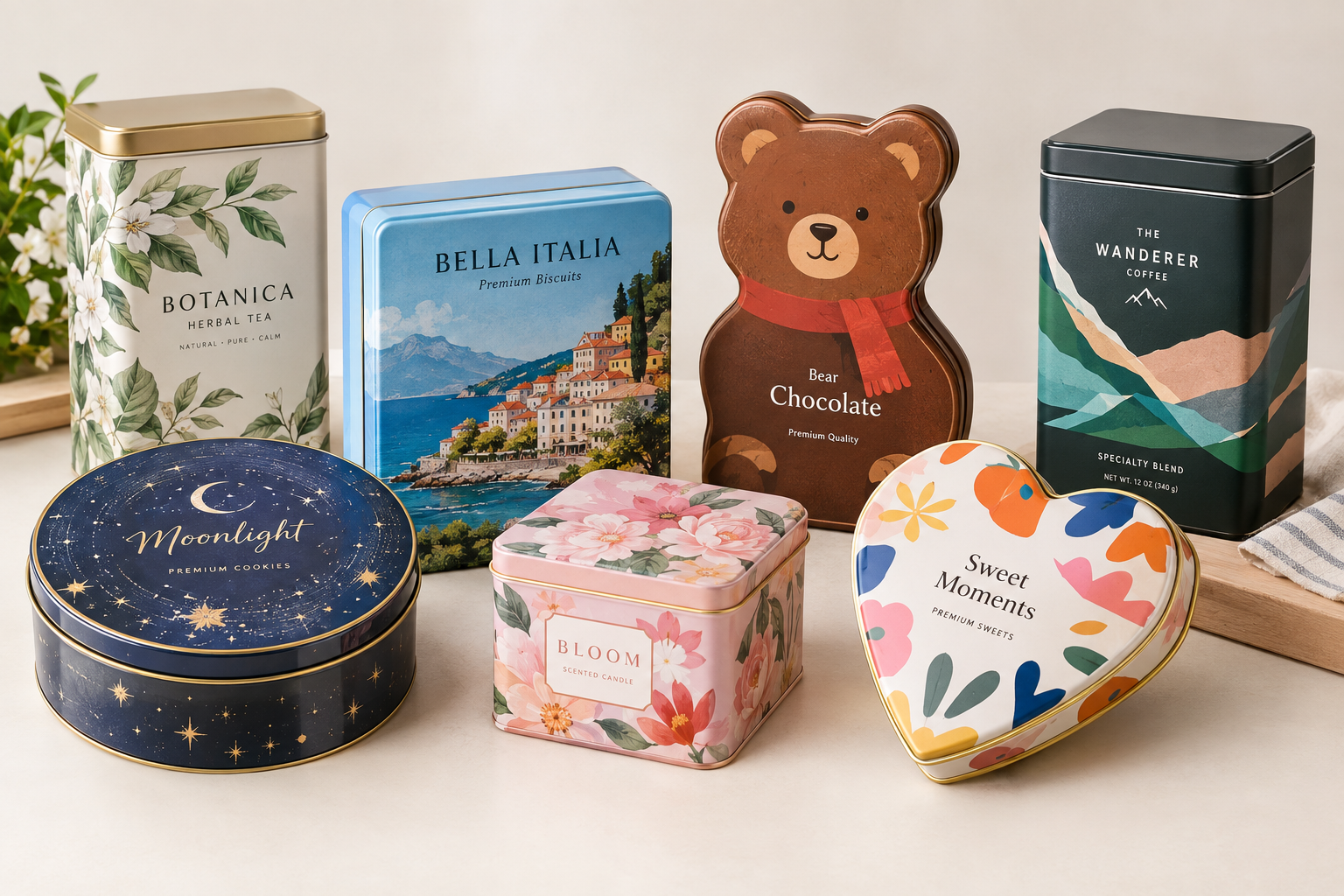
I’ve worked with custom tin packaging projects from artwork preparation to final production, and one problem appears often: the artwork looks right on a screen, but the finished tin does not look exactly the same.
The reason is simple. Tinplate is a metal surface, not a computer screen or a sheet of white paper. Color, white ink, artwork placement and surface finishing can all change the final appearance.
As of 2026, custom printed tin packaging from Liyipackaging can start from 3,000 pcs, depending on the project requirements. If you are preparing a new design, the most important step is not simply choosing a printing method. It is making sure your artwork is suitable for the actual tin before production begins.
This guide focuses on that process: how to prepare artwork, how printing works, how to control color, which finishing options matter, and what to check before approving production.
If you already have a tin structure and need help with the overall specification, you can also review our custom tin packaging solutions before preparing your artwork.
What Makes Custom Printed Tin Packaging Different?
The main difference is the printing surface. Your artwork needs to be designed for tinplate, not simply transferred from a digital design file without adjustment.
A design that works well on paper may need changes when it is applied to a metal tin.
What Can Be Printed on a Tin?
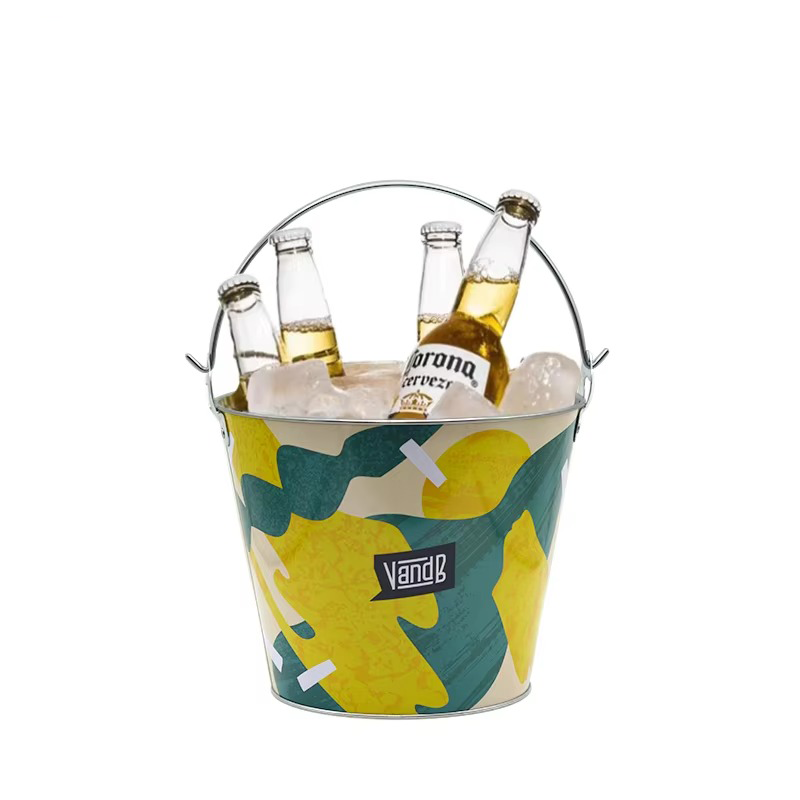
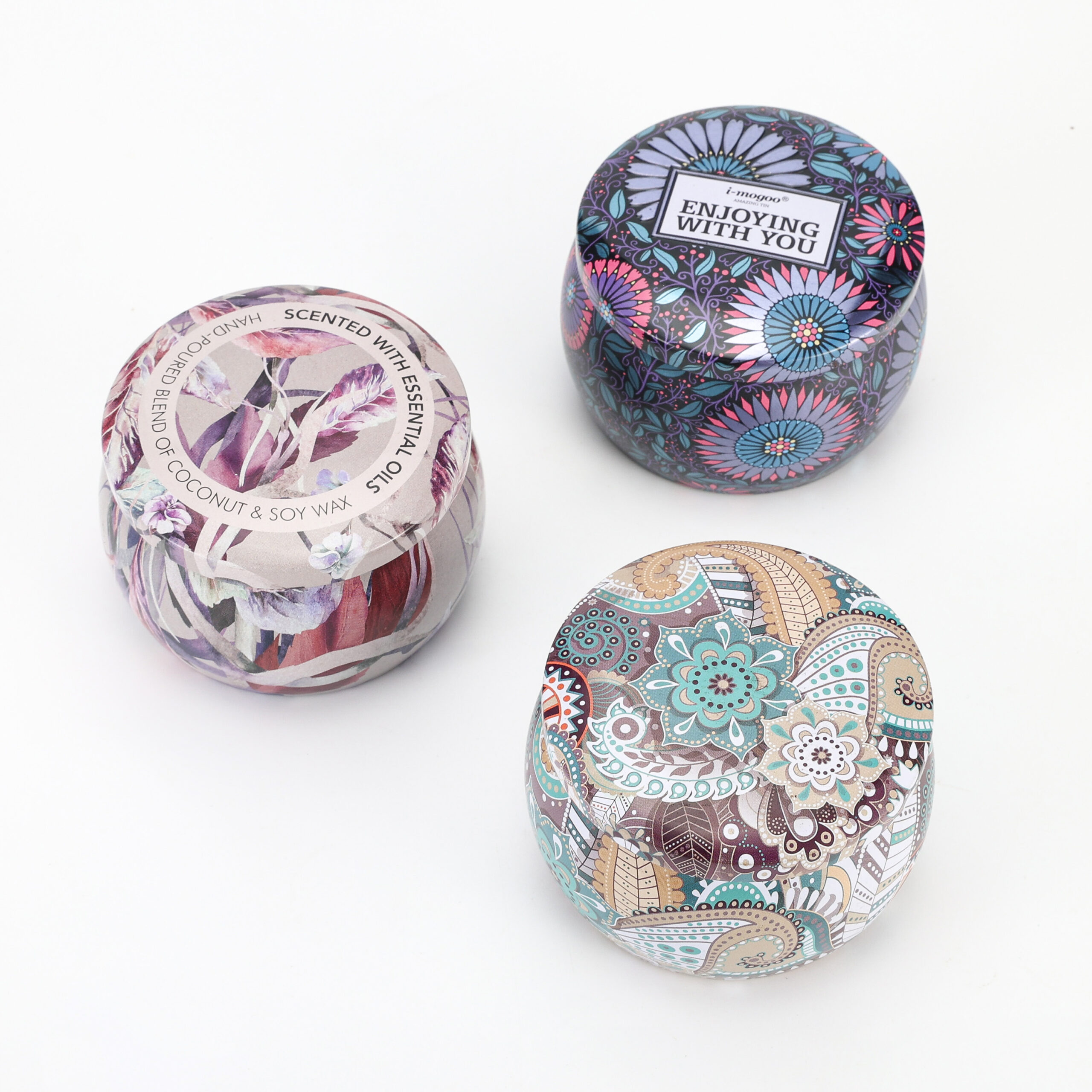
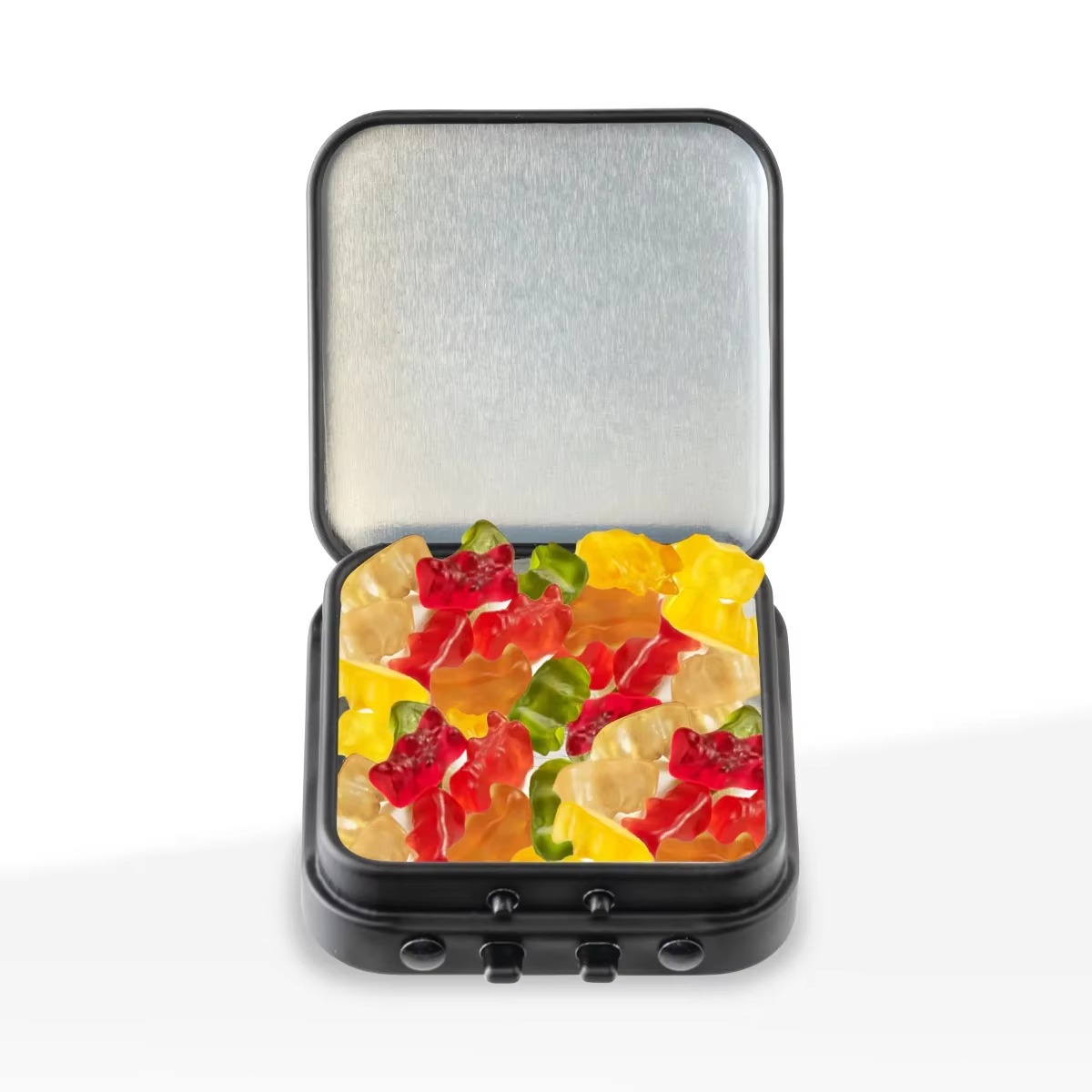
Most of the visible branding elements can be customized, including:
- Logo
- Brand colors
- Product graphics
- Illustrations
- Patterns
- Product information
- Seasonal designs
- Promotional graphics
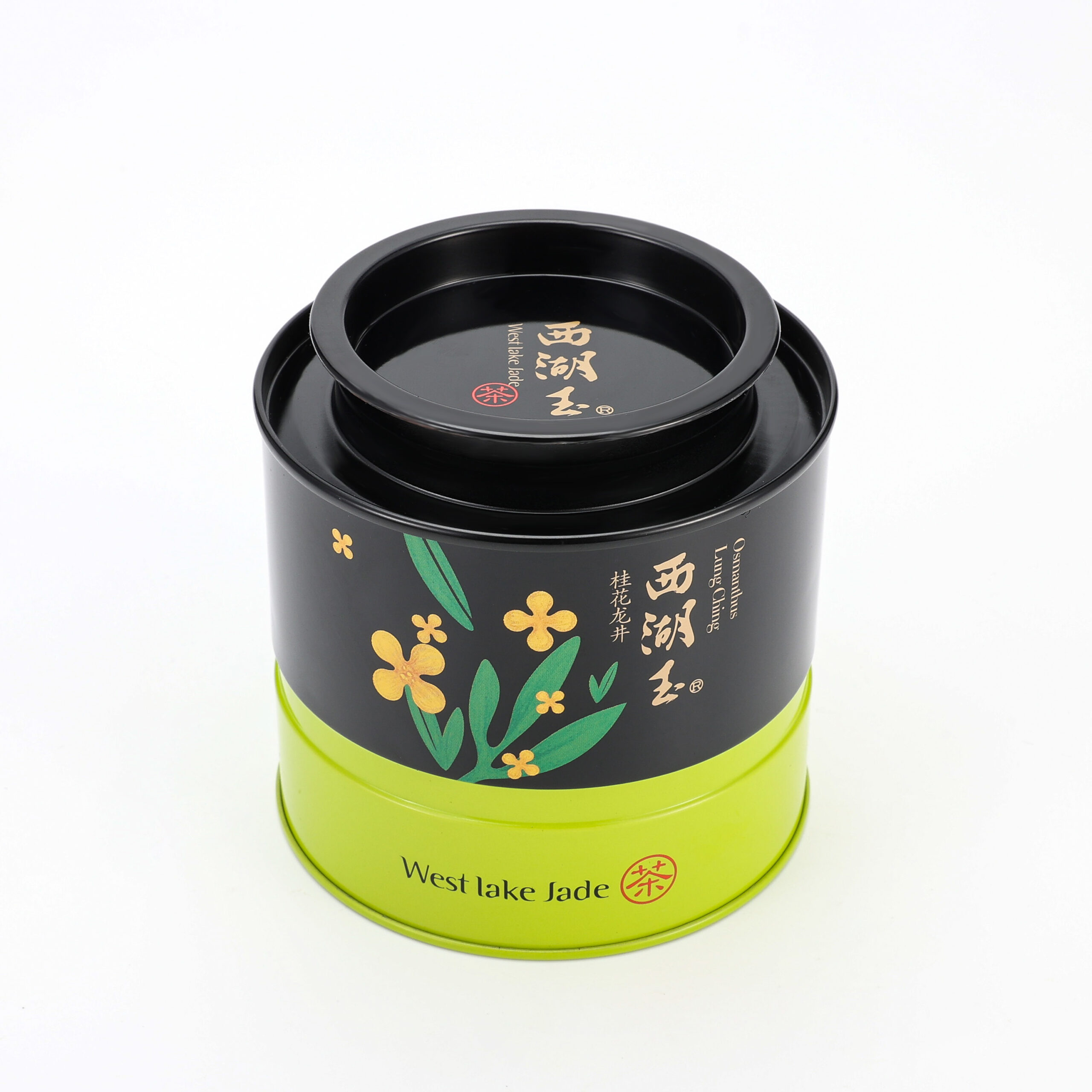
For example, imagine a tea brand with a dark green logo and a detailed botanical illustration.
On screen, the green may look exactly as expected. On tinplate, however, the final result can be affected by the metal base, white ink and surface finish.
That is why artwork review should happen before production, rather than after the first mass-production batch.
How Should You Prepare Artwork for Custom Printed Tin Packaging?
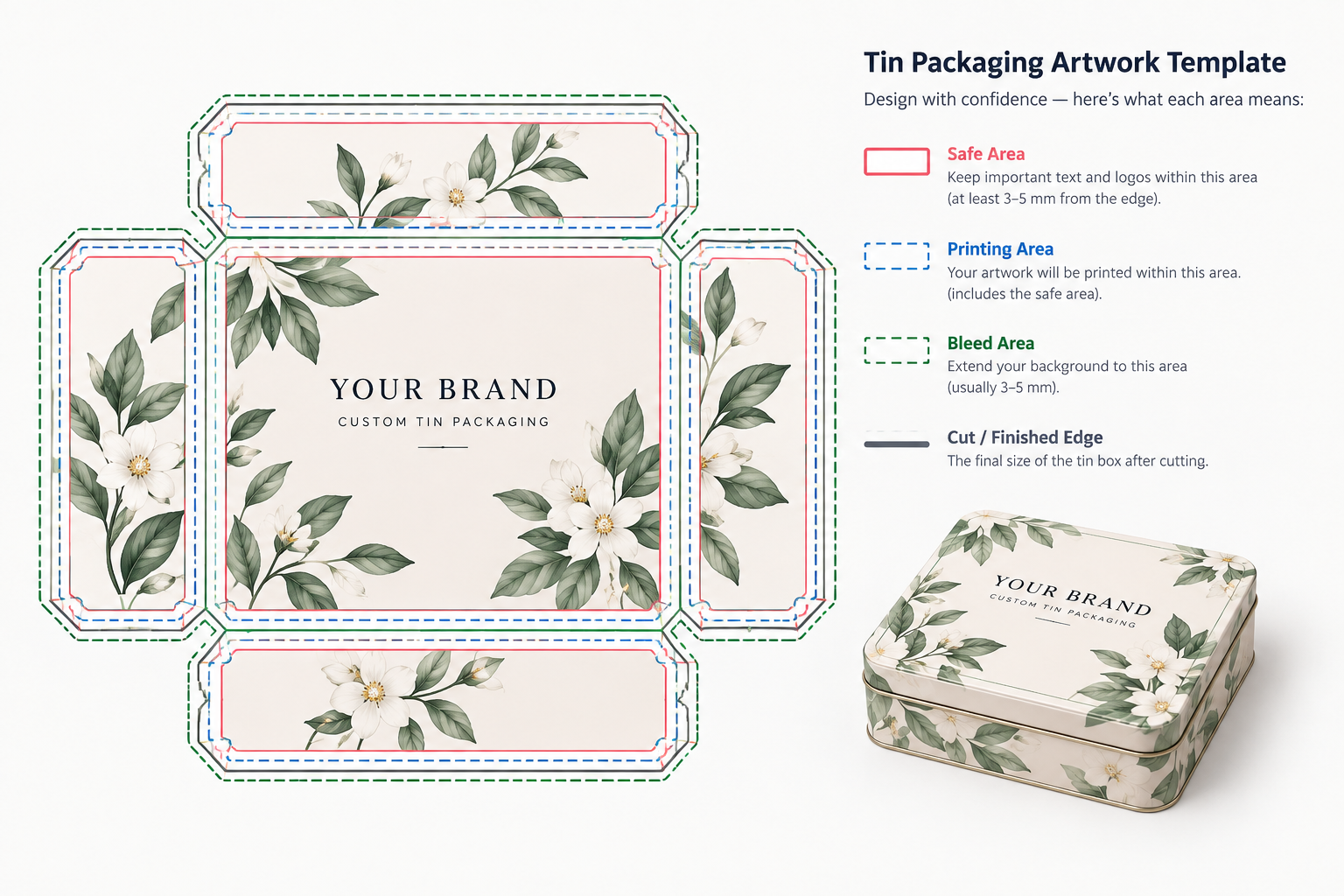
The easiest way to avoid printing problems is to prepare the artwork around the actual tin template from the beginning.
Start With the Correct Tin Template
Before designing the final artwork, confirm:
- Tin length and width
- Height
- Lid structure
- Printable area
- Edge area
- Logo position
- Text position
Do not assume that the entire visible surface can be printed in exactly the same way.
The lid, side wall and curved areas can have different printing requirements.
Keep Important Elements Away From Edges
Logos, small text and other critical elements should not sit too close to cutting, forming or joining areas.
For example, if a small logo is positioned too close to the edge of a lid, even a small change during forming can make the visual balance look different.
A safer approach is to keep important elements inside the recommended safe area of the manufacturer’s template.
Use Production-Ready Artwork
For professional packaging production, vector files such as AI or PDF are generally easier to adjust than a low-resolution JPG.
If the artwork contains photographs or raster graphics, use sufficiently high-resolution files.
The goal is not simply to give the factory a beautiful image. The goal is to provide a file that can be translated accurately into production.
How Does Printing Affect the Final Color?
Color should be discussed before printing because the metal substrate can change how the artwork appears.
Why Can the Same Color Look Different?
A color displayed on a monitor is created using light.
Printed color is created using ink on a physical surface.
When the substrate changes, the visual result can change as well.
For tin packaging, the underlying metal can therefore become part of the visual effect.
When Is White Ink Important?
White ink can be used as a base layer in areas where the artwork needs a more controlled color appearance.
This becomes particularly useful for designs containing:
- Bright colors
- White backgrounds
- Large solid-color areas
- Detailed illustrations
- Brand colors that need stronger consistency
For example, a bright yellow logo printed directly over a metallic surface may not have the same appearance as the same yellow printed over a white base.
The important decision is therefore not simply “Which yellow should we use?”
It is:
“Which yellow + which base + which surface finish?”
That is the level at which the artwork should be reviewed.
Which Printing Options Work Best for Tin Packaging?
There is no single printing option that is ideal for every design. The artwork itself should determine the approach.
CMYK Printing for Detailed Artwork
CMYK is suitable for artwork containing multiple colors, illustrations, photographs and gradients.
For example, a cookie brand may use a detailed illustration of a bakery scene across the lid. The design may contain dozens of visual color variations.
CMYK printing is a practical choice for this type of artwork because the design is not dependent on only a few fixed brand colors.
Pantone Matching for Brand Colors
Pantone matching becomes more useful when specific brand colors need to be controlled.
Consider a brand whose logo uses a distinctive red.
If the logo is one of the most recognizable parts of the packaging, simply choosing a visually similar red is not ideal. The required color should be clearly specified during artwork preparation.
Metallic Effects
The metal surface itself can sometimes become part of the visual design.
Instead of covering every area with a solid color, some designs intentionally leave selected areas metallic.
This can work particularly well with:
- Minimalist artwork
- Premium gift packaging
- Dark colors
- Gold or silver visual themes
The key is to decide where the metal should remain visible before the artwork is finalized.
How Should You Choose the Tin Packaging Finish?
The finish should support the artwork rather than be selected independently.
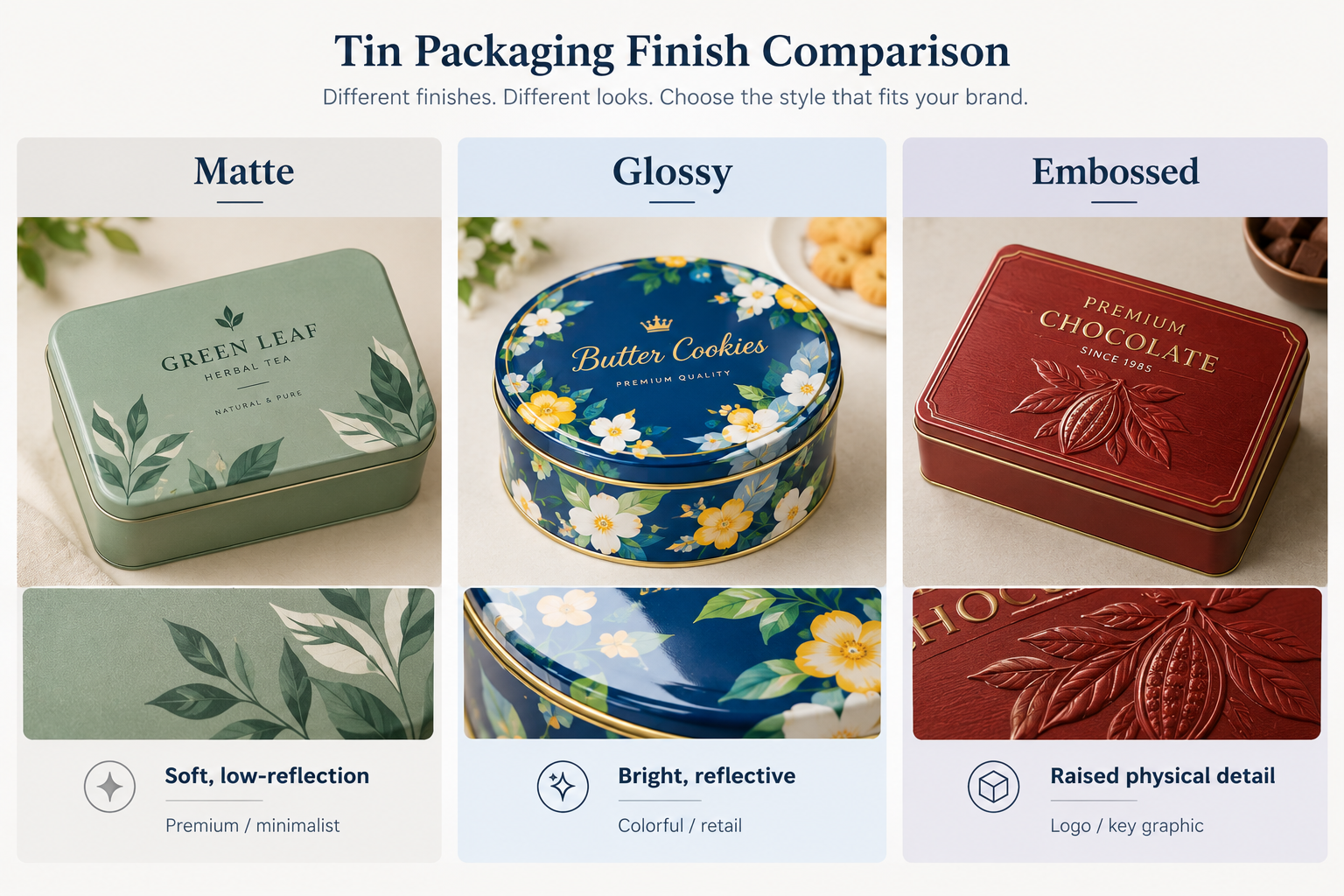
Matte Finish
Matte creates a softer and less reflective appearance.
It can work well when the artwork is:
- Minimal
- Premium
- Dark
- Typography-focused
Glossy Finish
Glossy produces a brighter surface and stronger reflections.
It can be suitable for:
- Colorful artwork
- Retail packaging
- Promotional designs
- High-contrast graphics
Embossing and Other Decorative Effects
If the brand logo or a specific graphic element needs additional physical presence, embossing or engraving can be considered.
The important point is to use these effects selectively.
For example, embossing the entire artwork may make the design unnecessarily complicated. Embossing only the logo can create a much clearer visual hierarchy.
What Should You Check Before Approving the Artwork?
A good artwork approval process catches problems before the printing stage.
Check the Dimensions
Make sure the artwork matches the latest tin template.
Do not use an old template after the structure has been changed.
Check the Logo Position
Look at the complete tin rather than only the flat artwork.
A logo that looks centered on a flat file may not appear centered once the lid or body is formed.
Check Small Text
Small text needs particular attention.
If important information is too small or positioned close to an edge, it may become difficult to read on the finished package.
Check Colors
Confirm the required CMYK or Pantone colors and discuss whether white ink is required.
Check Finishing
Make sure the approved artwork corresponds to the selected surface treatment.
For example, if the design was approved based on a matte appearance but production is changed to glossy, the visual result may be noticeably different.
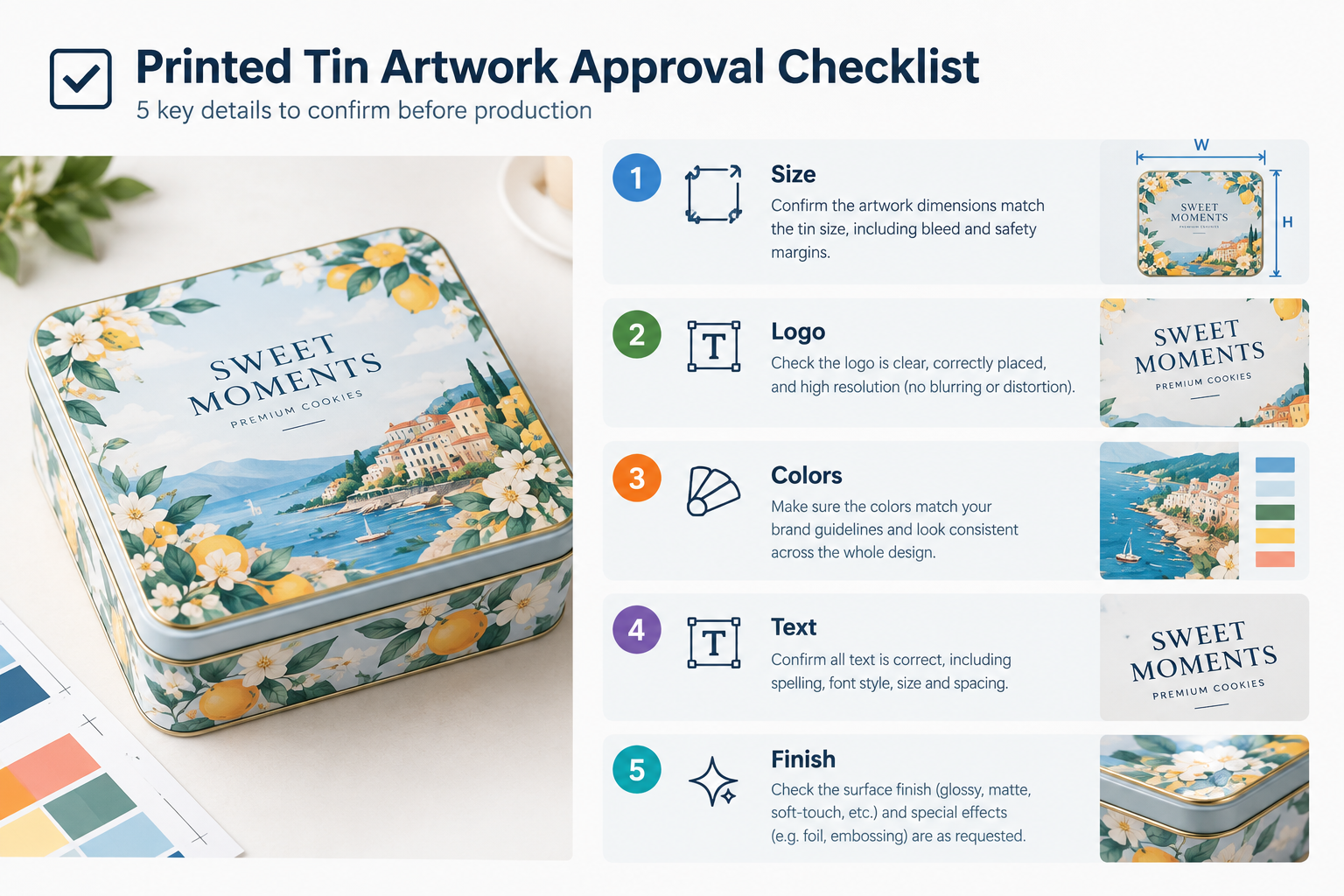
Artwork Approval Checklist
Before approval, check:
☐ Correct tin template
☐ Correct dimensions
☐ Logo position
☐ Text and graphics
☐ CMYK / Pantone colors
☐ White ink requirements
☐ Surface finish
☐ Final artwork version
What Is the MOQ for Custom Printed Tin Packaging?
As of 2026, the MOQ for custom printed tin packaging starts from 3,000 pcs for this project category.
The actual quotation can still vary according to the tin structure, artwork, printing requirements and order quantity.
Why Does Quantity Matter?
The quantity affects how the production cost is distributed across the order.
For example, a brand preparing 3,000 pcs for a first launch may have a different unit cost from a brand ordering 10,000 pcs for a larger retail program.
For that reason, it is useful to provide the expected quantity when requesting a quotation rather than asking only for a generic price.
What Should You Send With Your MOQ Request?
For a more accurate quotation, provide:
Tin size + artwork + quantity + printing requirements + finish
If the artwork is not finished yet, even a draft design can help the manufacturer understand the project.
How Can You Avoid Common Custom Printed Tin Problems?
Most printing problems are easier to prevent than to correct after production.
Do Not Design Without the Tin Template
A designer may create an attractive graphic first and worry about the packaging dimensions later.
This often creates unnecessary revisions.
Start with the actual template whenever possible.
Do Not Judge Color Only From a Monitor
Your screen is useful for design work, but it should not be treated as the final physical color reference.
Discuss the color specification and printing requirements with the manufacturer before approval.
Do Not Change Artwork at the Last Minute
Once the artwork has been approved and production begins, late changes can create additional work and potentially affect the schedule.
Keep a clear final artwork version so the designer, buyer and factory are working from the same file.
Do Not Treat Finishing as an Afterthought
A matte surface, glossy surface and embossed surface can create different visual results from the same artwork.
Choose the finish during the artwork approval stage.
How Can Liyipackaging Help With Custom Printed Tin Packaging?
For a B2B packaging project, the practical challenge is often coordination rather than simply finding a printing supplier.
The artwork designer may think in terms of pixels and colors, while the purchasing team is concerned with dimensions, quantity and delivery. The manufacturer needs to translate all of that into a production-ready specification.
Liyipackaging can help coordinate the tin template, artwork preparation, printing requirements, sampling and production communication so that the approved design is carried through to the finished tin.
The most useful workflow is straightforward:
Design → Template Review → Artwork Approval → Sample → Production
That gives the buyer a clear point at which the artwork is approved before moving into the next stage.
What Should You Prepare Before Requesting a Quote?
You do not need a complicated specification document to start.
Prepare these five things:
1. Tin Size
Provide the required length, width and height.
2. Quantity
State the expected order quantity, with 3,000 pcs as the starting MOQ for this custom printed tin packaging category.
3. Artwork
Send the existing artwork or a draft if the design is still being developed.
4. Printing Requirements
Mention CMYK, Pantone colors, white ink or any specific color requirements.
5. Finish
Specify whether you prefer matte, glossy or a decorative effect.
Once these details are ready, you can request a custom tin packaging quote and let the manufacturer confirm the production specification.
FAQ
What is the MOQ for custom printed tin packaging?
As of 2026, the MOQ for this custom printed tin packaging category starts from 3,000 pcs. The final quotation depends on the specific packaging and printing requirements.
Can I print my logo on a tin box?
Yes. Logos, brand graphics, patterns and other artwork can be printed on custom tin packaging.
Can I use Pantone colors for tin packaging?
Yes. Pantone colors can be specified when consistent brand colors are important. The final printing specification should be confirmed before production.
Do I need an AI or PDF file for custom printed tin packaging?
AI or PDF is recommended for production-ready artwork, particularly when the design contains logos, text and vector graphics. Other formats can be reviewed depending on the artwork.
Can I use white ink on tin packaging?
Yes. White ink can be used when the design requires a controlled base for colors or specific white areas.
How do I prepare artwork for a tin box?
Start with the manufacturer’s actual tin template. Then check the printable area, safe area, dimensions, logo position, colors, text and finishing requirements before submitting the final artwork.
What affects the final appearance of printed tin packaging?
The main factors are the artwork, color specification, metal substrate, white ink, printing method and surface finish. These should be reviewed together rather than separately.