By Liyipackaging Packaging Team | Published: November 5, 2026 | Regulatory information reviewed: November 5, 2026
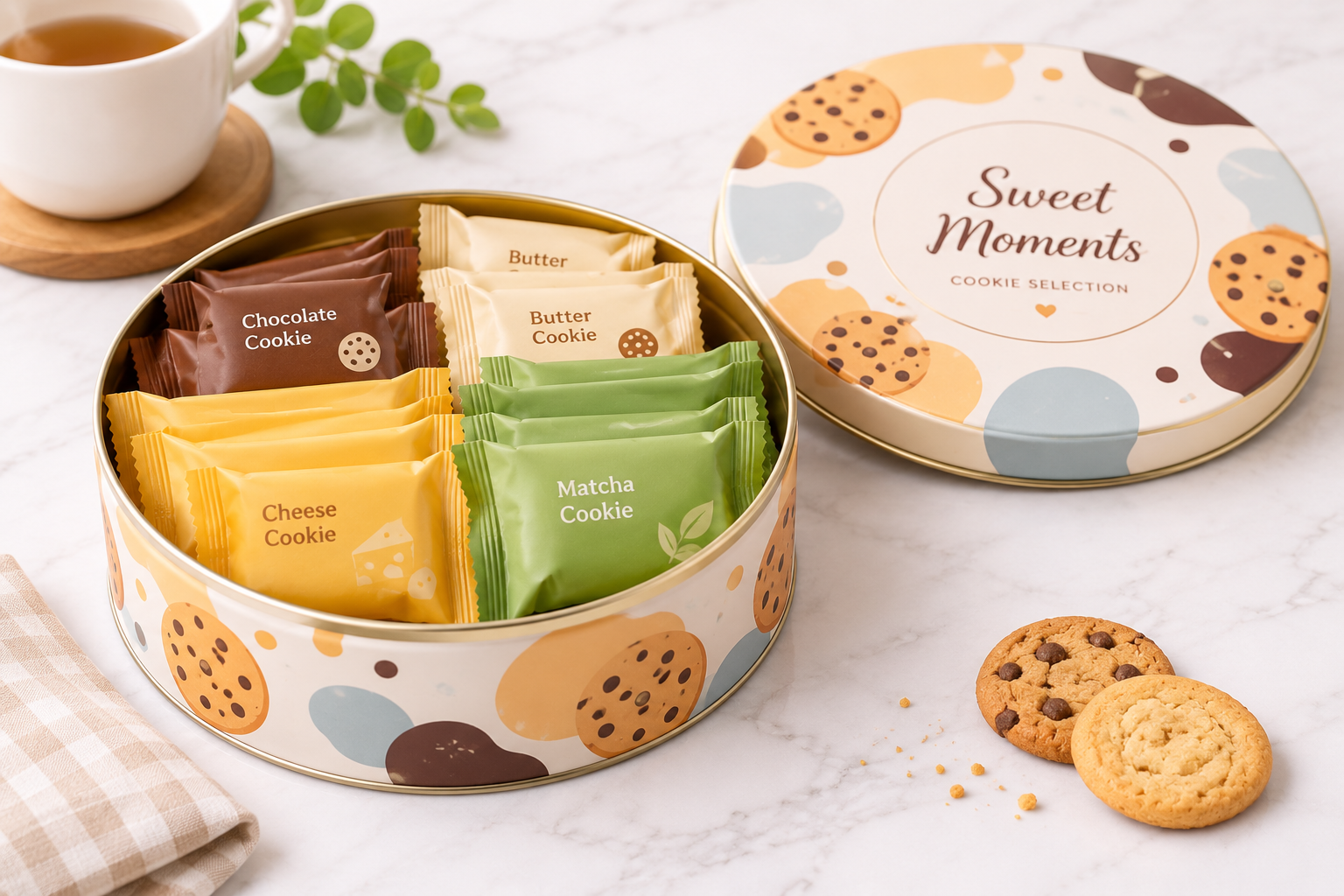
Custom snack tin packaging works best when the tin is planned around the snack as it is actually packed, not around a general category such as “nuts” or “crackers.” A tin can have enough total volume and still fail if the wrapped portions do not fit the layout, if the pieces shift when the tin is handled, or if the top layer presses against the lid.
This guide focuses on one situation: individually wrapped or assorted snacks that need to be arranged, separated and protected inside a tin. If your product is a single snack type, the table below points to a more specific guide.
Quick takeaways
- Measure the wrapped unit, not the snack itself. The wrapper, tray or inner bag is part of the dimension.
- Choose the layout before the tin size. The same product volume can need a wide, shallow tin or a compact, deeper one.
- Add dividers or trays only where they solve a real problem, such as crushing, movement or flavor mixing.
- Test the lid clearance with the packed product, not with an empty sample.
- Confirm whether snacks will touch the tin directly before choosing a structure and coating.
Which Snack Formats Suit a Snack Tin?
A snack tin suits snacks that are individually wrapped, portioned or assorted, because their primary packaging lets them be arranged in a tin without direct handling problems. Loose or fragile products need more attention to inner packaging, and some formats have their own dedicated guides.
| Snack format | Main fit question | Where to read more |
|---|---|---|
| Individually wrapped portions and bars | Layout and wrapper dimensions | This guide |
| Mixed snack assortments | Dividers and compartment sizes | This guide |
| Nuts and trail mix | Net weight and inner bag | Custom nut gift tins |
| Crackers and biscuits | Breakage and stacking | Custom cracker tin packaging |
| Popcorn | Volume and inner bag | Custom popcorn tins |
| Cookies | Circle packing and layers | Custom round cookie tins |
| Candy | Product size and lid | Custom candy tin guide |
If you are still comparing tin types for a new product line, the custom tin packaging guide gives a broader overview of structures and shapes.
How Do You Plan the Layout for Wrapped Snack Portions?
Start with the layout, because it decides the tin footprint and height. Measure one finished, wrapped portion, decide how many should fit, and then compare a single-layer and a multi-layer arrangement.
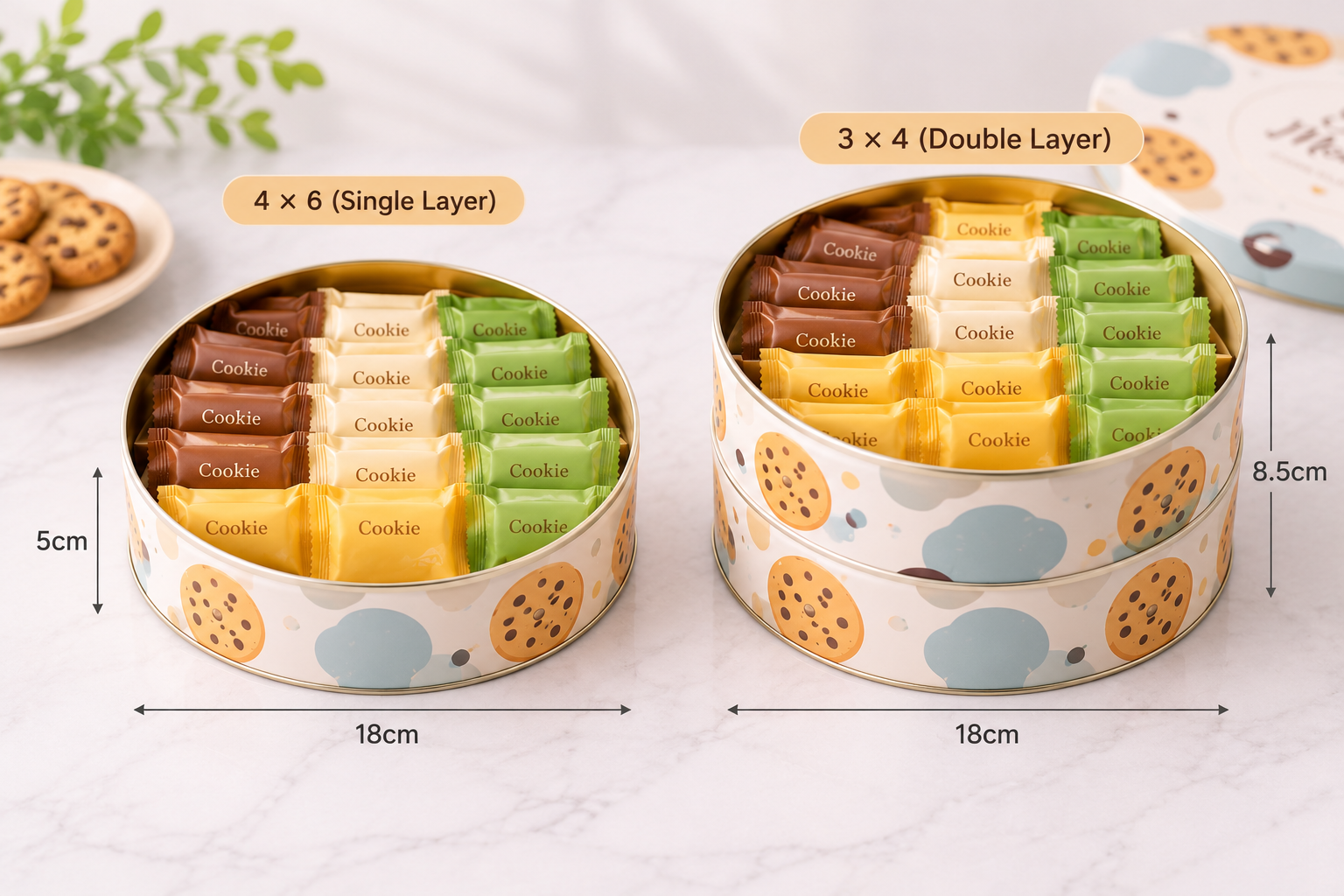
Consider an example. A brand wants 24 individually wrapped snack portions in one rectangular tin. Each wrapped portion measures about 35 × 45 × 15 mm, so the net product volume is 567 cm³ (567,000 mm³). The same product can be arranged in different ways:
| Layout | Footprint (approx.) | Height (approx.) | Best suited for |
|---|---|---|---|
| Single layer, 4 × 6 | 180 × 210 mm | 15 mm + clearance | Gift presentation where every portion is visible |
| Double layer, 3 × 4 per layer | 135 × 140 mm | 30 mm + clearance | Compact tins and more efficient shelf or carton space |
Both options hold the same 24 portions, but the single-layer tin has about twice the footprint of the double-layer tin. These figures are net product dimensions only. The final internal size also needs to allow for wrapper edges, loading tolerance, divider or tray thickness, and lid clearance.
For tins with a rectangular body, you can review the available structures on the rectangular tin box product page before deciding on a footprint.
When Do Dividers, Trays or Inner Bags Help?
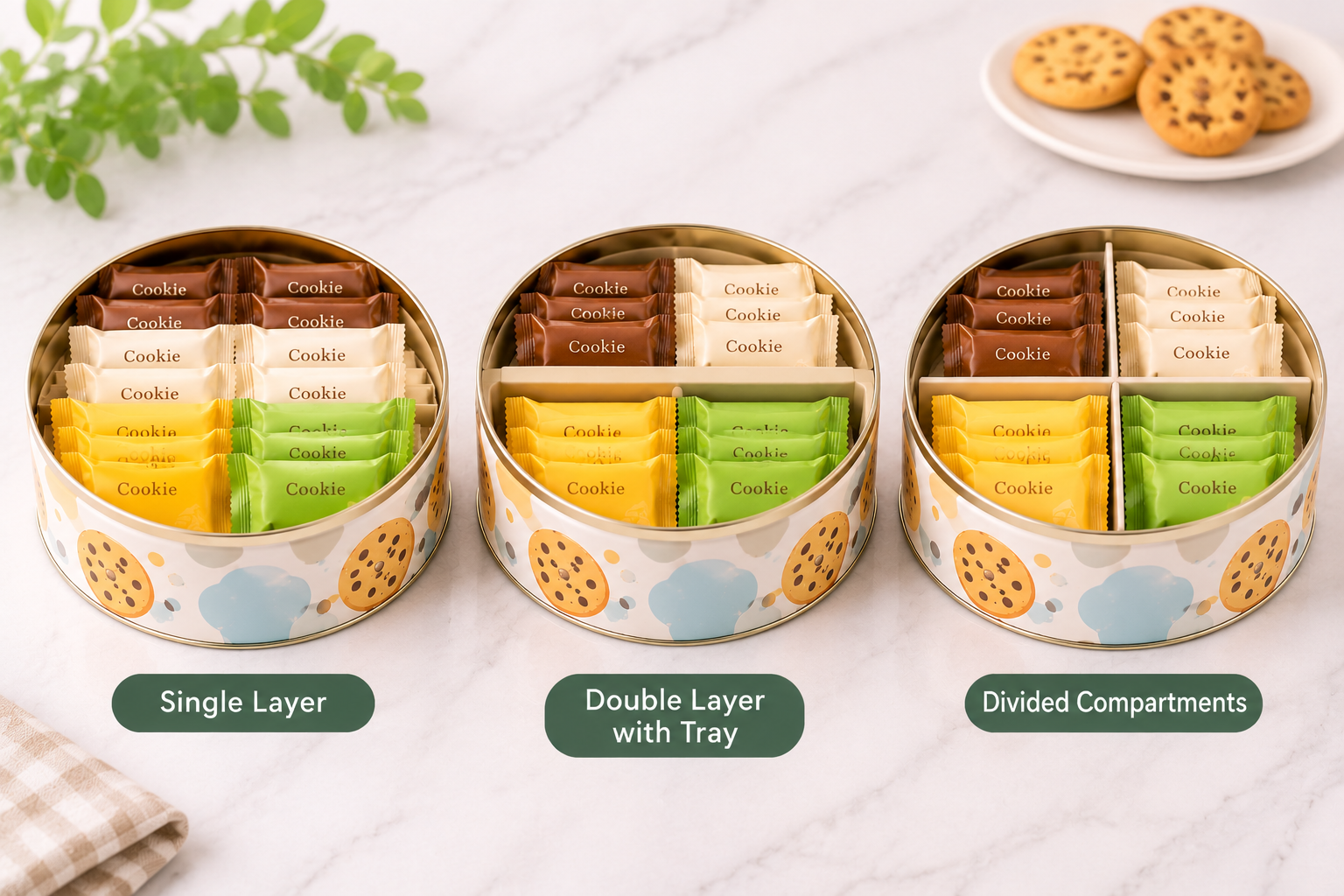
Dividers, trays and inner bags help when they solve a specific problem, such as crushing, movement or mixing of different snacks. Adding components that do not solve a problem only makes loading slower and more expensive.
| Component | Helps with | Check before choosing |
|---|---|---|
| Paper tray | Keeping portions in position | Tray thickness and loading speed |
| Divider or compartment | Separating different snacks in one tin | Compartment size for each product |
| Inner bag | Separating food from the tin surface | Bag material, sealing method and fill weight |
| Lower-layer tray in a double layout | Protecting the bottom layer from the top layer’s weight | Total height and lid clearance |
For a mixed snack collection, list each product’s wrapped dimensions first, then size the compartments around the largest item. Sizing around the average item often leaves one product forced into place.
How Do You Check Lid Clearance and Loading?
Check lid clearance by closing the tin with the real packed product inside. A tin that fits an empty lid test can still fail once the top layer, tray or wrapper edges push against the closing area.
When you receive a sample, check the following:
- Products load without being forced into position.
- Portions do not shift noticeably when the tin is tilted or shaken gently.
- Customers can remove items without damaging the wrappers.
- The lid closes without pressing on the top layer and opens without catching on the product.
The lid type also changes the clearance you need. For a comparison of lift-off, slip and hinged lids, see our guide to rectangular tin lid types.
What Snack-Specific Protection Issues Should You Plan For?
Snacks bring their own issues: oils, moisture, crushing and the fact that a metal tin is not automatically an airtight pack.
- Oils and moisture: Oily or moist snacks can come into contact with the tin surface, so decide early whether they will be protected by an inner bag, a tray or their own wrapper.
- Crushing: Fragile snacks need a layout that keeps the weight of the top layer off the bottom layer.
- Freshness: A tin with a slip lid or a hinged lid is a protective container, but it should not be assumed to be airtight. If crispness or shelf life matters, discuss sealed inner packaging and test the actual product.
Food-contact requirements depend on whether the snack touches the tin interior and on the destination market. In the United States, coatings and other food-contact materials are regulated by the FDA, including requirements such as 21 CFR 175.300 for resinous and polymeric coatings. In the European Union, the general framework is Regulation (EC) No 1935/2004, supported by Regulation (EC) No 2023/2006 on good manufacturing practice, and Regulation (EU) 2024/3190 restricts bisphenols such as BPA in certain food-contact materials, with transition periods that should be checked for each application. Compliance must be assessed for the specific tin, coating, food and conditions of use. For a detailed explanation, read our guide to food tin containers, coatings and food-contact requirements.
How Should You Handle Branding on a Snack Tin?
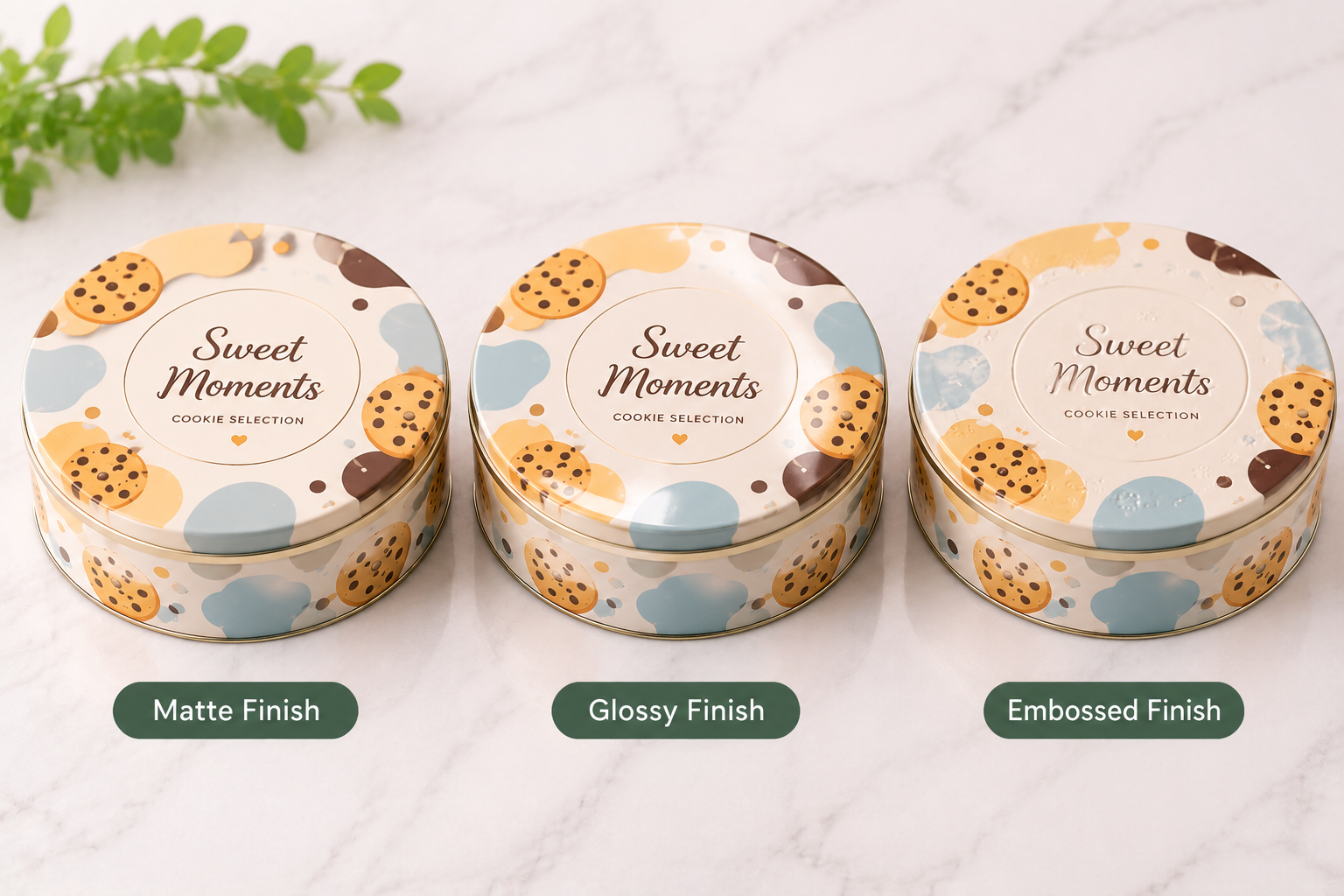
Keep the artwork simple enough to work with the tin structure and label requirements. Matte, glossy and embossed finishes can each suit a snack brand, depending on the artwork and the retail channel.
For artwork files, color control, white ink and finish decisions, our custom printed tin packaging guide covers the full process, so it is not repeated here. Before approving production, check that the logo position, small text and nutrition or ingredient label space still work on the actual tin.
What Should You Prepare Before Requesting a Sample or Quote?
A useful request includes the wrapped product dimensions, the quantity per tin and the layout you want to test. These details let the manufacturer evaluate the actual packaging rather than a general idea.
| Information | Example |
|---|---|
| Snack type | Individually wrapped snack portions |
| Wrapped portion size | 35 × 45 × 15 mm |
| Quantity per tin | 24 portions |
| Preferred layout | Single layer or double layer (open to advice) |
| Tin structure | Rectangular tin with removable lid |
| Internal accessories | Paper tray or divider, if needed |
| Printing | Full-color artwork with matte or glossy finish |
| Target order quantity | 3,000 pcs |
| Destination market | United States |
These are illustrative details, not a fixed specification. If the final product is not ready, preliminary dimensions and drawings are enough to start, but real samples are best for checking the layout and lid clearance.
As of November 2026, custom tin orders at Liyipackaging typically start from 3,000 pcs, with a practical range of 3,000–10,000 pcs depending on the structure, tooling and printing requirements. The final quotation depends on the project, and the custom tin box cost, MOQ and lead time guide explains what affects each of these.
Frequently Asked Questions About Snack Tin Packaging
How do I calculate the right size for wrapped snack portions?
Measure one finished, wrapped portion, decide how many should fit and compare a single-layer layout with a double-layer layout. The tin’s internal size then needs extra room for wrapper edges, tolerance, trays or dividers and lid clearance.
Do snacks in a tin need dividers?
Not always. Dividers or trays are worth adding when snacks move, crush each other or need to stay separated, such as an assortment of different flavors or textures. A single type of sturdy wrapped snack may only need a simple tray, or nothing extra.
Can snacks touch the tin directly?
It depends on the snack, the internal coating and the destination market. Wrapped snacks are often packed so the tin is used as outer packaging, while loose snacks usually need confirmed food-contact materials or an inner bag. Confirm the intended use and request the relevant documentation before production.
Will a snack tin keep crisp snacks fresh?
A tin protects snacks from crushing and handling, but it should not be assumed to be airtight. If crispness or shelf life is important, use sealed inner packaging and test the actual product in the sample.
What should I send to get a snack tin quote?
Send the wrapped product dimensions or actual samples, the quantity per tin, your preferred structure, the artwork and the target order quantity. You can also include the destination market so the food-contact requirements are considered from the start.
Planning a custom snack tin?
Contact Liyipackaging with your wrapped product dimensions, quantity per tin, preferred layout and estimated order volume. Our team can help evaluate the tin structure, internal space, printing options and production requirements for your project.