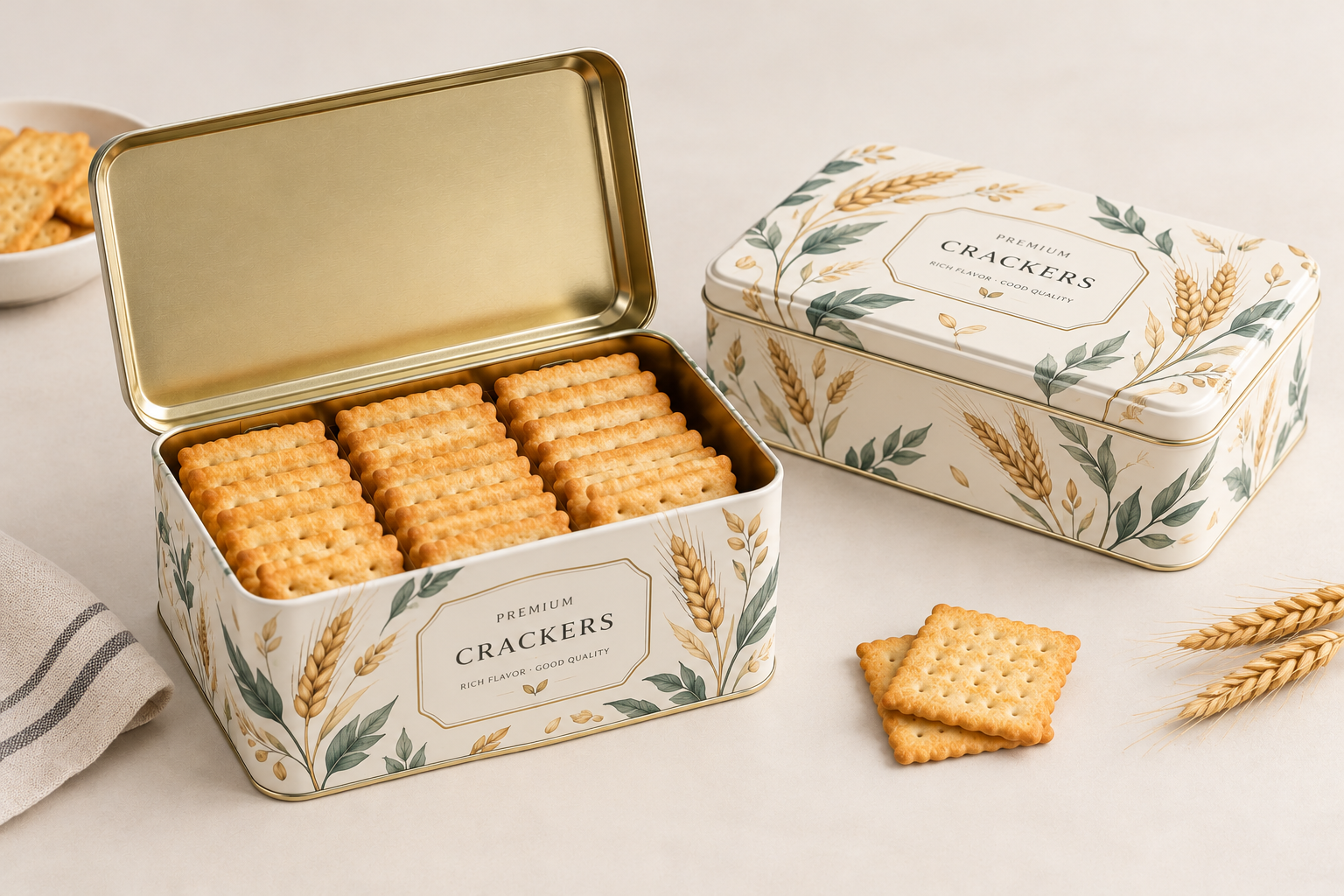
At Liyipackaging Packaging Team, we work with the practical questions that come up when buyers develop custom tin packaging: Will the product fit properly? Will the lid work as expected? Can the design be produced consistently at the required quantity?
Choosing a cracker tin involves more than selecting an attractive metal container. The wrong internal layout can leave crackers moving around during transport, while an unsuitable opening structure can make the package inconvenient to use. Unclear specifications can also lead to avoidable sample revisions and delays.
This guide explains how to evaluate cracker tin packaging, confirm the details that matter before production, and assess a manufacturer beyond the unit price. By the end, you should have a clear checklist for preparing your product specifications and requesting a quotation.
Is a Cracker Tin the Right Packaging Choice for Your Product?
A cracker tin is worth considering when product presentation, reusable packaging, and a more substantial retail appearance are important. Whether it is the right choice depends on the cracker format, protection requirements, and target selling price.
Which cracker products work well in a metal tin?
Metal tins can suit premium crackers, saltine crackers, specialty savory biscuits, and assorted cracker gift sets. They provide a defined container for retail presentation and can be customized to match a brand’s visual identity.
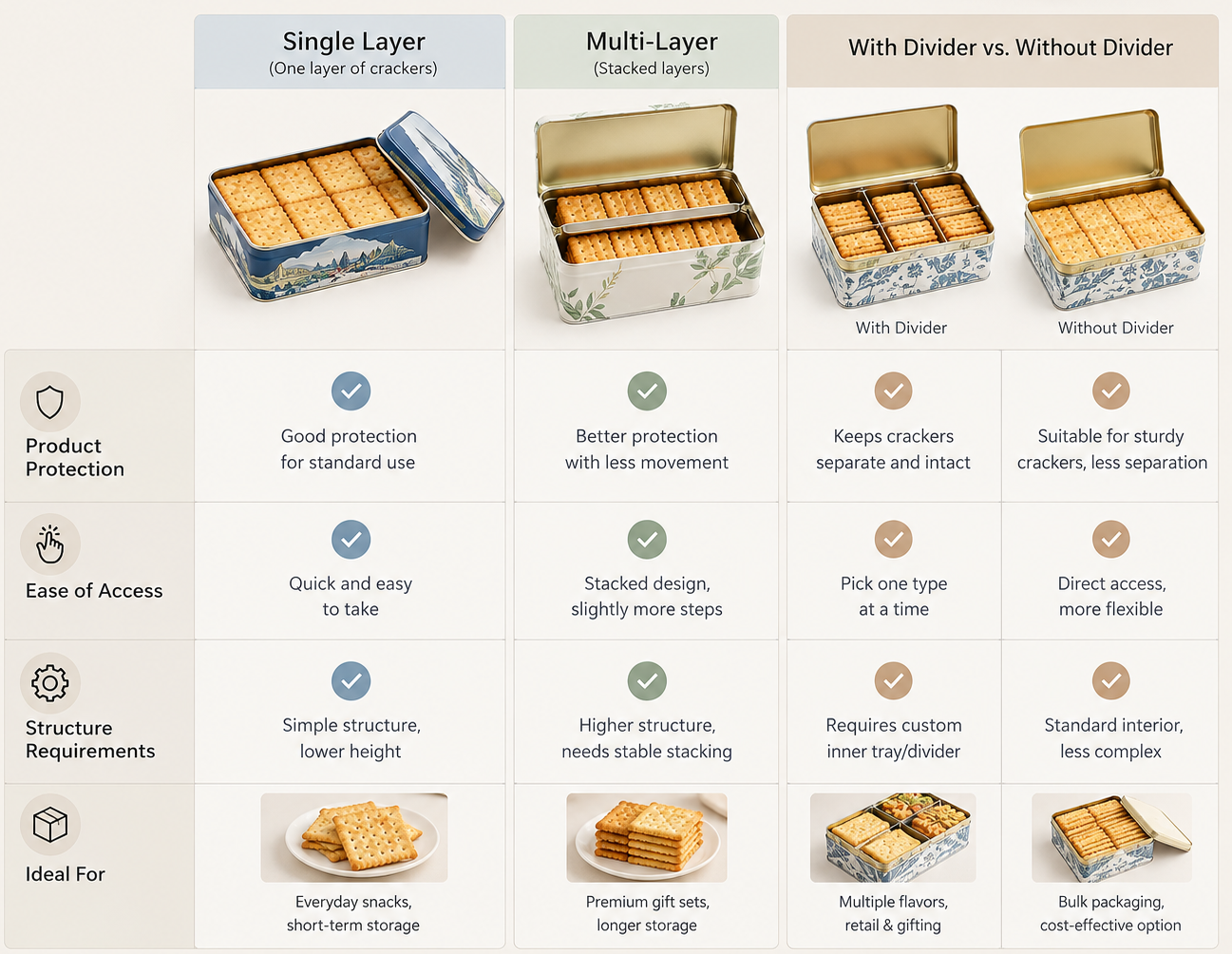
The packaging requirements differ by product. Uniform crackers may be arranged in neat stacks, while mixed assortments may need separate compartments or a suitable insert. Thin, fragile crackers also require more attention to movement and impact during handling.
A tin should not automatically be treated as a complete freshness barrier. The lid structure, closure fit, and any inner pouch or liner must be evaluated according to the product’s moisture sensitivity and shelf-life requirements.
When does premium cracker tin packaging add value?
A premium cracker tin may be appropriate for gift collections, seasonal products, specialty food retail, and branded assortments where the container contributes to the overall presentation.
For example, a brand preparing a holiday cracker assortment could use a printed rectangular tin with an insert that separates different varieties. The insert helps organize the contents, while the printed lid creates a consistent presentation for retail shelves or gifting.
This approach makes sense only when the packaging cost, product protection, and expected retail value support one another. For everyday products sold primarily on price, a simpler package may be more commercially appropriate.
What should buyers compare before choosing a tin?
Compare the complete packaging solution rather than the empty container alone. Consider product fit, protection, opening convenience, branding requirements, order quantity, and total project cost.
A tin that looks suitable in a product photograph may not provide enough usable internal space once the crackers are arranged inside. Confirming the actual packed configuration is more reliable than choosing a tin based on its external dimensions alone.
What Should You Check Before Selecting a Cracker Tin?
Start with the crackers and their intended arrangement, then evaluate the internal space and lid structure. This sequence helps avoid choosing a container that looks right but performs poorly in actual use.
How do cracker shape and arrangement affect internal space?
The number of crackers per tin is only one part of the specification. Buyers should also consider the dimensions of each cracker, the number of layers, the orientation of the stacks, and the space needed to remove the contents without excessive handling.
Suppose a brand wants to pack 24 square crackers in one tin. Before confirming the container, the buyer and manufacturer should establish whether the crackers will be stacked in one group, divided into smaller stacks, or separated by an insert.
Each arrangement changes the usable space and may affect the required internal height. A trial pack using actual crackers or dimensionally accurate samples helps confirm whether the proposed configuration is practical.
Which lid and opening structure suits your product?
The lid should match how customers will open, close, store, and reuse the package. A removable lid may be suitable for a straightforward gift tin, while a hinged lid may be more convenient when the product is intended for repeated access.
The decision should also account for closure fit and the possibility of product movement during transportation. A lid that is too loose may not stay securely in place, while an overly tight fit can make opening inconvenient.
If the package needs to provide a specific level of moisture protection, verify the complete packaging system rather than assuming that the metal body and lid alone will preserve freshness.
How can you reduce breakage and movement inside the tin?
A suitable internal arrangement can reduce unnecessary movement, but the best solution depends on the fragility of the crackers and the distribution conditions.
Possible options include closer-fitting stacks, paperboard dividers, or a custom insert. The insert should hold the product in position without putting excessive pressure on fragile edges or making the crackers difficult to remove.
For a mixed assortment, separate sections may also prevent different cracker varieties from shifting into one another. Before approving the final design, test the actual packed tin under representative handling and transport conditions.
Which Customization Options Matter for a Premium Cracker Tin?
Customization should reinforce the brand while remaining practical to manufacture. The most effective design is one that combines clear branding, an appropriate finish, and a structure that works with the product inside.
How should printed artwork support your brand?
The lid is often the main visual area, so the brand name, product identity, and principal artwork should remain easy to recognize. Side panels can support additional graphics or product information where appropriate.
Before production, confirm the final artwork, color references, print coverage, and placement. Buyers should also check that any required product information and labeling can be accommodated in the planned layout.
For a more detailed explanation of artwork preparation, color control, and finishing options, see our custom printed tin packaging guide.
Which finishes suit premium cracker tins?
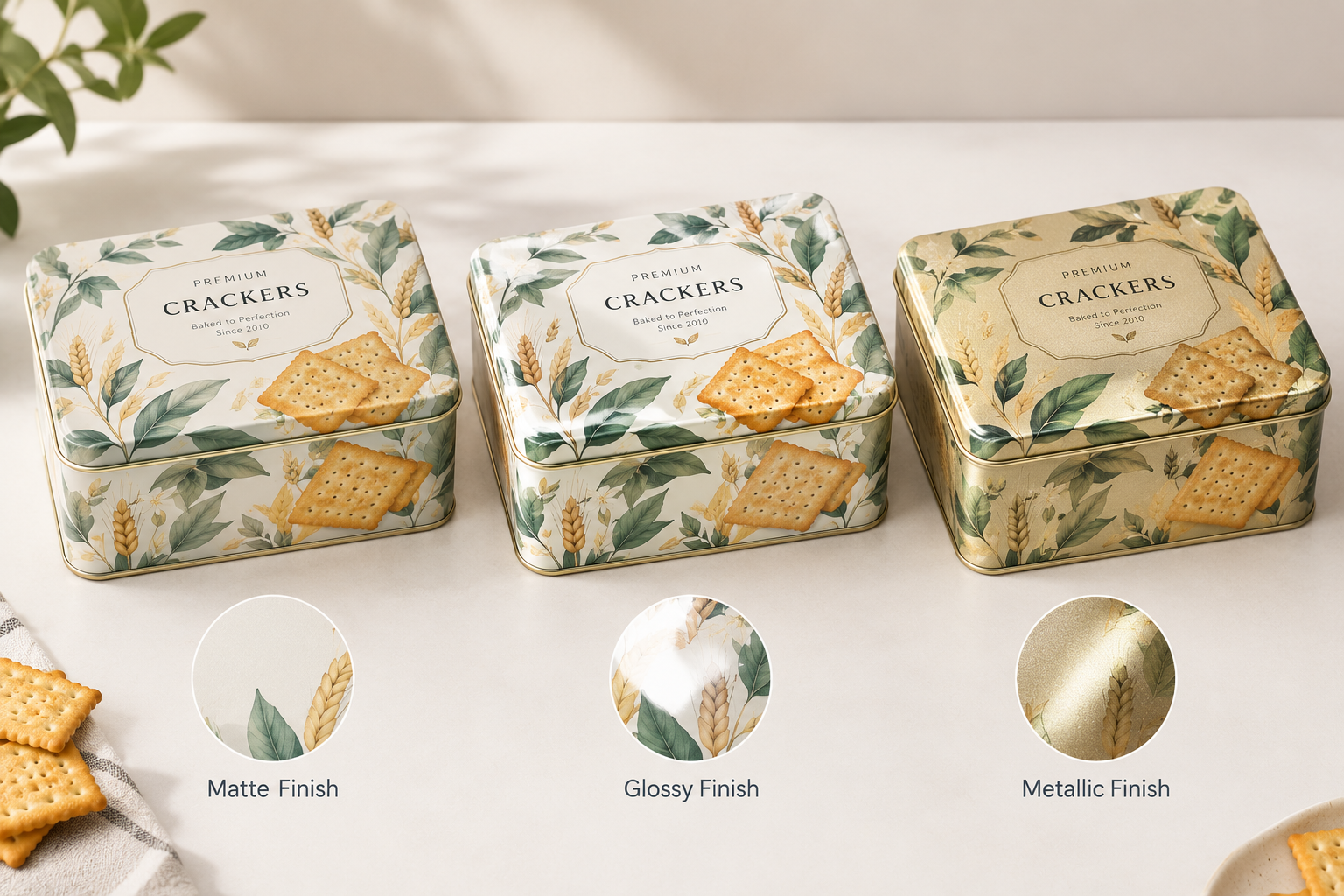
Matte finishes can create a restrained, contemporary appearance, while gloss finishes emphasize color and contrast. Metallic effects may suit premium or gift-oriented designs when they support the brand’s visual direction.
The choice should be assessed against the actual artwork. A finish that looks attractive on a digital mockup may appear different on a physical metal surface, so sample review is useful when color, texture, or special finishing is important.
Avoid adding decorative effects simply because they are available. A clear, consistent design is often more effective than a crowded lid with competing visual elements.
What should be confirmed before approving a sample?
The sample review should cover more than appearance. Confirm the dimensions, lid fit, internal arrangement, print placement, finish, and ease of opening.
Where possible, use the intended crackers or a representative product sample to check the packing configuration. If an insert is required, test whether it holds the contents appropriately and can be removed without damaging the product.
Record any changes before signing off on the production sample. This gives the buyer and manufacturer a shared reference for the approved specification.
What Food-Contact and Quality Requirements Should Buyers Verify?
Food-contact suitability must be assessed for the intended product, market, and complete packaging configuration. A metal container should not be assumed to meet every requirement simply because it is made from metal.
Does your cracker tin need an inner pouch or liner?
The decision depends on the crackers’ moisture sensitivity, fat content, expected shelf life, and how the product will be distributed.
An inner pouch may be needed when the product requires a more controlled barrier against moisture or air. A liner or insert may serve a different purpose, such as separating the product from the container or organizing multiple varieties.
These components are not interchangeable. Buyers should define the actual protection requirement and confirm that the proposed materials and packaging configuration are appropriate for the product.
Which food-contact requirements apply to your target market?
Requirements vary by destination market and by the materials that may contact the food. Buyers should identify the intended sales market early and confirm the applicable requirements for the metal, coatings, inks where relevant, and any inner packaging.
Ask the manufacturer for the available material specifications and supporting compliance documentation. If the tin is used with a separate food-contact pouch, that component must also be considered.
Do not rely on a generic statement such as “food-grade tin” without confirming what materials and intended uses the claim covers. The finished packaging arrangement and the responsibilities of the food producer should be clear before launch.
For a broader overview of materials, interior coatings, and food-contact documentation, see our food tin containers guide.
What quality checks should be completed before shipment?
Pre-shipment inspection should follow the agreed product specification and acceptance criteria. For a custom cracker tin, relevant checks may include:
- Dimensions and overall appearance.
- Print alignment, color consistency, and visible surface defects.
- Lid fit, opening, and closing.
- Edge condition and cleanliness.
- Insert fit and the actual product arrangement, where applicable.
Inspection results should be assessed against agreed requirements rather than an informal visual impression. If the project has specific acceptance criteria, establish them before mass production.
How Can You Evaluate a Custom Cracker Tin Manufacturer?
A suitable manufacturer should be able to translate your product requirements into a workable structure, a reviewable sample, and a consistent production specification. A low initial quotation is not enough to establish that a supplier can deliver the required result.
Can the supplier support design, sampling, and production?
Ask how the supplier handles specification review, structural confirmation, sample production, revisions, and production approval.
The important question is whether feedback from each stage is carried into the next. If the approved sample differs from the intended product arrangement or the final artwork is not clearly documented, the project may encounter avoidable problems during production.
A clear process should establish what the buyer must provide, what the supplier will confirm, and which details require approval before mass production begins.
What should a useful quotation include?
A useful quotation should make the proposed product and commercial terms clear. Check whether it specifies the tin structure, dimensions, material assumptions, printing requirements, order quantity, applicable tooling costs, sampling arrangements, production lead time, and shipping terms.
Not every project requires new tooling, and the cost structure will depend on the selected design and existing manufacturing options. Ask the supplier to identify any assumptions or exclusions that could change the final price.
For a more detailed breakdown of purchasing costs, minimum order quantities, and production scheduling, see our custom tin box cost, MOQ and lead time guide.
Compare quotations on the same specification. Otherwise, a lower unit price may simply reflect a different structure, finish, quantity, or scope of service.
How can you compare suppliers beyond unit price?
Compare the supplier’s ability to communicate technical details, resolve sample issues, maintain agreed specifications, and explain quality-control procedures.
For example, if two quotations cover the same quantity, ask both suppliers to confirm the same lid structure, print finish, insert arrangement, and delivery terms. This makes the comparison more meaningful than reviewing unit prices in isolation.
Liyipackaging can help buyers clarify packaging requirements, coordinate custom artwork and sampling, and connect approved specifications with production and pre-shipment quality checks. These steps are particularly useful when a project involves several rounds of design confirmation or requires close coordination between the brand, packaging buyer, and manufacturer.
You can learn more about Liyipackaging’s manufacturing capabilities and its approach to design, production, and quality control.
What Information Should You Prepare Before Requesting a Cracker Tin Quote?
A complete initial brief helps the manufacturer assess feasibility and prepare a more relevant quotation. You do not need to know every technical detail before contacting a supplier, but the product and order requirements should be as specific as possible.
Product specifications
Describe the cracker type, approximate dimensions, quantity per tin, intended arrangement, and whether the crackers are individually wrapped. If the product is fragile or includes several varieties, explain how it should be separated or protected.
Photos, product samples, and existing packaging references can help clarify details that are difficult to communicate through text alone.
Packaging and branding requirements
Provide the preferred tin shape or reference design, approximate dimensions if known, lid preference, insert requirements, and artwork status.
If you are still deciding on the structure, state the intended product configuration and ask the manufacturer to review suitable options rather than committing to an unverified size.
Order and delivery requirements
Include the estimated order quantity, destination market, required delivery date, and any applicable compliance-documentation needs.
If the product is intended for a seasonal launch, work backward from the required arrival date. Allow time for specification review, sampling, revisions, sample approval, mass production, and transportation. Confirm the actual schedule with the supplier instead of relying on a generic lead-time estimate.
Once these details are available, you can request a quotation based on a clearly defined specification. If you need help evaluating tin structures, confirming customization options, or preparing your project requirements, contact our team to discuss your custom cracker tin packaging project.
Choosing the right cracker tin starts with the product, not the artwork. Confirm the cracker arrangement, internal space, lid structure, protection requirements, and production specification before committing to a design. With these details established, buyers can compare manufacturers more fairly and move toward sampling with fewer unresolved questions.
Frequently Asked Questions
1. What is a cracker tin used for?
A cracker tin is a metal container used to package crackers and similar savory biscuits. It is often considered for premium retail products, gift assortments, and branded packaging where presentation and a reusable container are desirable.
2. Are metal cracker tins suitable for food packaging?
They can be suitable when the materials, coatings, and complete packaging configuration meet the requirements for the intended food and destination market. The need for an inner pouch or liner should be evaluated separately according to freshness and shelf-life requirements.
3. How do I choose the right size for a cracker tin?
Start with the dimensions and quantity of the crackers, then determine their arrangement and the internal space required. Confirm the proposed configuration with an actual packing trial or representative sample before approving the final dimensions.
4. Can I customize cracker tins with my own logo and artwork?
Yes, custom cracker tins can be developed with brand artwork and selected surface finishes, subject to the available structure and production requirements. Confirm artwork, color references, print placement, and sample approval before mass production.
5. What should I ask a cracker tin manufacturer before placing an order?
Ask about structural suitability, sampling and revision procedures, order quantity, tooling costs where applicable, material documentation, quality checks, production lead time, and delivery terms. Make sure the quotation and approved sample refer to the same specification.