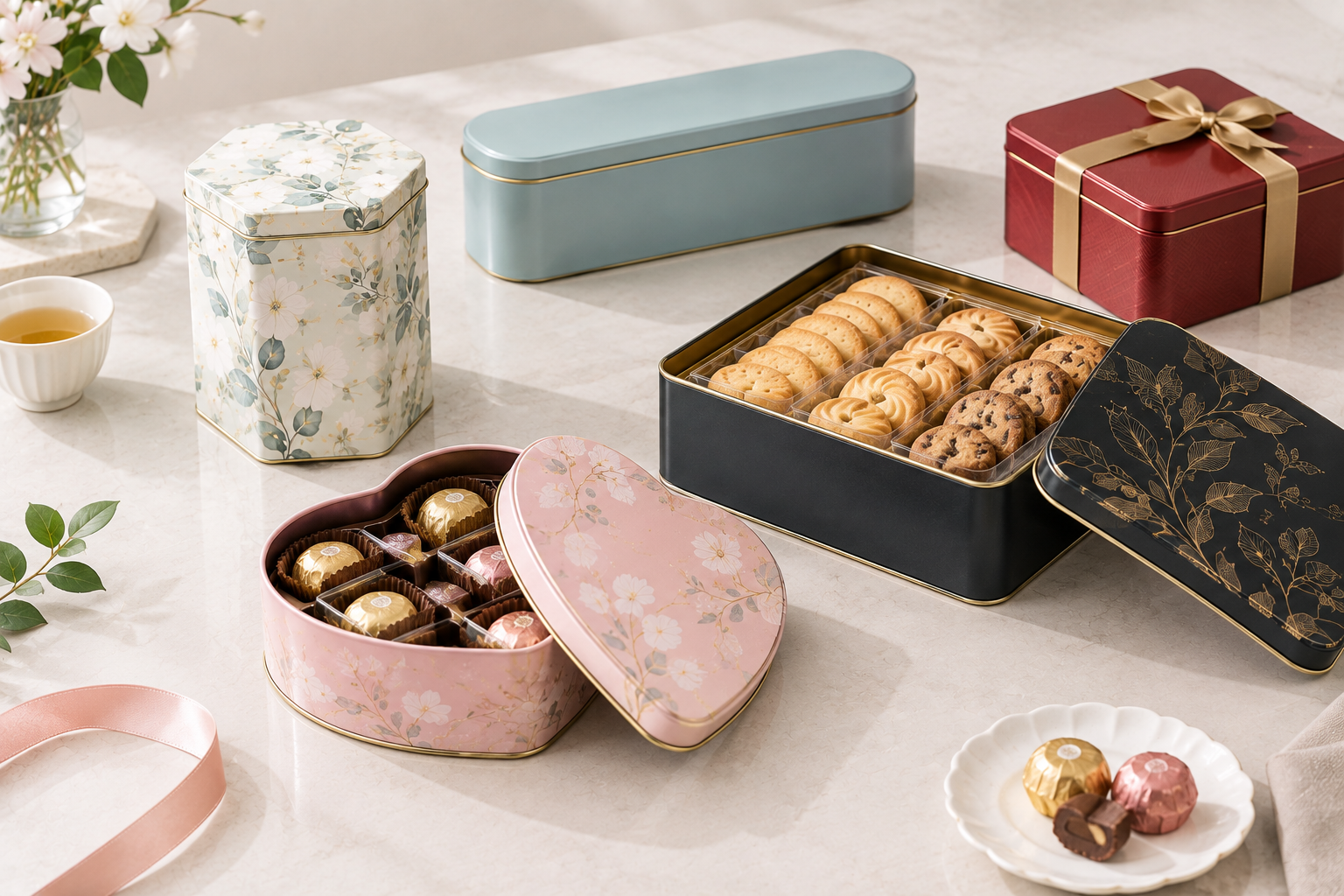
Last Updated: September 2026
Choosing the right gift tin box size is not simply about matching the product’s length and width. You also need to consider internal clearance, product arrangement, inserts, lid structure, and how the finished package should look when opened.
For custom projects, the safest approach is to start with the product and its actual placement inside the tin, then confirm the packaging dimensions through structural development and sampling.
If you are still comparing gift tin structures and customization options, see our guide to gift tin box packaging.
Start With the Product, Not the Tin
Before deciding on a tin size, measure the product or products that will actually go inside.
For a single product, record:
- Length
- Width
- Height
- Shape
- Fragile or movable parts
For gift sets, also consider how many individual products need to fit inside and whether they should sit side by side, in rows, or at different levels.
The important point is that the product dimensions are the starting point, not the final tin dimensions.
A tin that looks large enough from the outside may have less usable internal space because of the wall construction, lid structure, and insert.
Understand Internal and External Dimensions
When discussing a custom gift tin box, always clarify whether a measurement refers to the inside or outside of the tin.
This distinction matters because your product needs to fit into the usable internal space.
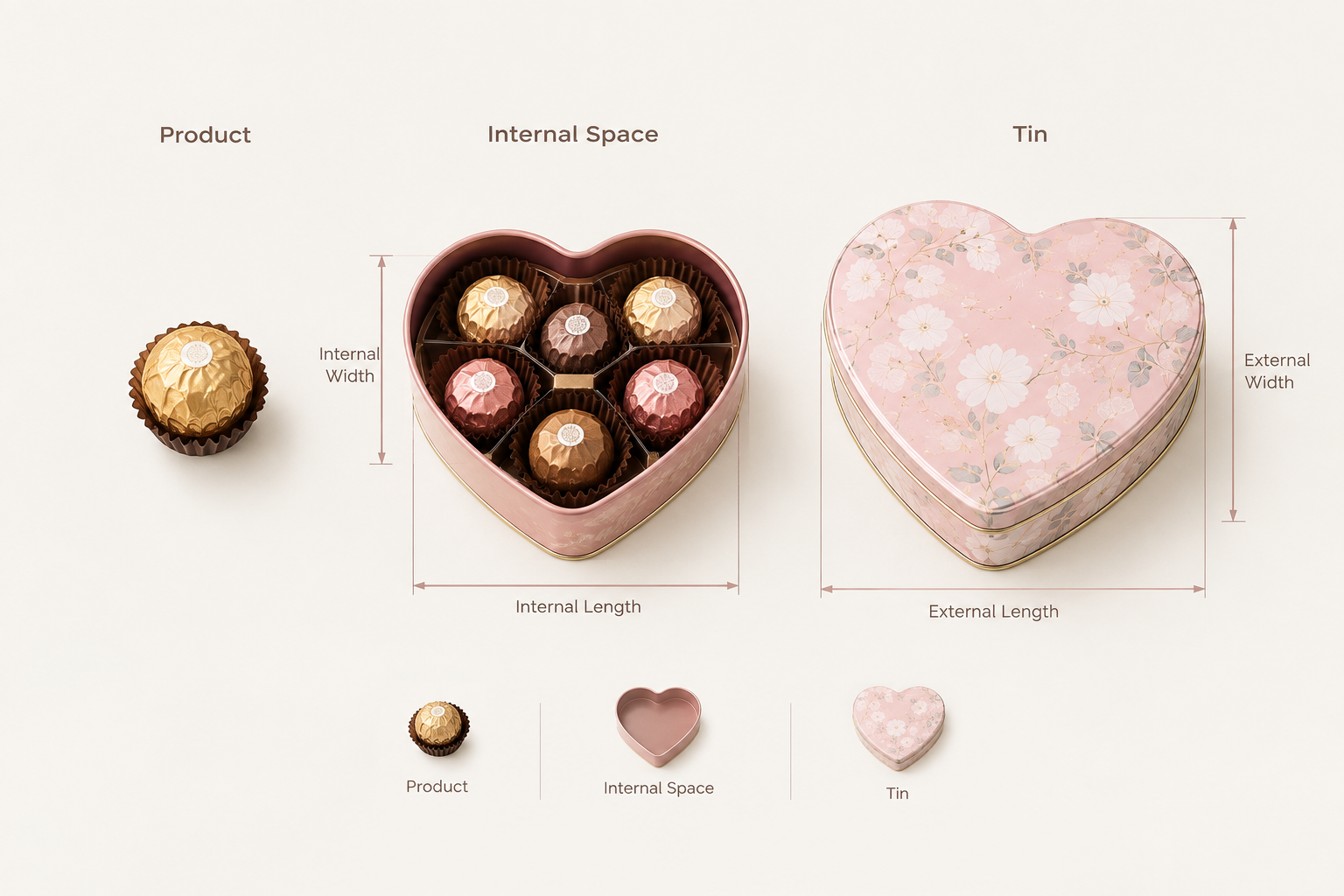
A simple development sequence is:
Product Size → Internal Space → Insert → Tin Structure → External Dimensions
For example, if a product is already packaged in an individual pouch or sleeve, the dimensions of that finished unit—not the bare product—should normally be used as the starting reference.
This avoids one of the most common development mistakes: designing the tin around the wrong measurement.
For custom development, the internal usable space is the dimension that matters most for product fit.
Leave Enough Clearance for Real-World Fit
A gift tin should not be designed so tightly that the product becomes difficult to insert or remove.
At the same time, excessive empty space can allow products to move during handling and may make the packaging look poorly fitted.
The right amount of clearance depends on:
- Product shape
- Product quantity
- Insert structure
- Opening method
- Product fragility
- How the package will be handled
This is why a drawing alone is not always enough. The final fit should be checked with a physical sample.
How Inserts Change the Required Tin Size
An insert can significantly change the amount of internal space available.
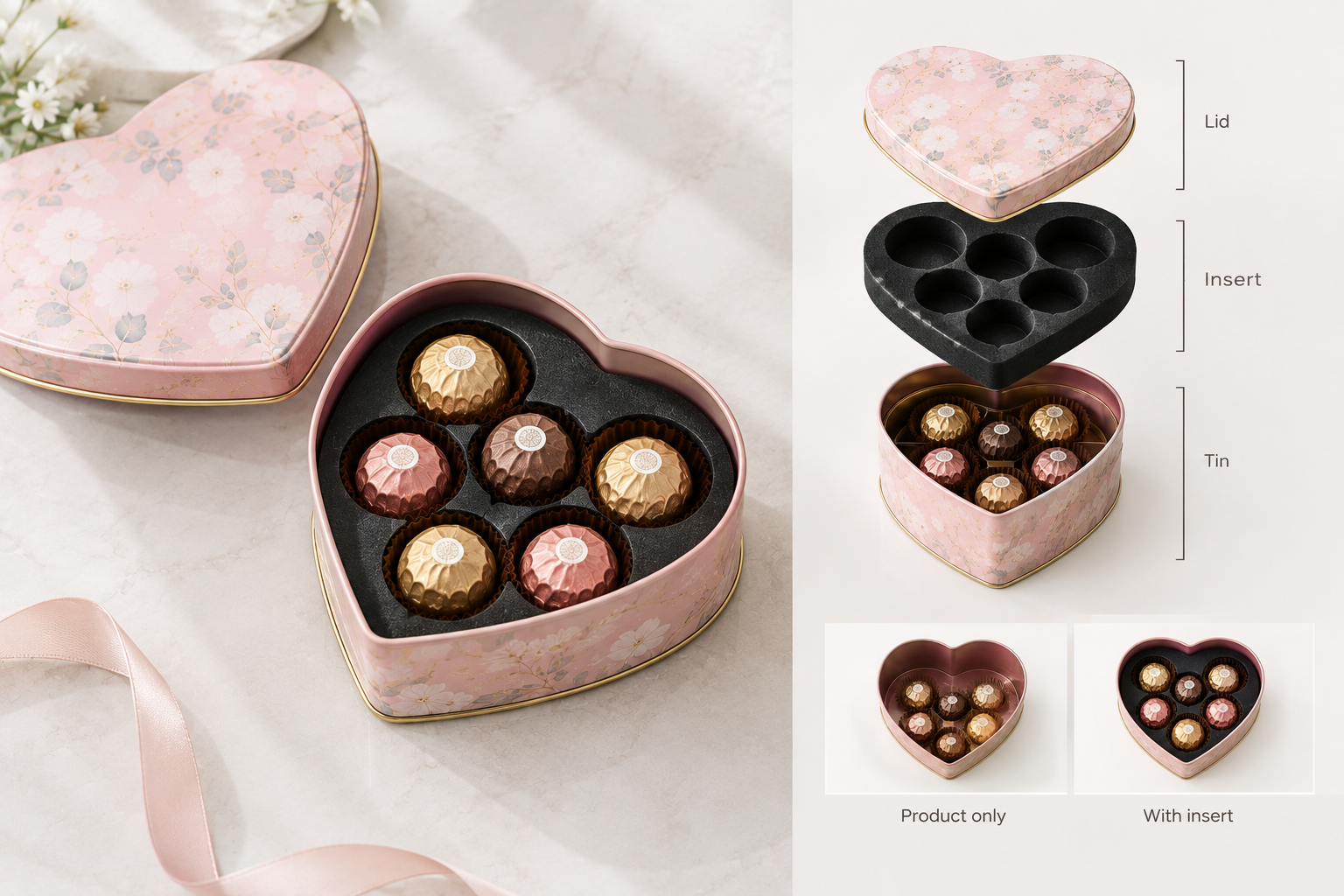
For example, a gift tin may use:
- EVA
- Foam
- PET
- Cardboard
- Paper
- Velvet
- Formed trays
The insert may hold the product in a fixed position, separate multiple items, or create a more structured presentation.
When an insert is required, the development should consider the product + insert as one packaging system rather than calculating the tin size from the product alone.
This is especially important for gift sets where several products need to appear evenly spaced when the lid is opened.
Consider the Lid and Opening Structure
The usable space of a gift tin is also affected by its lid structure.
A simple lift-off lid may allow a different opening experience from a hinged lid. A window lid, handle, or other structural feature may also affect the available space or the way the product is positioned.
For this reason, don’t finalize the tin dimensions before the basic opening structure has been confirmed.
For most custom projects, size and structure should be developed together.
Single Product vs. Gift Set Dimensions
The calculation approach changes depending on what you are packaging.
Single Product
The main considerations are:
Product dimensions + clearance + optional insert
The goal is usually a compact fit that still allows practical opening and removal.
Multiple Products
You need to consider:
Product arrangement + spacing + insert + clearance
For example, four small products may fit into one large empty space, but that does not necessarily mean the resulting packaging will provide the best presentation.
A properly designed insert can make the same tin feel much more organized.
Don’t Choose a Tin Size From External Dimensions Alone
This is particularly important when comparing existing tin samples.
Two tins with similar external dimensions may have different usable internal spaces because of differences in:
- Tin construction
- Wall profile
- Lid design
- Corners
- Internal accessories
- Insert thickness
If you are using an existing tin as a reference, provide the physical sample or accurate dimensions rather than assuming another tin with the same outside size will provide the same internal fit.
A Common Sizing Mistake
One common sizing mistake is comparing two tins by their outside dimensions and assuming they will provide the same usable space inside.
In practice, differences in wall construction, corners, lid structure, and internal accessories can change how much room is actually available for the product. Even tins with similar external dimensions may have different internal usable space.
This is why we recommend checking the actual internal fit rather than selecting a tin based only on its external measurements. If possible, use accurate internal dimensions or a physical sample to confirm the fit before finalizing the size.
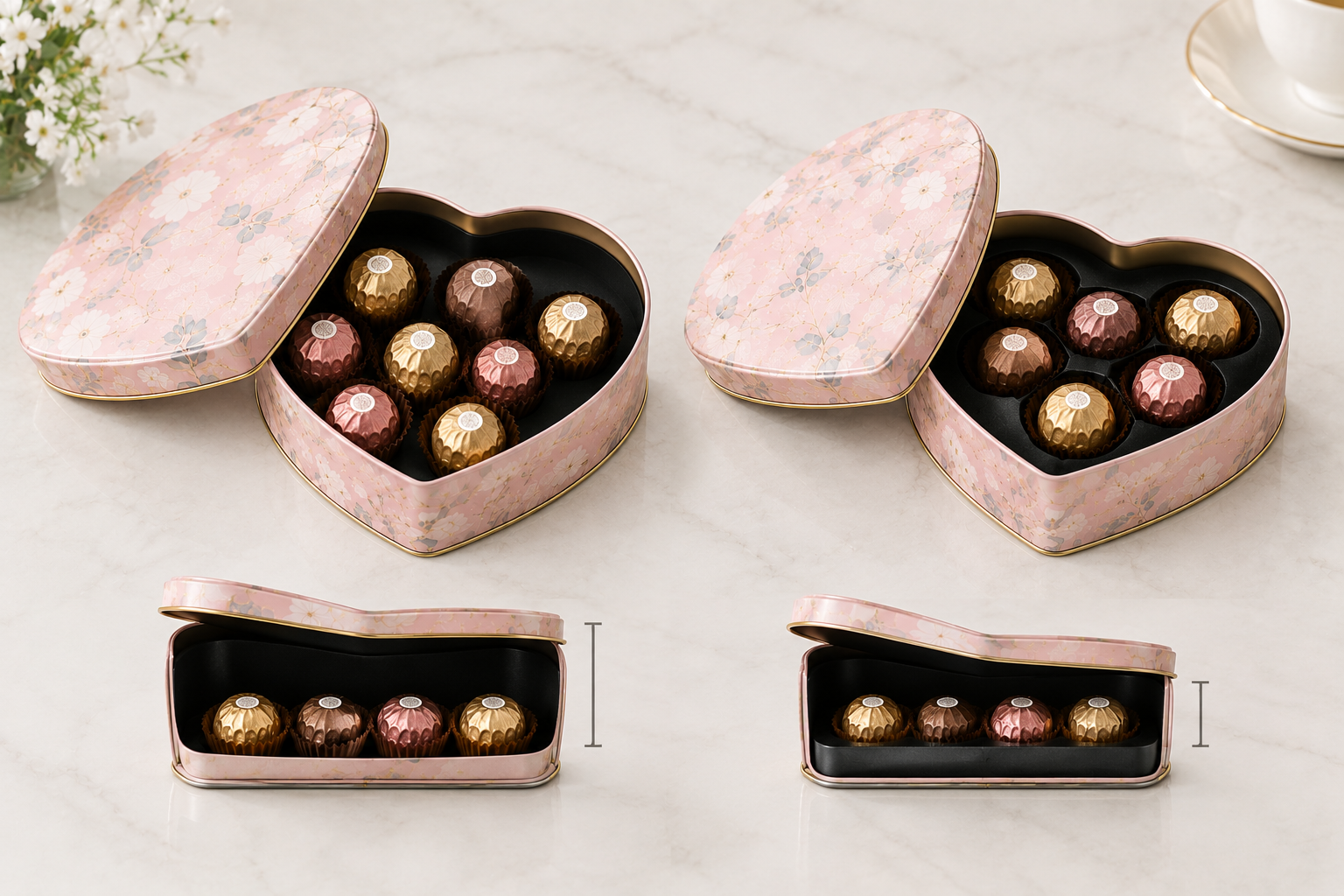
Use a Physical Sample to Confirm the Final Size
Once the initial dimensions have been developed, the physical sample should be used to check the actual packaging system.
Check the Product
Does it fit without excessive movement?
Check the Insert
Does the insert hold the product securely?
Check the Lid
Can the tin open and close smoothly?
Check the Presentation
Does the product sit at the intended height and position?
Check Removal
Can the customer take the product out without unnecessary difficulty?
This stage can reveal problems that are difficult to identify from a 2D drawing alone.
Our development process covers structure, sampling, production and pre-shipment quality control. You can also learn more about our tin packaging manufacturing capabilities.
What Information Should You Send for a Gift Tin Size Quote?
For a manufacturer to recommend or develop a suitable size, prepare:
| Information | What to provide |
|---|---|
| Product | Product photo or physical sample |
| Product dimensions | Length × width × height |
| Products per tin | Number of items inside each tin |
| Product arrangement | How the products should be positioned |
| Insert | Required or not |
| Opening | Preferred lid structure if known |
| Artwork | Existing artwork or design direction |
| Order quantity | Expected total order quantity |
| Target market | Destination country/region |
If the product is irregularly shaped, photos or a physical sample can be particularly useful.
Providing this information early gives the manufacturer a clearer basis for discussing the structure, size, insert, and quotation.
If your tin size is already defined and you are ready to work on artwork and printing, see our guide to custom printed tin packaging.
What Happens After the Size Is Confirmed?
For a custom gift tin project, the development normally moves through several stages:
Requirement → Structure → Prototype → Fit Check → Artwork → Production
The physical sample is important because it gives both the buyer and manufacturer a chance to confirm the actual fit before mass production.
If the size, insert, lid operation, and artwork are approved at this stage, the production specifications can be finalized.
Frequently Asked Questions
What is the best size for a gift tin box?
There is no single standard size that fits every gift product. The appropriate dimensions depend on the product size, quantity, arrangement, insert, and opening structure.
Should I measure the product or the existing packaging?
Measure the actual finished item that will be placed inside the tin. If the product already has a pouch, sleeve, or other packaging, include that packaging in the reference dimensions.
Can I use a standard stock tin for my gift set?
Yes, if an available stock size provides sufficient internal space and the structure suits the product. A custom size may be considered when the stock dimensions do not provide the required fit or presentation.
Do inserts affect the tin size?
Yes. Insert thickness and structure reduce usable internal space, so they should be considered during the initial size development rather than added later.
Can I confirm the size from a drawing?
A drawing is useful for development, but a physical sample provides a more reliable way to check actual product fit, insert positioning, lid operation, and presentation before mass production.
Conclusion
Choosing a gift tin box size starts with the product, but the final dimensions depend on the entire packaging system.
Product size, clearance, insert structure, lid design, product arrangement, and physical sampling all need to work together.
For custom gift tin projects, confirming these details before mass production can reduce avoidable changes later and give you a clearer specification for quotation and production.
Need help developing the right gift tin box size? Contact us with your product dimensions, quantity, and packaging requirements.