I’m part of the Liyipackaging Packaging Team, where we work with brands on tin packaging development, sampling and production.
Choosing a tin for dog treats is not simply a matter of finding a box that looks large enough. The outside dimensions can be misleading, especially when the treats have an unusual shape, need to be stacked, or require an inner tray. The lid structure can also affect the space available inside.
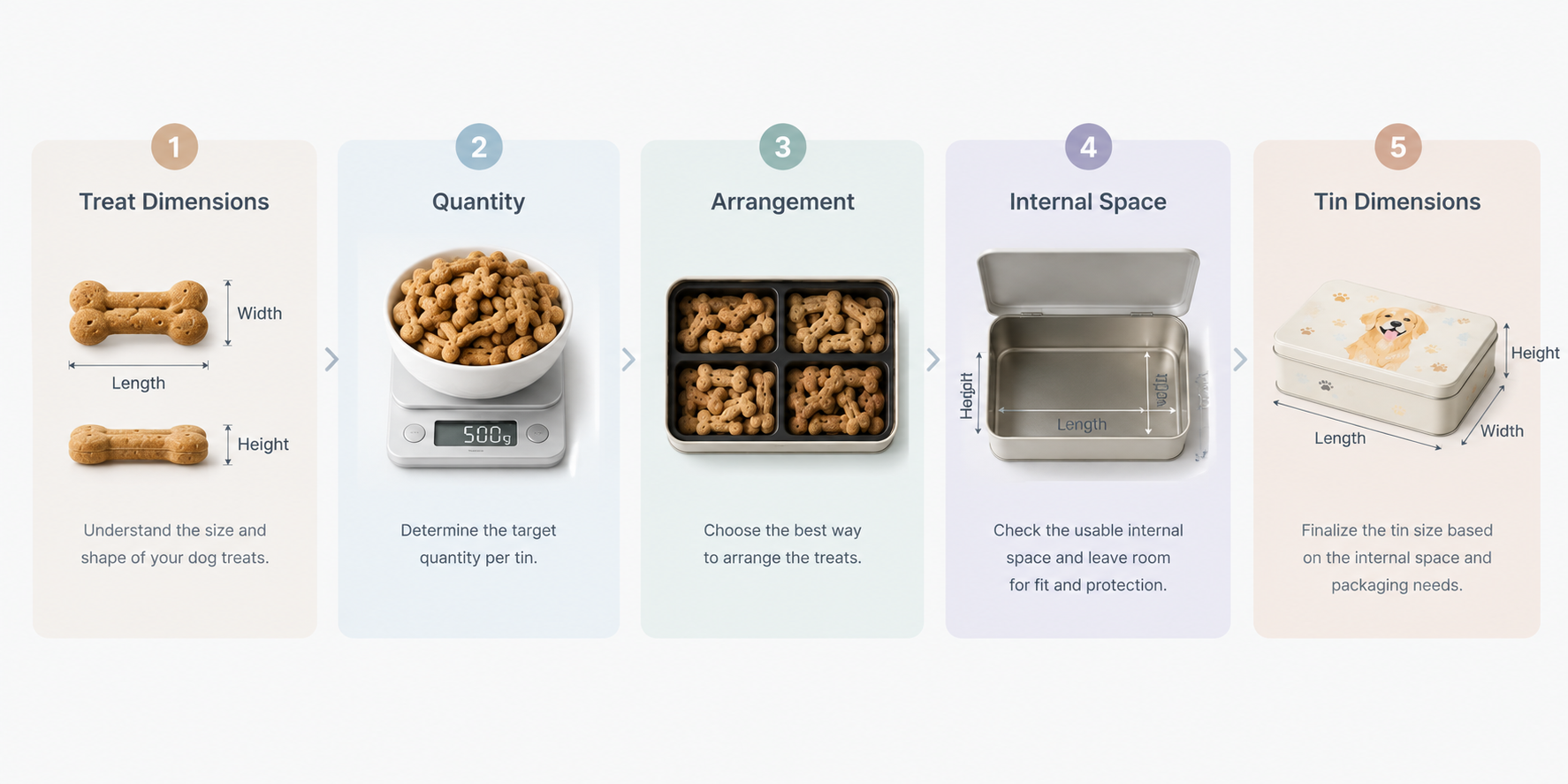
A better approach is to start with the treats and work outward: product size → quantity → internal arrangement → lid structure → sample fit.
This guide explains how to make those decisions before production. If you already know your treat dimensions and target quantity, you can use them to prepare a clear packaging brief and discuss the right structure with a supplier.
For a broader selection of tin packaging options, you can also explore Hot Sale Tin Packaging.
What Should You Consider When Choosing a Dog Treat Tin?
The product should determine the package. Before looking at the outside dimensions, confirm the size, quantity and arrangement of the treats you want to put inside.
Start With the Treat Dimensions
Measure the actual treats rather than estimating their size from the product name.
For a first packaging discussion, the useful information includes:
- Length
- Width
- Thickness or height
- Approximate quantity per package
- Whether the treats are individually wrapped
- Whether they will be stacked or arranged side by side
This gives a manufacturer enough information to discuss the internal dimensions without guessing.
Why Does the Quantity Matter?
The number of treats affects the required internal volume, but quantity alone does not determine the tin size.
Ten large treats can require more space than thirty small training treats. Similarly, irregularly shaped treats may leave more unused space than uniformly shaped pieces.
That is why product dimensions and quantity should always be considered together.
Check the Usable Internal Space
The internal space is not simply the same as the external dimensions.
Corners, wall construction, lid structure and internal accessories can all affect how much room is actually available for the treats.
From the sample-development stage, this is one of the practical points worth checking before finalizing the package: a tin may look sufficiently large from the outside but still require a different internal arrangement.
Which Lid Structure Works for Dog Treats?
The lid should reflect how the package will be used. If the treats will be accessed repeatedly, the opening method becomes part of the overall packaging experience.
When Does a Removable Lid Make Sense?
A removable lid is a straightforward option when the customer can easily remove it, take out the required treats and replace it afterward.
It can work particularly well when simplicity is more important than keeping the lid attached to the base.
The key consideration is what happens during everyday use. If the owner needs to open the tin several times a day, the lid should be easy to handle and replace.
When Is a Hinged Lid Worth Considering?
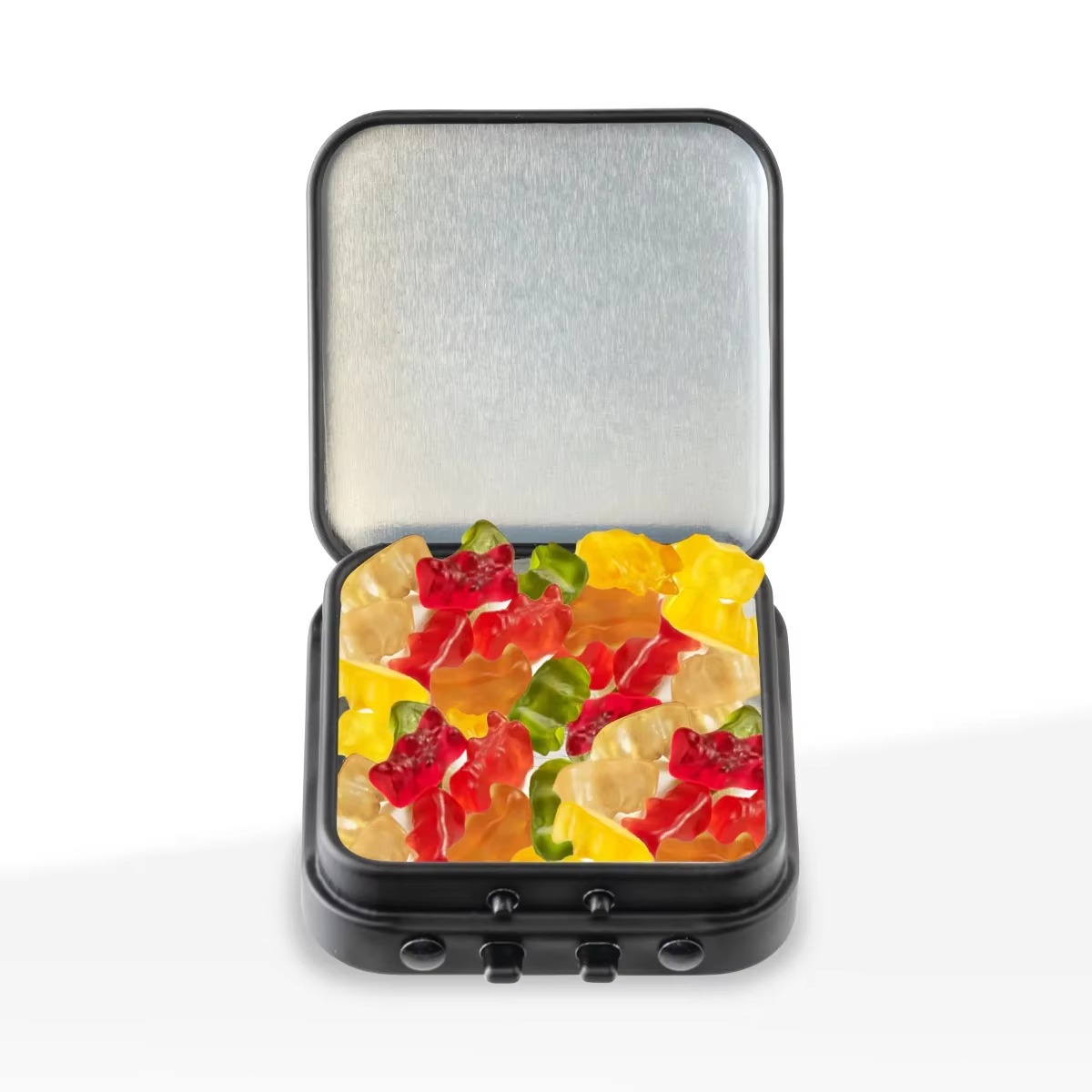
A hinged lid keeps the lid connected to the base, which can make repeated access more convenient.
Consider a training-treat package that is opened several times during a walk or training session. The user takes out a few treats and closes the package again. In that situation, an attached lid can make the handling process simpler.
This does not mean a hinged structure is always preferable. The decision should follow the intended use of the product.
Do You Need an Insert?
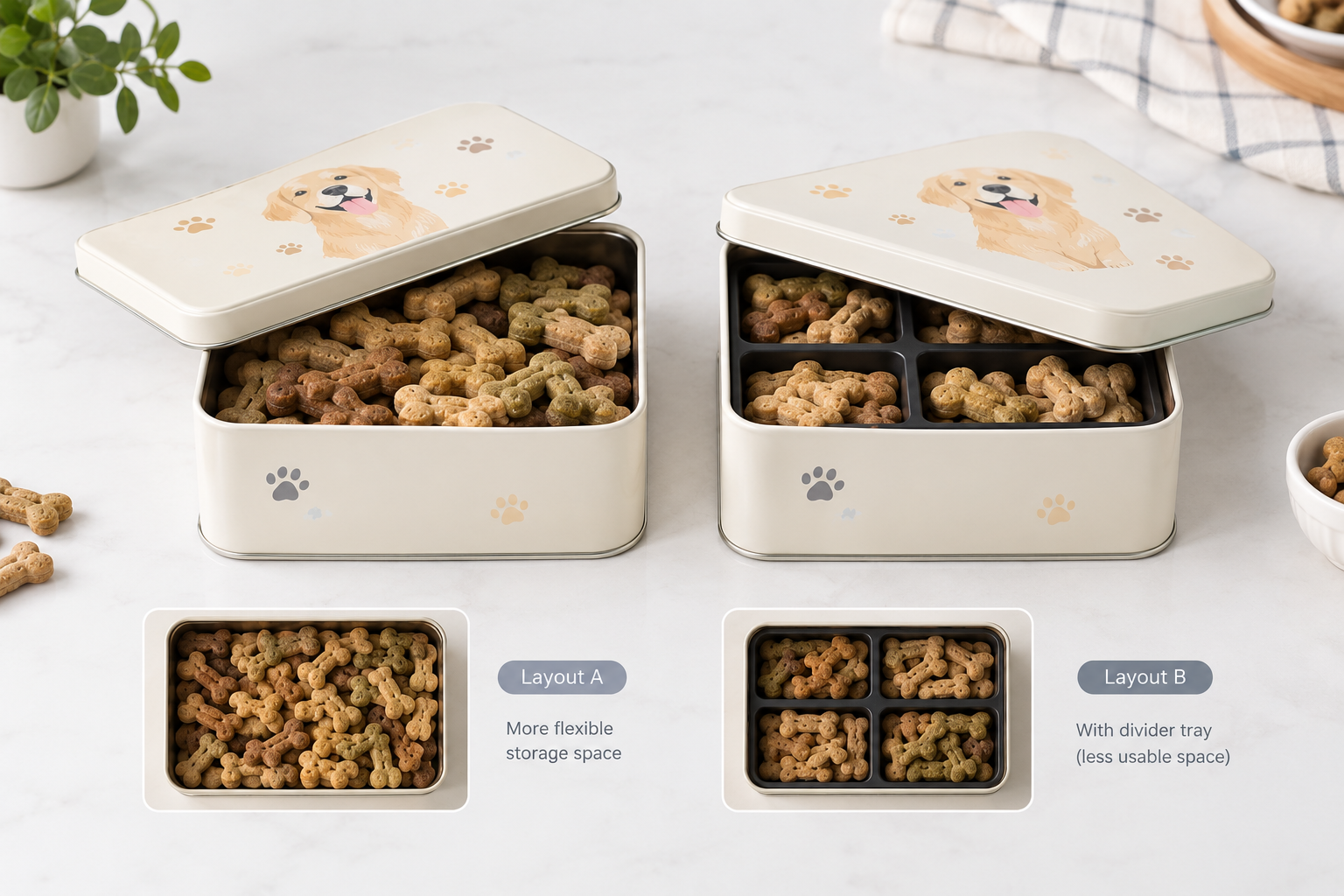
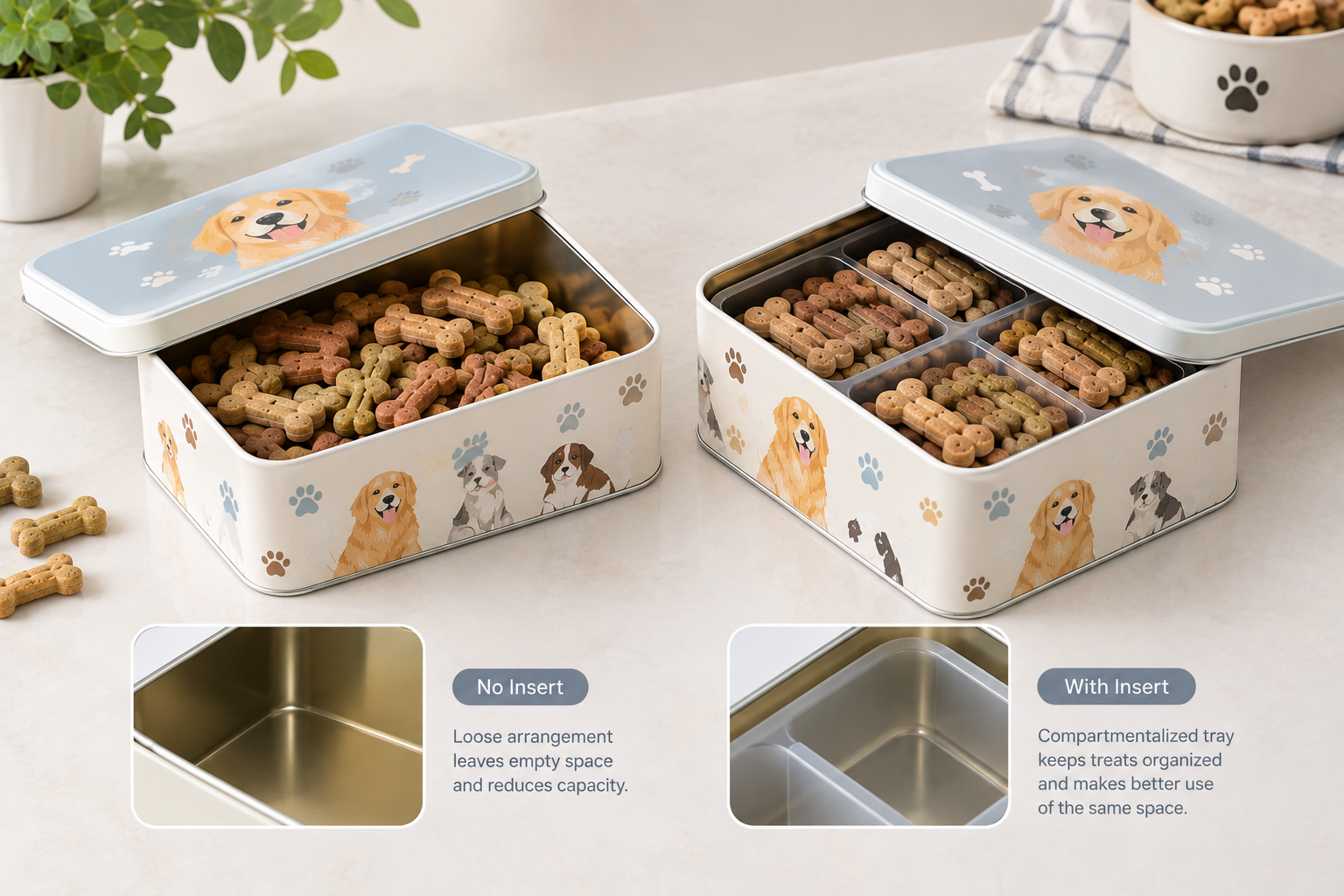
An insert is useful when the treats need to stay in a specific position or when different products need to be separated.
For example, a brand selling two types of treats in one package may use an internal divider to keep them separate.
However, an insert also takes up space. It should therefore be considered during the initial structure discussion rather than added after the tin dimensions have already been approved.
How Should You Plan the Tin Size?
The goal is not to choose the largest available tin. It is to create enough usable space for the product while keeping the package practical to handle.
Measure the Product Before Finalizing the Tin
If you do not know the final tin dimensions, that is fine.
Start with:
Product dimensions + target quantity + product arrangement
For example, a pet treat brand may know that its treats need to be packed in a single package and that customers will remove only a few pieces at a time. The manufacturer can then evaluate the internal arrangement and suggest a suitable structure.
The example is intentionally general because there is no universal conversion between treat weight or quantity and tin dimensions.
Think About How the Treats Will Be Arranged
The same number of treats can require different internal dimensions depending on their shape.
Thin treats may be stacked. Larger pieces may need to sit side by side. Irregular pieces may need additional clearance to avoid making the package difficult to fill or use.
This is why a physical sample is more useful than relying only on a volume calculation.
Consider the Complete Packaging System
If the treats will first be placed in an inner bag, tray or other component, measure that complete unit.
Do not finalize the tin around the bare treats and then discover that the secondary packaging no longer fits.
How Can You Customize the Tin Without Overcomplicating It?
The physical structure should come first. Once the dimensions and opening method are confirmed, artwork and finishing can be developed around the approved structure.
Custom Size Should Solve a Real Packaging Problem
A custom size can be useful when a standard tin leaves too much unused space or cannot accommodate the product properly.
For example, if the treats are relatively thick, increasing the internal height may be more useful than making the entire package substantially longer or wider.
The objective is not simply “make it custom.” The objective is to make the package fit the product more efficiently.
Keep Printing Separate From the Size Decision
Printing is important for brand presentation, but it should not drive the physical dimensions.
Once the structure is approved, artwork can be prepared for the actual printable areas.
For detailed information about artwork preparation, printing options and MOQ, refer to the dedicated Custom Printed Tin Packaging Guide.
Keeping these topics separate also makes the content easier to use: this article answers how to choose the package, while the printing guide answers how to print and customize it.
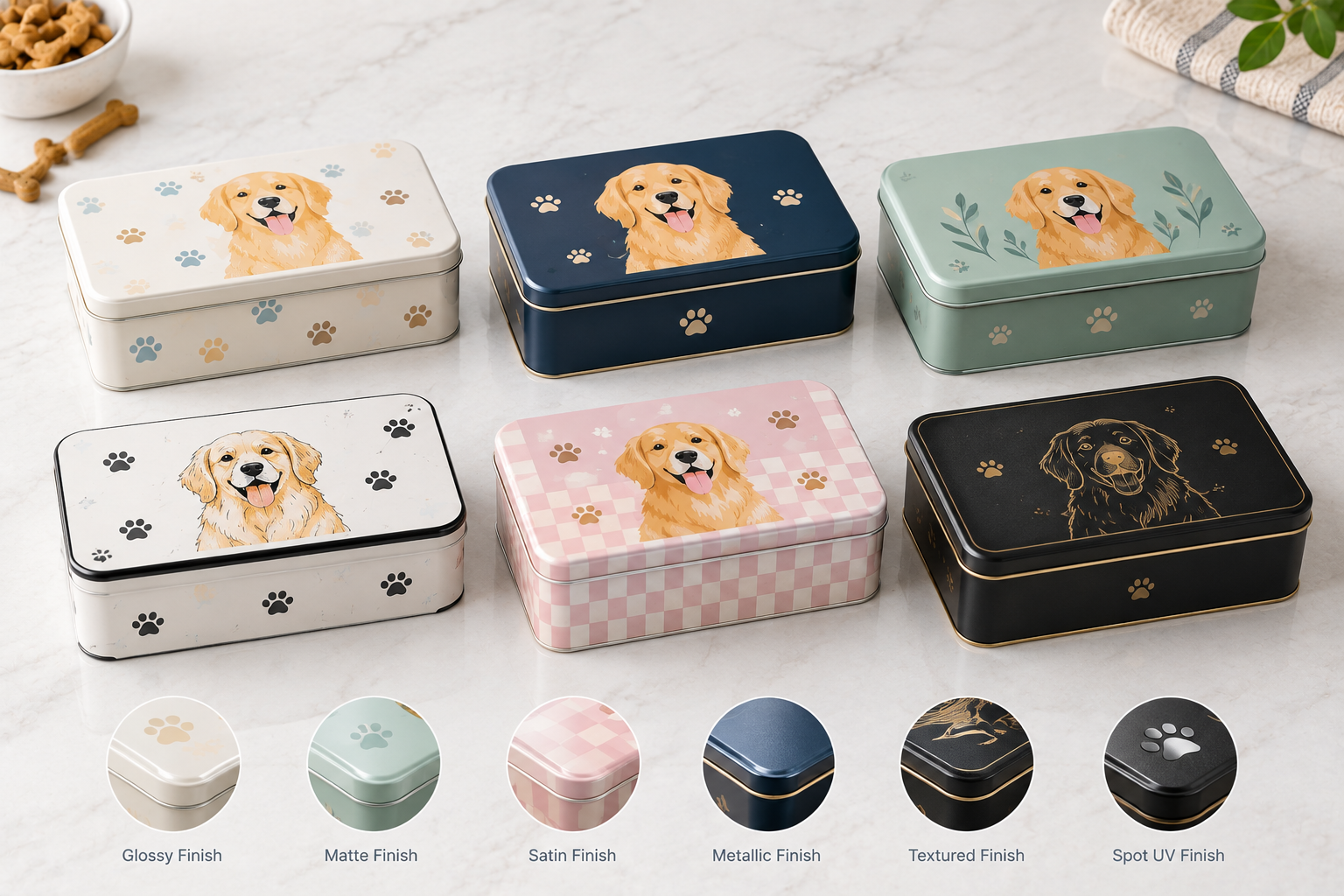
Choose Finishing Based on the Packaging Concept
Depending on the project, the surface can use different finishing effects.
The important point is to choose a finish that supports the brand’s packaging concept instead of adding unnecessary production complexity.
How Should You Check the Tin Before Production?
The sample stage is where the proposed dimensions and structure need to be tested against the actual product.
Check the Product Fit
Place the real treats into the sample and check:
- Required quantity
- Internal arrangement
- Available clearance
- Ease of removal
- Lid operation
Do not rely entirely on a drawing or nominal dimensions.
Check the Opening Experience
Open and close the sample as a customer would.
If the product is intended for repeated daily use, test whether the lid is easy to handle and whether the treats can be accessed without unnecessary movement.
Check the Finished Appearance
Once the physical structure works, review the artwork and finish on the actual sample.
Look at:
- Artwork position
- Edges and corners
- Surface appearance
- Lid alignment
- Overall proportions
This sequence prevents a common problem: spending time refining the artwork before discovering that the physical package needs to change.
What Should You Prepare Before Requesting a Quote?
You do not need to have every specification finalized before contacting a manufacturer. A clear product brief is enough to start the discussion.
Product Information
Prepare:
- Product dimensions
- Approximate quantity
- Product photos
- Product arrangement
- Inner packaging, if any
If the treats have an unusual shape, photographs are particularly useful because they show details that measurements alone may not communicate.
Packaging Information
Add whatever you already know:
- Preferred lid structure
- Approximate order quantity
- Artwork status
- Desired finish
- Target delivery date
If you are unsure about the lid or dimensions, say so. It is better to leave a requirement open for discussion than to choose a structure that does not suit the product.
How Do You Start a Custom Dog Treat Tin Project?
Once the product information is ready, the next step is to turn those requirements into a physical sample.
Start With the Product, Not a Random Tin Size
Send the treat dimensions, quantity and product photos first.
The manufacturer can then review the likely internal arrangement and discuss the appropriate structure.
This is usually more efficient than selecting a tin from a catalogue first and trying to make the product fit afterward.
Confirm the Sample Before Bulk Production
The development sequence can remain simple:
Product → Structure → Sample → Fit Check → Artwork → Production
Each step answers a different question:
- Product: What needs to fit?
- Structure: How should the package work?
- Sample: Does the proposed design work physically?
- Fit Check: Does the actual product fit as expected?
- Artwork: Does the finished package look right?
- Production: Can the approved specification be reproduced consistently?
For projects that require custom development, Liyipackaging can coordinate the structure, sampling, printing and production process in one workflow. The company states that its manufacturing process covers design and development through production and pre-shipment quality control. Its published company information also lists more than 25 years of industry experience and a 3,000㎡ production facility. (Liyipackaging About Us)
As of September 2026, Liyipackaging’s published FAQ gives customized projects a general MOQ reference of around 3,000–10,000 pieces, with the actual requirement depending on the product, structure and printing specifications. Customized samples are generally listed at around 5–15 days, while production schedules vary by project. These figures should be confirmed when the specific tin structure and order quantity are finalized. (Liyipackaging FAQ)
If you already have the treat dimensions and estimated quantity, you can share your treat dimensions with our packaging team to start the discussion.
FAQ
What size tin is suitable for dog treats?
There is no universal size. The required dimensions depend on the treat dimensions, quantity, arrangement, internal clearance and any inner packaging.
How do I calculate the capacity of a dog treat tin?
Start with the actual dimensions and quantity of the treats rather than relying only on weight. The final usable capacity also depends on how the treats are arranged inside the tin.
Should I choose a removable or hinged lid?
Choose according to how the package will be used. A removable lid can suit straightforward storage, while a hinged lid can be useful when the package will be opened repeatedly.
Do dog treat tins need an insert?
No. An insert is only necessary when the treats need separation, positioning or additional presentation. Remember that an insert also reduces the available internal space.
Can the tin size be customized?
Yes. A custom size can be developed when standard dimensions do not provide a suitable fit or efficient use of space.
Should I make a sample before bulk production?
Yes. A physical sample allows you to check product fit, internal arrangement, lid operation and overall appearance before committing to mass production.