By Liyipackaging Packaging Team | Published and updated: October 20, 2026
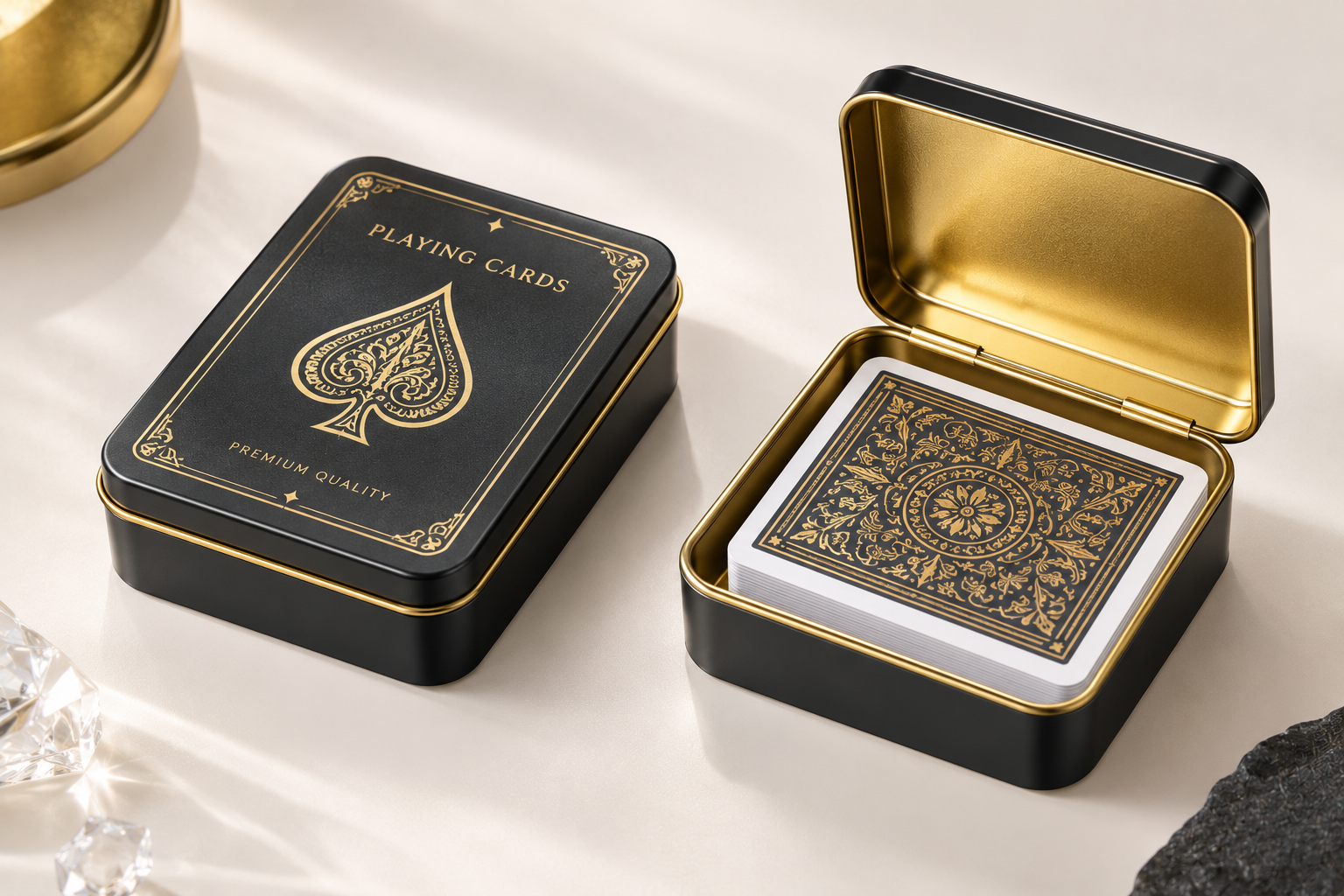
A custom playing card tin has to do three things well: hold the complete deck without squeezing it, open smoothly every time, and carry your artwork cleanly. Most problems come from the first point. The tin is ordered by outside size or by “standard deck” assumptions, and the real deck turns out to be a few millimeters too thick or too wide.
This guide shows how to measure the deck, turn those measurements into an internal size, choose a lid, and check the sample before you approve production.
Quick takeaway
- Measure the finished deck as customers will receive it: cards, jokers, sleeve or wrap included.
- Plan the internal size from the measured deck plus a small clearance, then confirm with a physical sample.
- Choose the lid by use: hinged for frequent play and travel, lift-off for a gift-style presentation, sliding for a compact look.
- Send the quote request with card dimensions, deck thickness, quantity, lid preference and artwork. Cost, MOQ and lead time are covered in our custom tin box cost, MOQ and lead time guide.
Which Card Sizes Do Playing Card Tins Need to Fit?
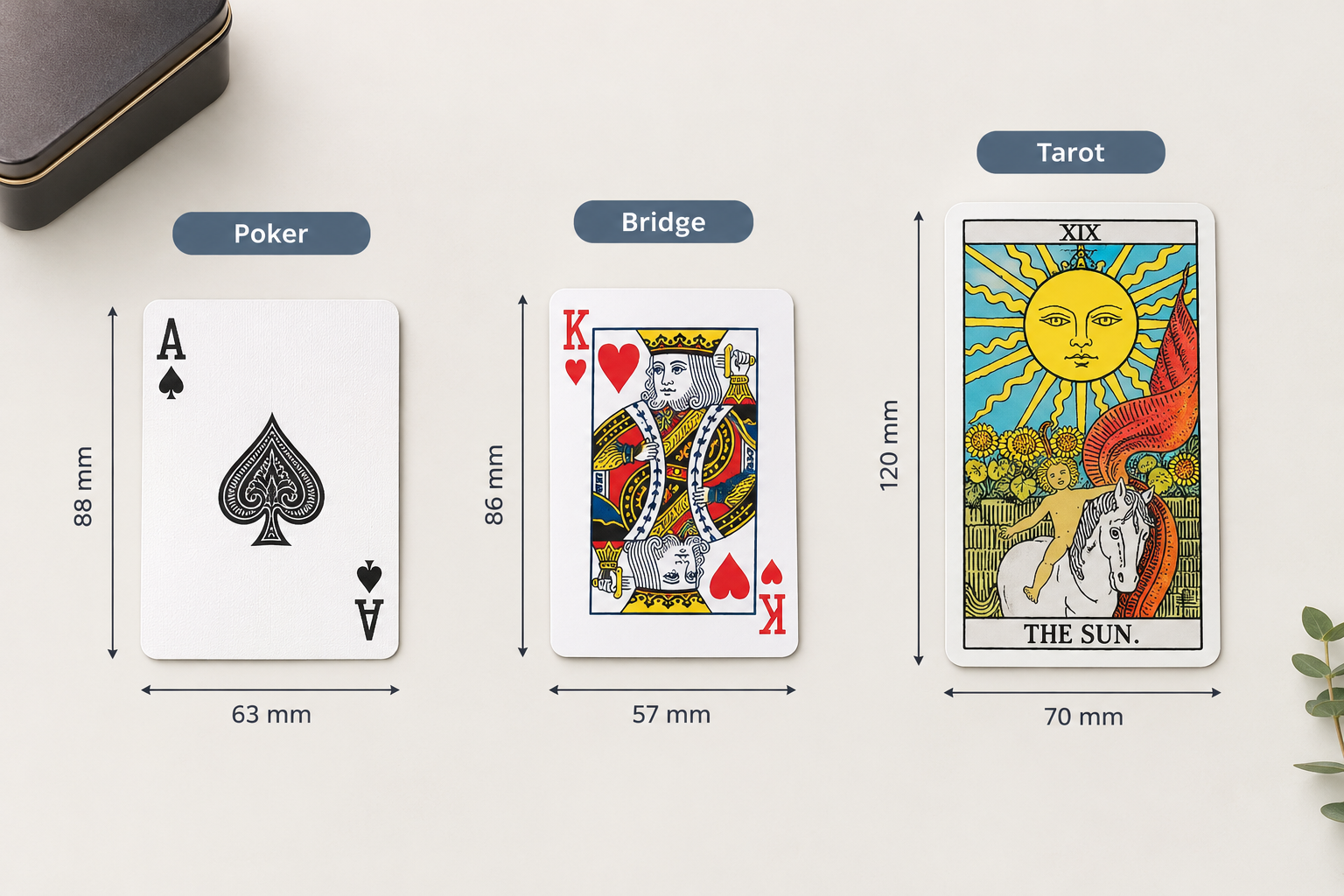
Start from the card format, not from a stock tin size. Card formats differ in both length and width, so a tin made for one format will not suit another.
| Card format | Typical card size | What to remember |
|---|---|---|
| Poker size | about 63.5 × 88.9 mm (2.5 × 3.5 in) | The most common format for standard decks |
| Bridge size | about 57 × 89 mm (2.25 × 3.5 in) | Narrower than poker, so a poker tin leaves the deck loose |
| Tarot size | commonly about 70 × 120 mm, varies by publisher | Larger and thicker; often needs a deeper tin |
| Custom or oversized decks | varies | Measure the actual cards before specifying anything |
These figures are typical reference sizes. Printed decks vary slightly between publishers, so always measure the deck you will actually ship.
How Do You Measure a Deck for a Tin?
Measure the packed deck, not the loose cards. Record three numbers: length, width, and total thickness.
- Length and width. Measure the longest and widest card in the deck. If the deck includes a special card, such as a larger instruction card, measure that as well.
- Thickness. Stack the full deck, including jokers, extra cards and any sleeve or wrap, and measure the height without pressing down. Card stock, coating and card count all change this number, so a 54-card deck can differ noticeably from one brand to another.
- Extras. If the tin will also hold dice, chips, a rules card or a second deck, measure them together in the layout customers will see.
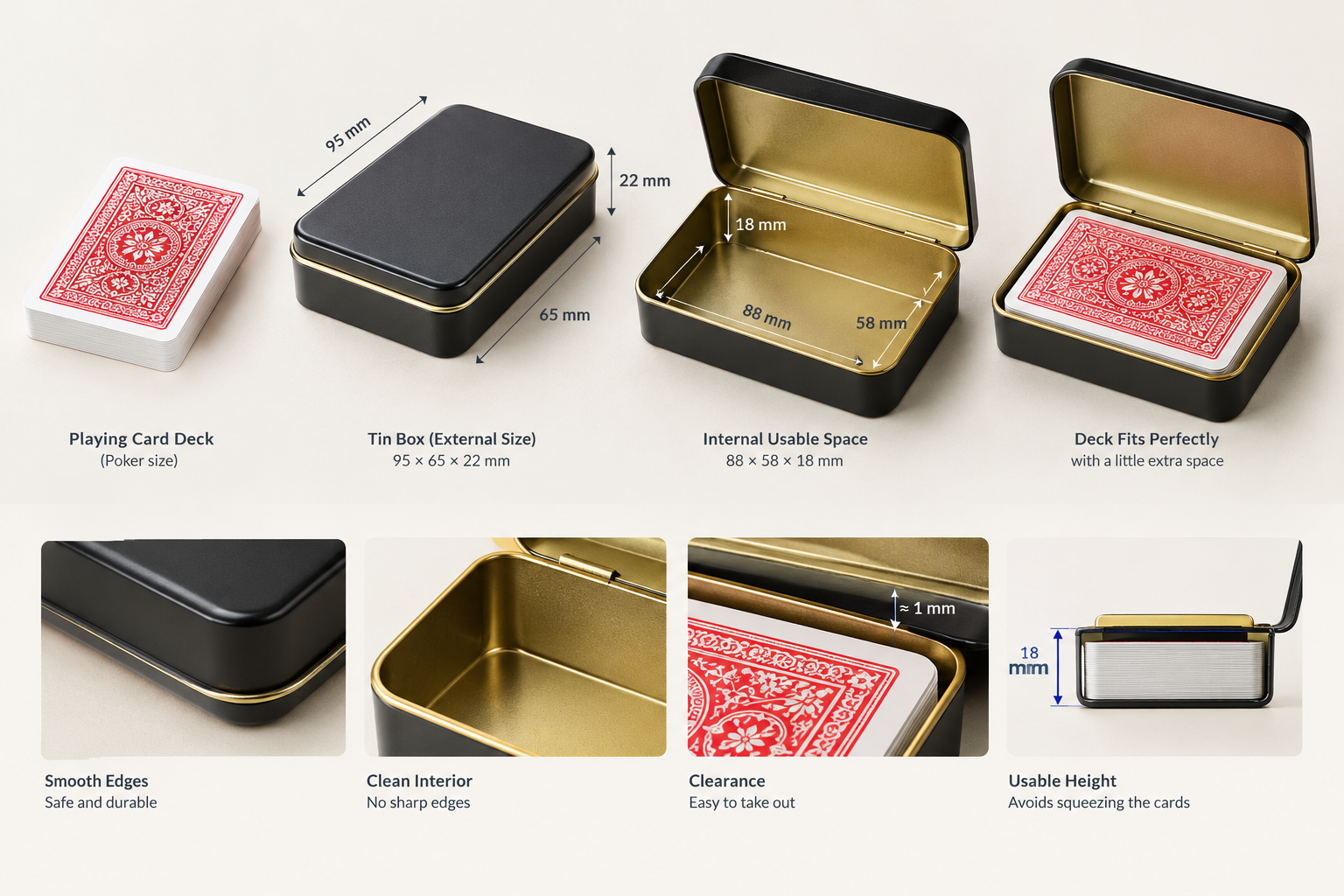
Planning example. Suppose a 54-card poker-size deck measures 64 × 89 mm and about 18 mm thick. A sensible starting point is an internal size of roughly 66 to 67 mm wide, 91 to 92 mm long and 20 to 21 mm high. That leaves about 1 to 1.5 mm of room on each side and a few millimeters of height for the lid. This is a planning range only. Confirm the final internal size with a sample, because wall construction, folded edges and the lid profile all reduce usable space.
Avoid excess clearance. A deck that slides around can scuff its edges in transit and feels cheap when the tin is opened. For a deeper look at how internal and external dimensions differ, see our gift tin box size guide.
Which Lid Works Best for a Playing Card Tin?
Match the lid to how the deck will be used. Liyipackaging’s tin styles include hinged lid, sliding lid and clip lid tins, among others, so the structure can follow the product rather than the other way round.
| Lid type | How it opens | Best suited to |
|---|---|---|
| Hinged lid | Lid stays attached to the base | Decks used often, travel decks, retail packs where a lost lid would be a problem |
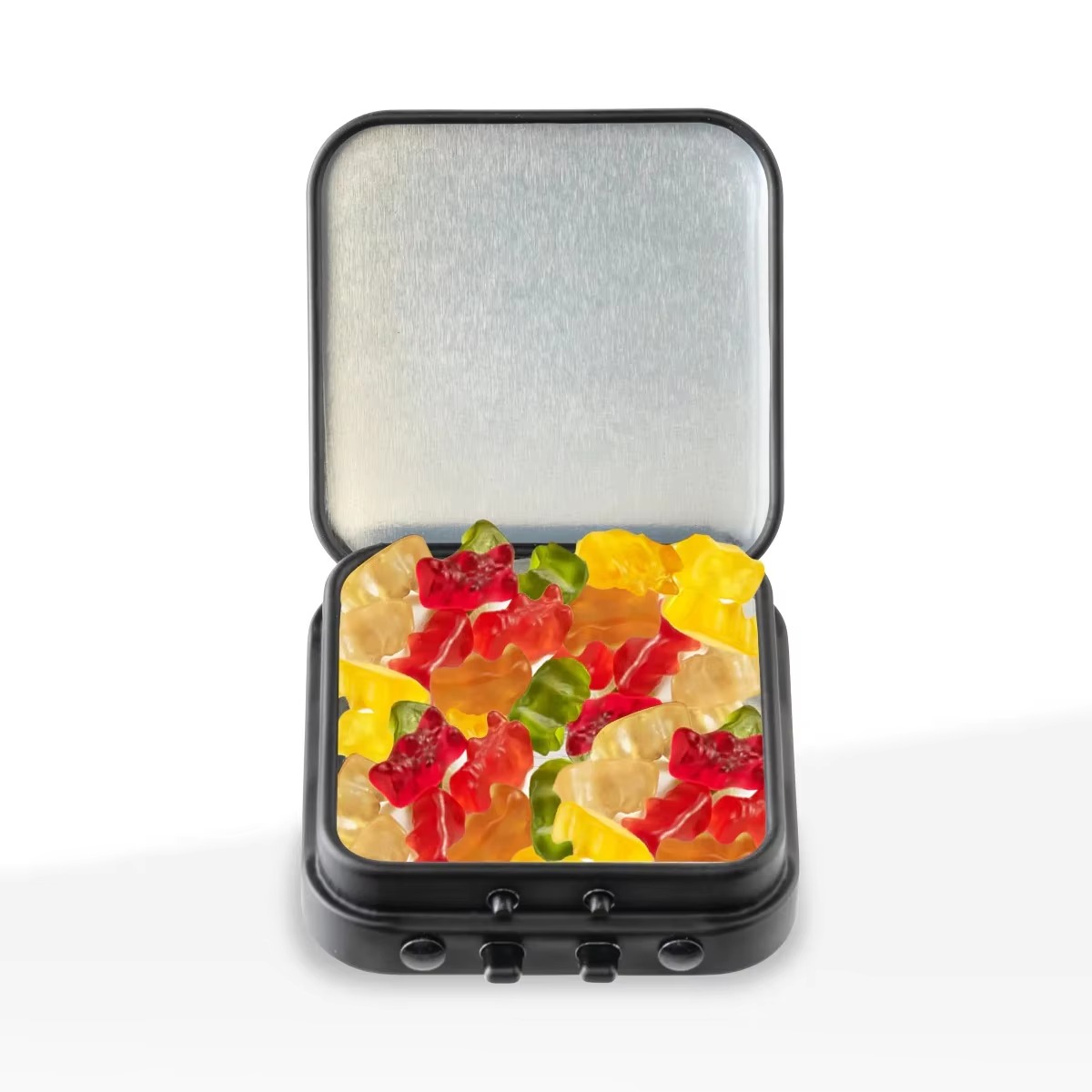
| Lift-off (slip) lid | Lid separates completely from the base | Gift decks, collector editions, premium presentation |
| Sliding lid | Lid slides off along the base | Compact decks and designs with a clean, minimal look |
For a deck that is shuffled and dealt regularly, the lid should open with one hand and close without catching the cards. For a collector or gift deck, the unboxing moment matters more, and a lift-off lid often gives the cleaner reveal.
Check the lid against the real deck. Corners should not catch on the lid edge, and the lid should close without pressing on the top card. For a deeper comparison of lift-off, slip, hinged, sliding and clip structures, see our rectangular tin lid types guide, and for general structure choices see rectangular tins with lids.
When Does a Playing Card Tin Need an Insert?
Most single decks do not need one. A correctly sized tin holds a single deck securely on its own. An insert becomes useful when the tin carries more than the deck:
- Two or more decks side by side
- A deck plus dice, chips or a small accessory
- A tuck box or sleeve that should sit in a fixed position
- A collector edition where the presentation matters
Liyipackaging can supply accessories such as sponge, foam, EVA, flocking trays, transparent PET, cardboard, paper and velvet to match the tin. An insert takes up internal space, so its thickness and layout must be included when you work out the internal size and when you test the sample.
If you are building a series or a limited edition around the deck, the planning points in our collectible tin design, insert and series guide apply to card tins as well.
How Should You Plan Artwork and Finish for a Card Tin?
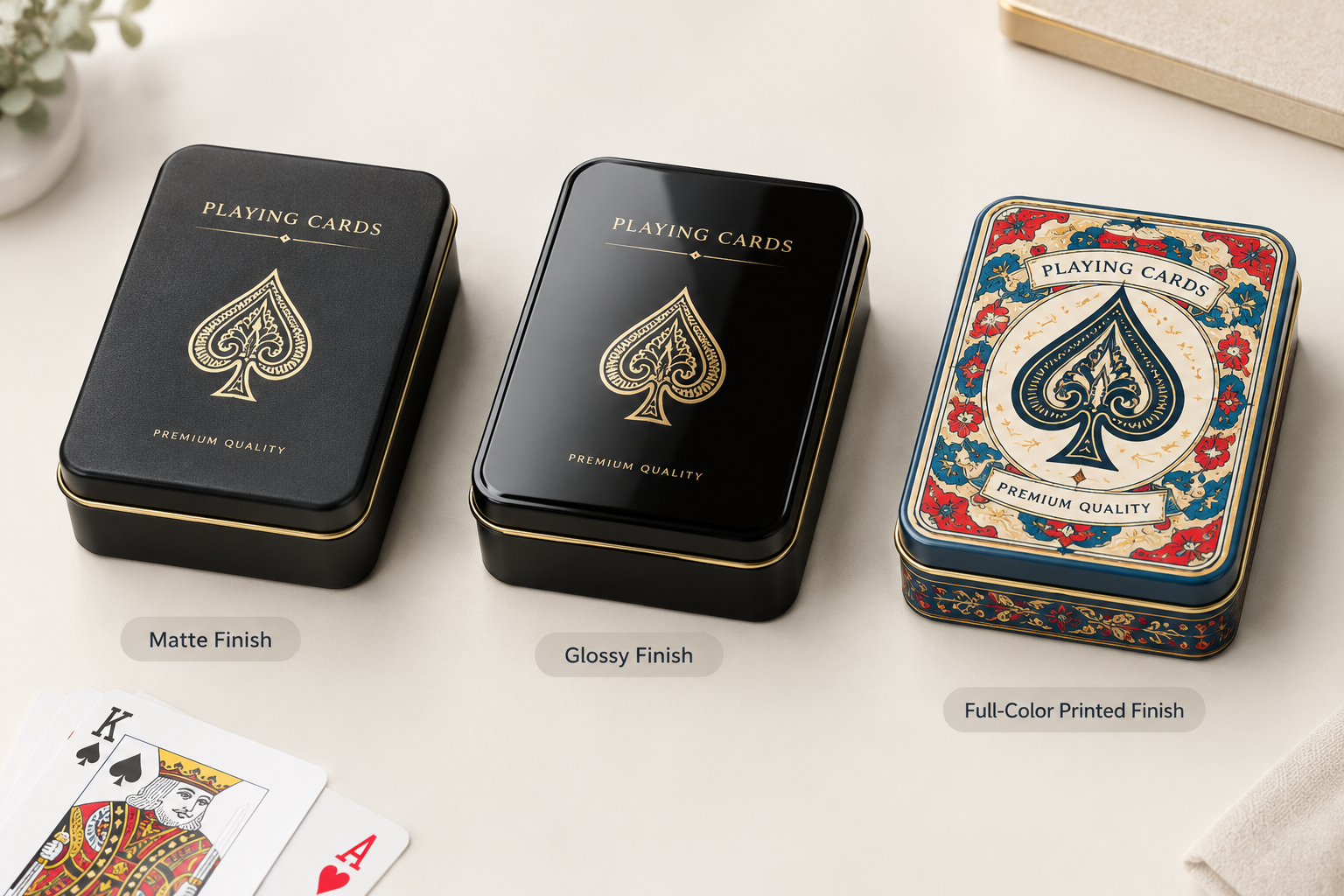
Design for the actual surface, then confirm on a sample. The lid is the main canvas, and the shape of a card tin is shallow and rectangular, so artwork is easy to position but easy to crowd.
- Keep logos and important text away from folded edges, hinge areas and seams.
- Decide whether the lid, base or both carry the design. A printed base is a good place for a rules summary, a series number or a short brand message.
- Choose the finish by brand positioning. A matte surface suits minimalist and tarot-style designs, while glossy or metallic effects suit collector and gift editions. Liyipackaging lists glossy, matt, varnish, embossing and engraving among its finishing options, and CMYK printing with Pantone matching for outer artwork.
Liyipackaging’s website states that it provides mockups and die-cut templates in formats including AI, EPS, CAD, PDF and CorelDRAW, so artwork can be placed on the real tin outline before printing. For file preparation, color control, white ink and artwork approval, read our guide to custom printed tin packaging.
How Do You Check a Sample Before Mass Production?
Test the sample with the real, fully packed deck. A digital mockup shows the layout, but only a physical sample shows fit, lid action and surface quality.
- Fit. Place the complete deck, with any sleeve, extra cards and accessories, inside the tin.
- Removal. Take the deck out and put it back several times. Corners should not bend or catch.
- Lid. Open and close the lid repeatedly. Check hinge movement, lid alignment and the force needed to open it. It should hold in a bag without being hard to open.
- Edges. Run a finger along the inside edges and the lid rim to check for rough spots that could mark the cards.
- Print. Check color, logo placement and finish against the approved artwork.
Settle any changes at this stage. Revisions after mass production begins are far more costly than revisions on a sample.
What Should You Send to Get a Playing Card Tin Quote?
A complete inquiry saves a round of back and forth. Prepare these details before you contact the factory:
- Card format, card dimensions and total deck thickness
- Number of cards and any extras (sleeve, jokers, dice, chips, second deck)
- Preferred lid type: hinged, lift-off or sliding
- Artwork, or a logo, reference images and brand colors if the design is not final
- Estimated order quantity
- Insert or individual packaging requirements
- Destination country and required delivery date
On timing, Liyipackaging’s FAQ states that customized samples take about 5 to 15 days and custom printed tin boxes about 25 to 30 days, depending on order quantity and production schedule. Developing a new mold and sample normally takes about 20 to 25 days. Stock tins ship faster. The same FAQ gives a general customized-product MOQ of 3,000 to 10,000 pieces, depending on structure and printing complexity. The cost, MOQ and lead time guide explains tooling, sampling and how to compare quotations, and more answers are on the FAQ page.
If the deck is a seasonal release or a Q4 gift product, give the target delivery date when you request the quote so the schedule can be checked against sampling and production time. Our Christmas tins guide shows how to plan backward from a holiday deadline.
Related Guides and Products
- Gift tin box: custom metal gift packaging for brands
- Custom-printed rectangular tin cans for pencil and card storage
- Hot sale tin packaging
- Rectangular tin box and can range
FAQ
What size tin fits a standard poker deck?
A poker-size card is about 63.5 × 88.9 mm, and a 54-card deck is often in the range of 15 to 20 mm thick depending on stock. The tin’s internal size should be slightly larger than the measured deck on every side. Measure your own deck and confirm the fit with a sample.
Is a hinged or lift-off lid better for playing cards?
A hinged lid suits decks that are used often or carried, because the lid cannot be lost. A lift-off lid gives a cleaner presentation for gift and collector decks. Test both against your actual deck before choosing.
Can I put my logo and artwork on the tin?
Yes. Lids and bases can be printed with full-color artwork, and finishes such as matte, glossy, varnish, embossing and engraving are available depending on the tin structure and process. Confirm the printable area and finish with the factory before the design is final.
Do I need an insert for a single deck?
Usually not. A tin sized correctly for one deck holds it without an insert. An insert is useful for multiple decks, accessories or a fixed presentation layout.
How long does it take to get a custom playing card tin?
According to Liyipackaging’s FAQ, customized samples take about 5 to 15 days and custom printed tin boxes about 25 to 30 days, depending on quantity and schedule. Confirm the timeline for your design when you request a quote.
Request a Custom Playing Card Tin Quote
Send your card dimensions, deck thickness, lid preference and artwork, and the Liyipackaging team can help you confirm the internal size, arrange a sample and plan production. Contact us for a quote, or browse the hot sale tin packaging range for ready-made structures.