By Liyipackaging Packaging Team | Published November 10, 2026
A custom spice tin should be developed around the spice, not chosen from an attractive tin shape. Ground paprika, whole peppercorns and a salted seasoning blend can share the same net weight and still need different amounts of space, a different opening and a different interior coating.
This guide covers the decisions that are specific to spices: how spice form changes the volume you need, how customers will take the spice out, and what salt, oil and aroma mean for the coating and inner packaging. For general tin structures, artwork and pricing, we link to the guides that cover them in full.
Quick takeaway
- Net weight alone does not set the tin size. Ground spices, flakes, whole spices and blends occupy different volumes at the same weight.
- Measure your final spice at its target weight, then compare it with the usable internal volume of the tin, not the external size.
- Decide how customers will take the spice out (spoon, pour or shake) before you fix the lid. A sifter or shaker opening must match the particle size and should be confirmed, not assumed.
- Salt, acidic ingredients and natural oils can affect how a coating performs, so confirm the coating for your exact recipe.
- A standard tin lid is not automatically airtight. If aroma matters, plan a sealed inner bag.
- As of November 10, 2026, custom orders typically start at 3,000–10,000 pcs. See our cost, MOQ and lead time guide for how quantity affects the quotation.
How Does Spice Form Change the Tin Size You Need?
Piece size, shape and the way a spice settles all change the volume it takes up. A tin sized for 100 g of one spice may be too large or too small for 100 g of another.
| Spice form | Why it changes the space needed | What to record |
|---|---|---|
| Ground spices (paprika, turmeric, cumin) | Fine powders settle and compact after filling and transport, so the fill height can drop | Fill height right after filling and after settling |
| Flakes and cracked spices (chili flakes, cracked pepper) | Irregular pieces leave gaps and pack unevenly | Particle size range |
| Whole spices (peppercorns, cloves, cardamom pods, star anise) | Round or irregular pieces leave air between them | Variety and whether pieces are whole or broken |
| Seasoning blends with salt or sugar | Ingredients of different density can separate as the blend settles | Exact recipe and blend ratio |
| Dried herbs | Light and bulky, so volume is large for the weight | Whole leaf, rubbed or cut |
Record the form you will actually sell, not a similar product. If you plan to sell several spices in one tin size, measure each one separately.
How Do You Measure Spice Volume for a Tin?
Start with the final product. Fill a measuring container with the exact spice at the planned net weight, level it the way it will sit in the tin, and record the filled volume and the fill height. For fine powders, tap the container lightly and record the height again, because the spice will settle in the tin.
Then calculate the usable internal volume of the tin you are considering:
Usable internal volume = internal length × internal width × usable depth below the lid (for a round tin, use π × radius² × usable depth).
The two examples below are shown only to explain the method:
- A round tin with an internal diameter of 60 mm and a usable depth of 70 mm has about 198,000 mm³, or about 198 mL.
- A square tin with internal dimensions of 65 × 65 mm and a usable depth of 80 mm has 338,000 mm³, or 338 mL.
Compare the usable volume with your measured filled volume. Leave clearance below the lid so the spice does not press against the lid or spill when the tin is opened. With fine powders, check that spice does not collect on the rim, where it can affect how the lid seats. Always use internal dimensions, because rolled edges, seams and wall thickness make external dimensions overstate the space.
Confirm the result on a physical sample filled with your final spice. Custom samples typically take 5–15 days according to our FAQ, so build the fill test into your schedule. If you change the recipe, repeat the test.
What Opening Suits a Spice Tin: Spoon, Pour or Shake?
Choose the opening from the way the spice is used, then confirm it on a filled sample.
- Spoon access: A removable lid with a wide mouth suits ground spices and blends that customers scoop with a spoon. If your spice is sold with a scoop, our custom cocoa tins guide explains how scoop clearance affects tin depth, which applies equally to ground spices.
- Pouring: Coarse and whole spices pour more easily from a wide opening. Check that the lid edge does not trap pieces.
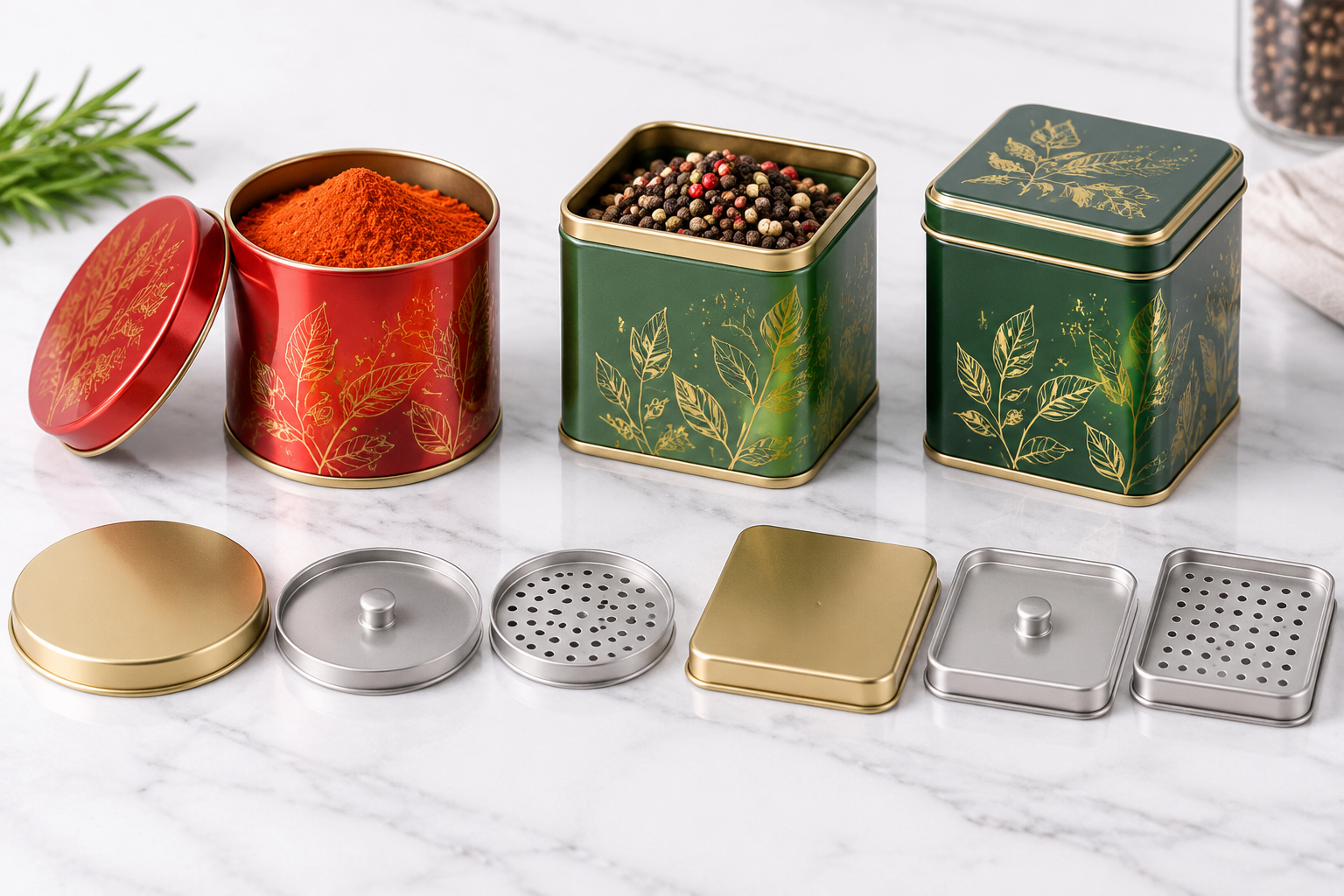
- Shaking: A sifter or shaker opening only works if the hole size matches the spice. Fine powder can clump or leak through large holes, and flakes can block small ones. A sifter insert is not a standard option you can assume for every tin structure, so ask whether it can be developed for your chosen structure and test it with the real spice.
- Inner and outer lids: Our range includes double-lid structures. Confirm how the inner lid sits, how customers remove it, and whether it suits your spice. You can browse structures in our hot sale tin packaging range.
For shape, a round tin suits a single spice, while a square tin stacks neatly in a multi-spice display. If you plan a gift set with several tins or bags in one box, our guide to rectangular tins with lids explains how that layout works.
Do Salt, Oil and Acid Affect the Coating You Need?
They can. Seasoning blends often contain salt, sugar or acidic ingredients, and many spices carry natural oils. These can affect how an interior coating performs and how the spice keeps in storage.
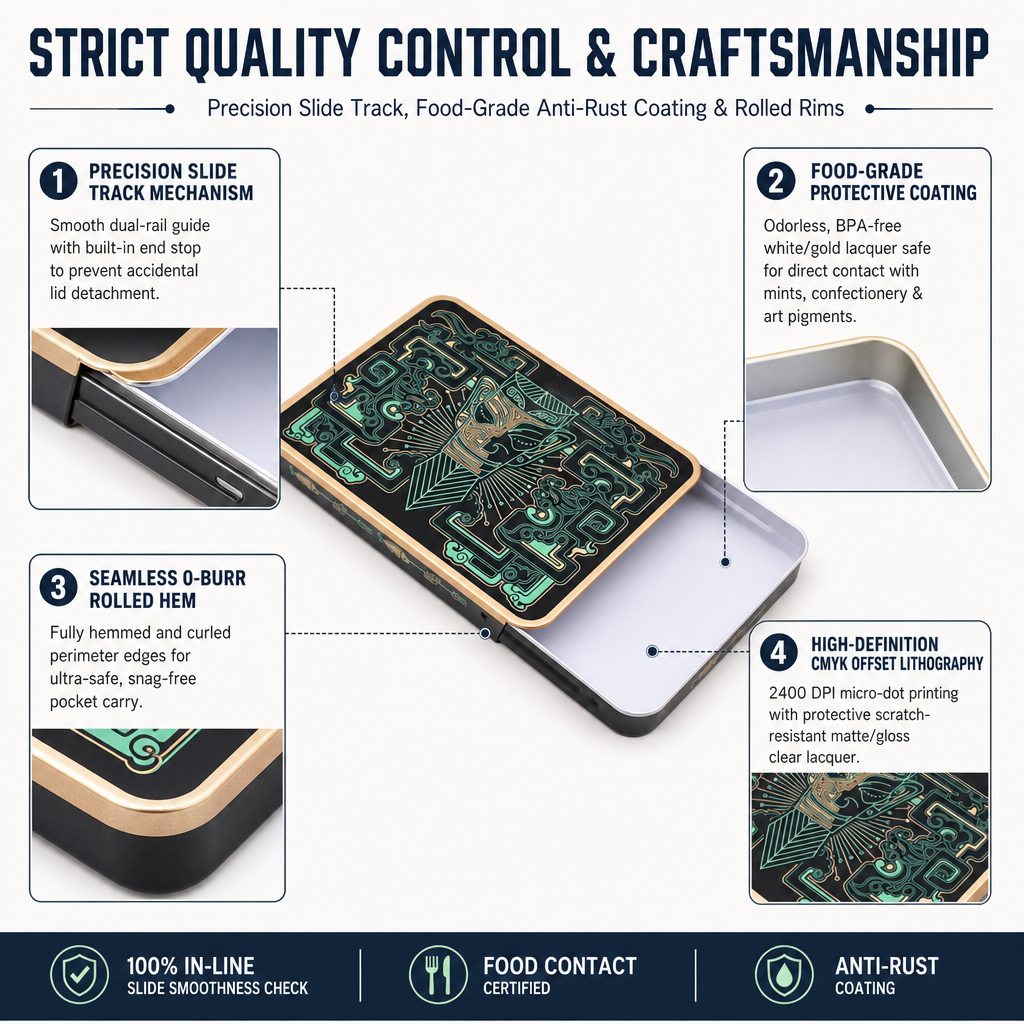
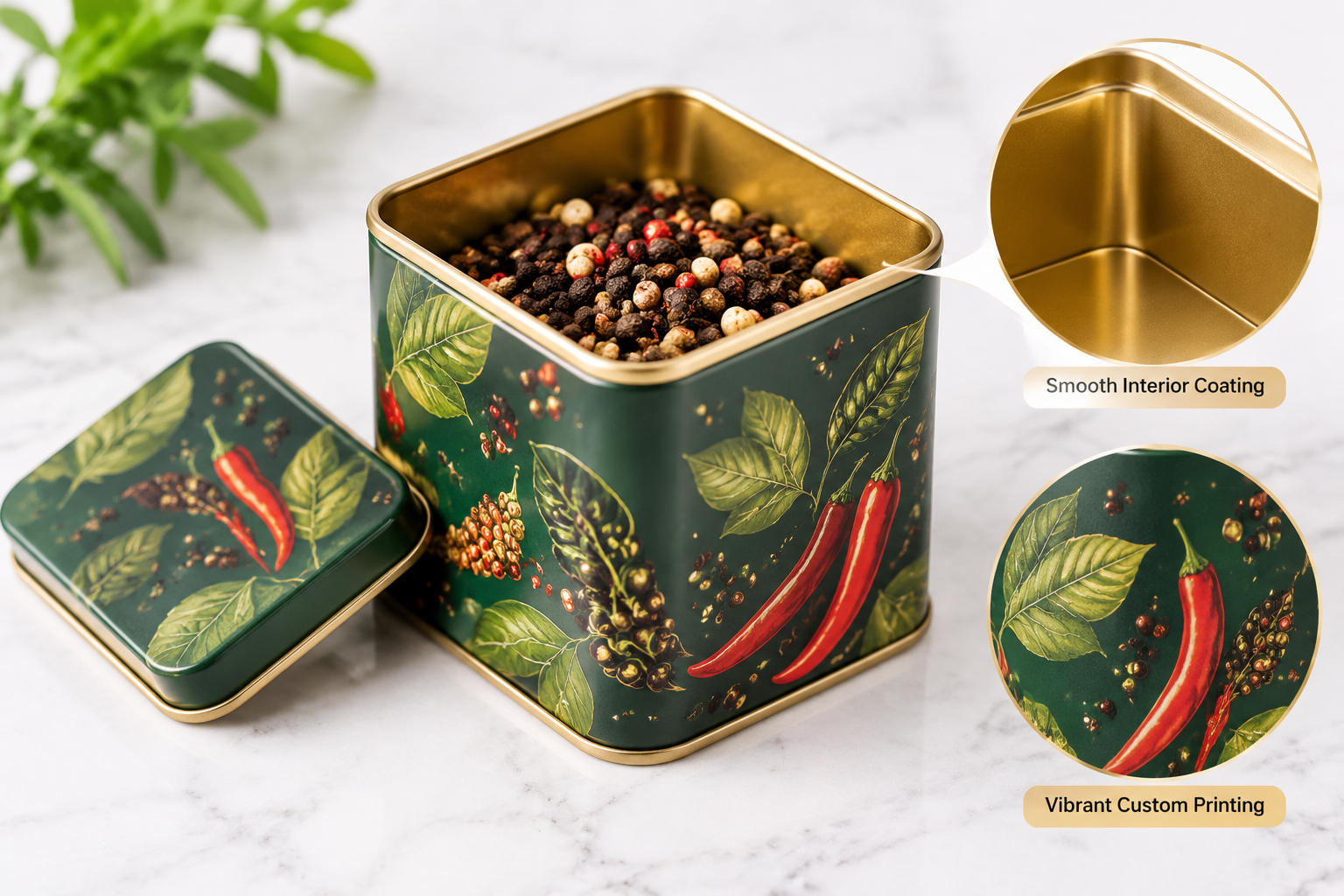
Do not assume that one coating suits every spice. Give us the composition of the actual product, including salt, sugar, oil and moisture content and the intended storage conditions, and confirm the coating for that recipe before approving production. Our food tin containers guide explains coating and food-contact basics in more detail.
How Do You Protect Aroma and Keep Flavors Separate?
A standard slip lid or hinged lid is not automatically an airtight seal. If aroma strength or shelf life is part of your product promise, put the spice in a sealed inner bag or sachet and discuss the closure you need before sampling. Do not describe the tin as airtight in your marketing unless the construction and test results support that claim.
Strong spices such as cumin, curry blends and garlic can transfer aroma to neighboring products. In a multi-spice gift set, keep each spice in its own sealed pack or its own tin instead of loose in shared compartments. Our custom tea tins guide explains the same inner-pouch logic for another aroma-sensitive product.
How Do You Plan a Multi-Flavor Spice Set?
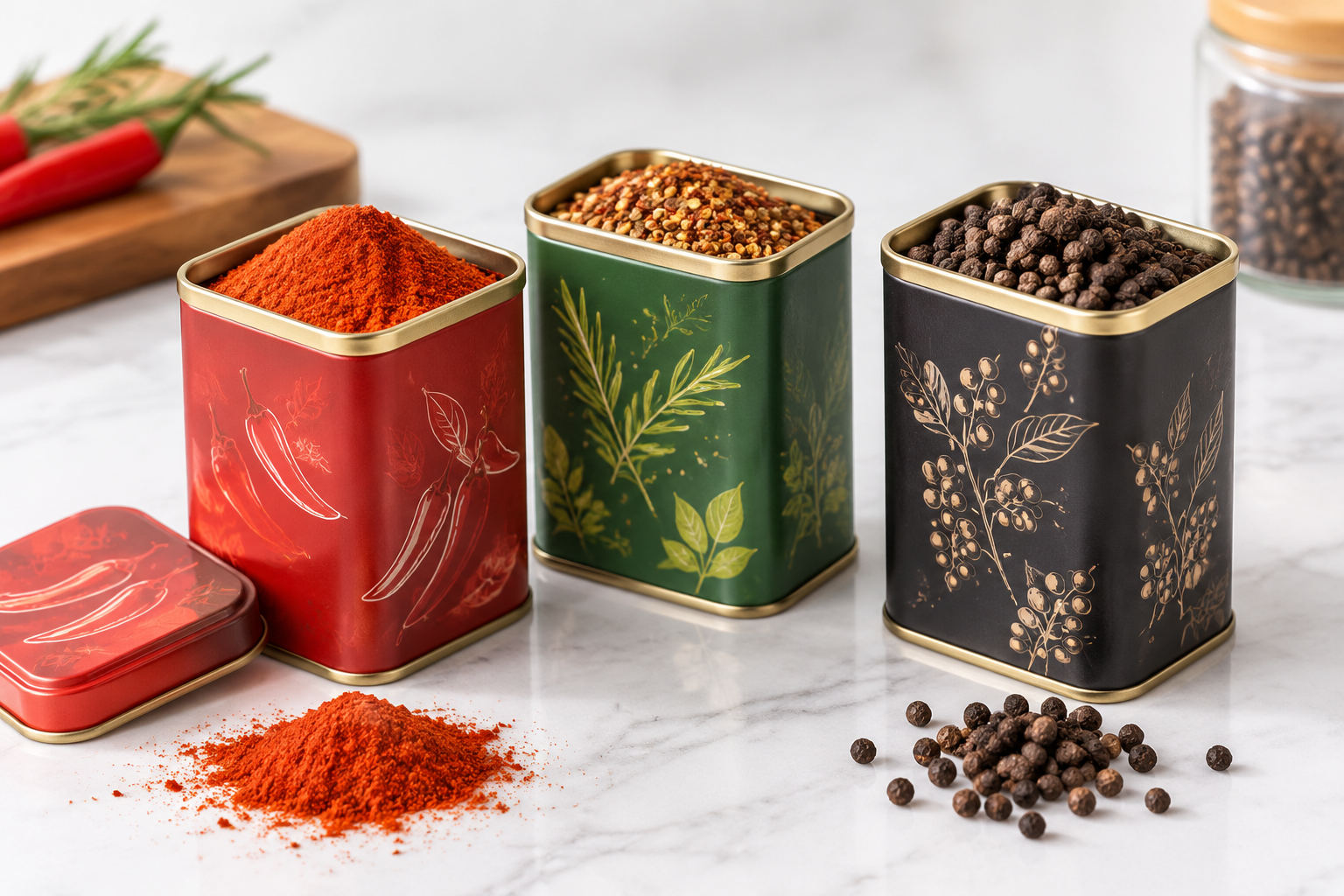
A common approach is one tin structure across the whole collection with a different color and illustration for each flavor. This keeps the specification consistent and makes each flavor easy to identify on the shelf.
Two points need attention:
- Size for the largest filled volume. If several spices share one tin size, a fixed tin holds different net weights of each spice. Measure each spice and decide whether to fill to the same weight in different tin sizes or to the same tin with different net weights, then label each accurately.
- Quantity per design. Clarify in your quotation whether the quantity applies to each design or to the total order.
For file preparation, color and finish choices, read our custom printed tin packaging guide. For gift sets, see our gift tin box guide.
Which Food-Contact and Label Rules Apply?
Regulatory information reviewed: November 10, 2026.
Spices go into food, so check food-contact requirements for your destination market before approving the packaging:
- United States: food-contact articles must meet FDA requirements.
- European Union: Regulation (EC) No 1935/2004 and the good manufacturing practice rules in Regulation (EC) No 2023/2006 apply, along with Regulation (EU) 2024/3190 on bisphenol A in food-contact materials.
Our FAQ states that tin interiors are coated with food-grade lacquer and that tinplate products can be produced with food-grade materials. Confirm the material, coating specification and any test documents for your market and your product before production.
Some spices and seasoning blends contain declarable allergens, such as sesame or mustard, depending on the market. The food business selling the product is responsible for the ingredient, allergen and net weight information on the label, and the required wording depends on the destination market. Plan label space on the tin artwork, or on a separate label, before you finalize the design.
What Should You Send Before Requesting a Quote?
You do not need every detail final, but mark what is confirmed and what may still change. For spice tins, these items matter most:
- Spice type and form (ground, flakes, whole or blend), with the recipe for blends
- Target net weight and, if available, your measured filled volume
- Salt, oil and moisture content, and the intended storage conditions
- Opening preference: spoon, pour, shake or inner lid
- Direct food contact or inner pack, and the destination market
- Preferred tin shape and any existing dimensions
- Estimated quantity, number of designs and target delivery date
- Artwork files or design references
Send your project details through our contact page. For schedule planning, the lead times on our FAQ page as of November 10, 2026 are about 7–10 days for stock products and about 25–30 days for custom printed tin boxes, depending on quantity and production schedule. A new mold takes about 20–25 days.
Frequently Asked Questions
1. Can spices go directly into a metal tin?
That depends on the tin material, the interior coating and the rules in your destination market. Salt, oil and acidic ingredients can affect coating performance, so confirm food-contact suitability for your specific spice before approval, or use a food-grade inner pack instead.
2. Will a spice tin keep spices fresh?
A standard tin lid is not automatically an airtight seal. If aroma or shelf life matters, pack the spice in a sealed inner bag and discuss the closure you need before sampling.
3. How do I choose the size of a 100 g spice tin?
Measure the filled volume of your actual spice at 100 g, then choose a tin whose usable internal volume covers it with clearance below the lid. Confirm the result on a filled sample.
4. Can one tin size hold several different spices?
Yes, but each spice fills the tin differently at the same weight. Measure each one, and label the net weight of each product accurately.
5. What is the MOQ for custom spice tins?
As of November 10, 2026, customized products typically start at 3,000–10,000 pcs depending on structure and printing complexity, and stock items start at about 100–200 pcs. The exact figure for your project, including whether it applies per design, is confirmed in the quotation.
Request a Quote for Custom Spice Tins
Share your spice type, target net weight, preferred opening, estimated quantity and artwork through our contact page. We will review the fit, structure and coating requirements with you before sampling. For a wider view of tin options, start with our custom tin packaging guide.