Written by: Liyipackaging Packaging Team
Published: November 11, 2026
Last Updated: November 11, 2026
A rectangular tin box should be sized from the product inward, not from the outside of a tin that looks about right.
The same product can often fit into several different rectangular proportions: shallow and wide, medium, or tall and compact. Each one changes the usable internal space, the tin’s appearance and the way it packs into cartons.
A practical sizing sequence is:
Product size → Arrangement → Clearance → Internal size → External size → Filled sample check
This guide focuses on those dimension decisions for rectangular tin boxes. Lid structures, printing, MOQ and food-contact requirements are covered in separate guides linked below.
Quick takeaway
- Specify the internal size first, then check the external size for cartons and shelves.
- The same product volume can produce very different tin proportions depending on the arrangement.
- Confirm the final size with a filled sample, not a calculation alone.
How Are Rectangular Tin Box Dimensions Written?
Rectangular tin box dimensions are usually written as length × width × height, in millimetres.
Before sending or comparing dimensions, confirm three things:
- Which side is the length and which is the width. Always state it, because “100 × 150” and “150 × 100” describe the same footprint turned 90 degrees.
- Whether the height is measured with the lid closed or on the body only. A lid adds height that the product does not use.
- Whether the numbers are internal or external dimensions.
The internal size decides whether the product fits. The external size decides how the finished tin fits on a shelf, in a gift box or in a shipping carton.
How Do You Convert Product Size Into Internal Tin Size?
Start by measuring the product in its final form, including any wrapper, pouch or tray.
Then calculate the product block, which is the space the arranged products occupy:
- Block length = number of pieces along the length × piece length
- Block width = number of pieces across the width × piece width
- Block height = number of layers × piece height
Next, add clearance:
- Internal length = block length + side clearance on both ends
- Internal width = block width + side clearance on both sides
- Internal height = block height + headspace for the lid, plus any liner or tray
Finally, estimate the external size by adding the tin wall and edge construction to each side. This allowance varies with the structure and metal thickness, so ask the manufacturer to confirm it rather than assuming a fixed number.
For loose products that cannot be counted in rows, start from net weight and bulk volume instead. Our custom candy tin guide explains that approach.
How Can One Product Fit Into Three Different Tin Proportions?
Take a wrapped chocolate piece measuring 45 × 30 × 12 mm, with a target of 18 pieces per tin.
All three arrangements below hold the same 18 pieces, with the same total product volume:
| Arrangement | Layout | Product block (L × W × H) | Illustrative internal size* | Resulting tin shape |
|---|---|---|---|---|
| Single layer, flat | 3 × 6 | 135 × 180 × 12 mm | 139 × 184 × 15 mm | Wide, shallow, close to square |
| Two layers, flat | 3 × 3 × 2 | 135 × 90 × 24 mm | 139 × 94 × 27 mm | Medium rectangle |
| Standing on long edge | 2 rows of 9 | 108 × 90 × 30 mm | 112 × 94 × 33 mm | Compact, taller |
*Illustrative only: 2 mm clearance on each side and 3 mm of headspace. Real allowances depend on the product, the lid and how the tin is filled.
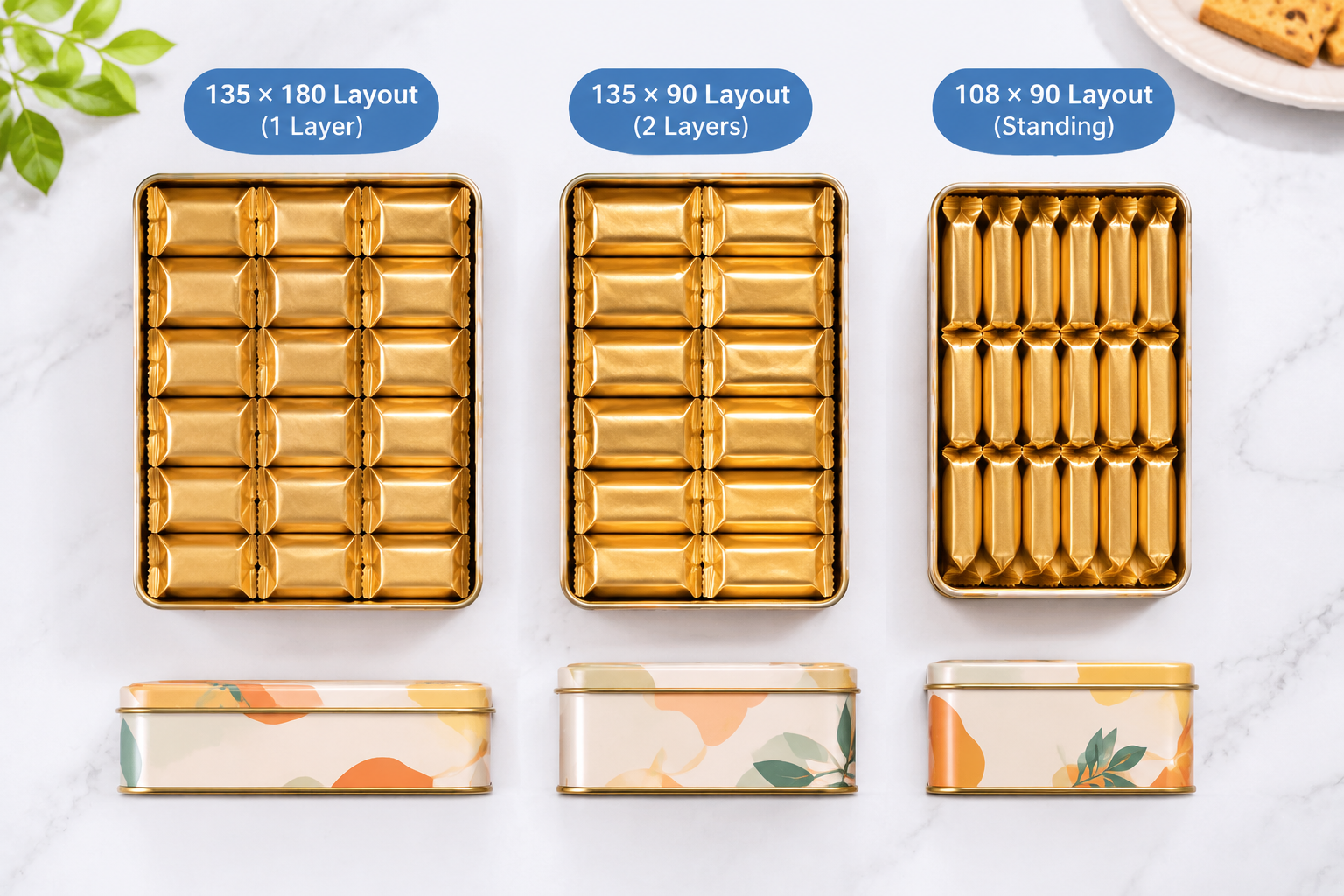
A long, narrow format is also possible. Arranging the same pieces as 6 × 3 in a single layer gives a product block of 270 × 90 × 12 mm, which suits a slim presentation tin.
Two points follow from the comparison:
- A single-layer layout suits a flat, display-style tin, but it needs the largest footprint.
- A standing layout is compact, but the pieces need a snug fit or dividers so they stay upright during handling.
This is why “18 pieces per tin” alone does not define a tin size. The arrangement does.
How Do Wall Construction and Edges Change Usable Space?
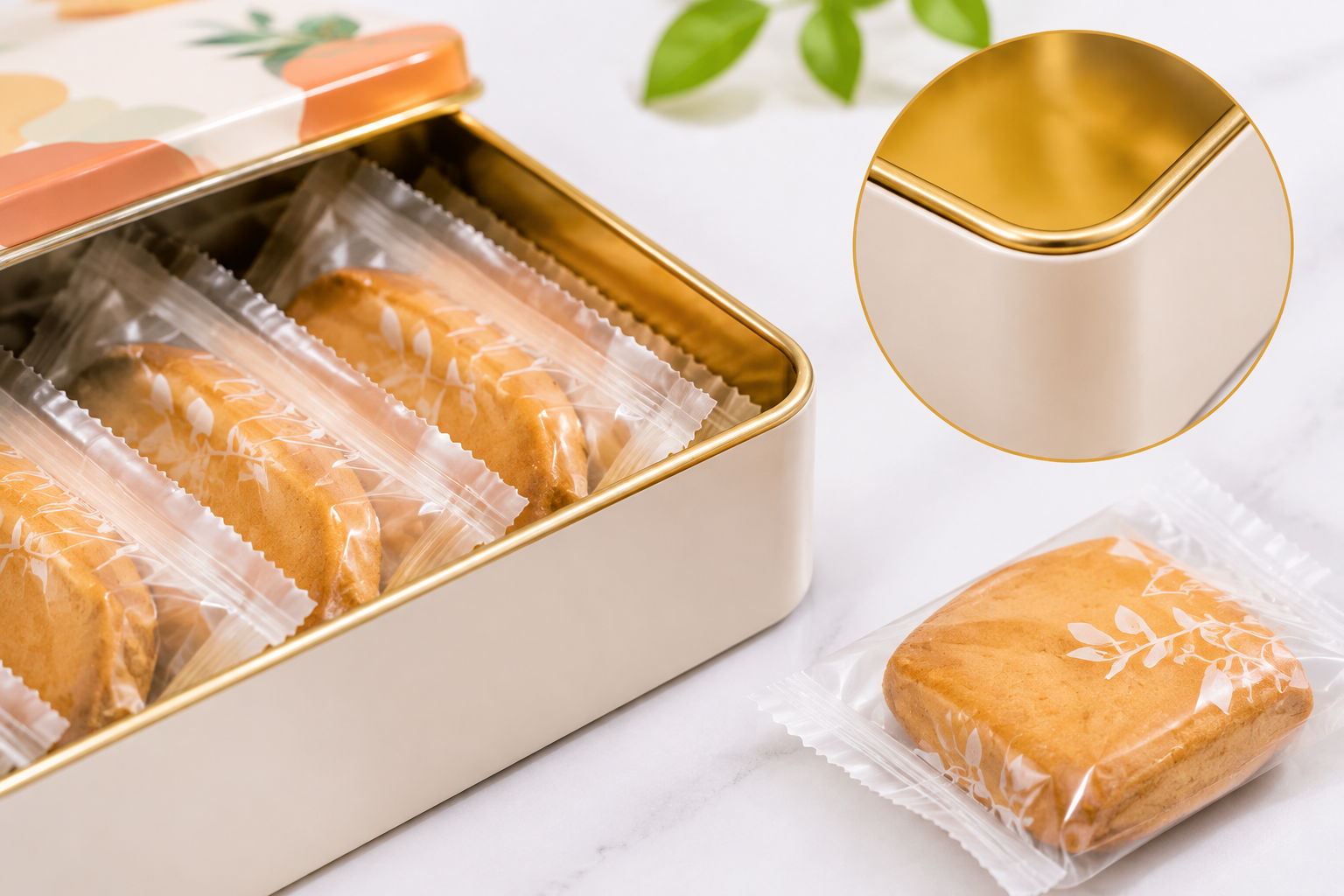
Two tins with similar external dimensions can have different usable internal space.
The difference comes from:
- Metal thickness
- Rolled or folded edges
- Corner radius
- The way the lid and body overlap
- Any tray, liner or divider added inside
Rounded internal corners also matter for rectangular products. A square-cornered wrapped piece pushed into a rounded corner may leave a gap or sit slightly raised, so check the corners with a real product.
Tinplate thickness is specified in fractions of a millimetre, and the right choice depends on the tin’s size and structure. Ask the manufacturer to confirm the thickness for the project instead of assuming one.
How Does Tin Proportion Affect Handling, Cartons and Shelves?
Proportion affects more than appearance.
Panel size and rigidity. Large, flat panels on a wide, shallow tin can flex or show dents more easily than a smaller or deeper design. If the tin has a large footprint, discuss panel size and metal thickness early.
Carton layout. Rectangular tins pack in a grid, and the external size decides how many fit per layer. For example, a tin with an external size of 150 × 100 × 35 mm placed in a carton with an inner size of 460 × 310 × 210 mm fits 3 × 3 = 9 tins per layer and 6 layers, or 54 tins. These carton dimensions are illustrative. Check the real carton size and whether turning the tins 90 degrees improves the count.
Shelf and gift-box fit. Confirm the external length, width and height against the shelf depth or the outer gift box before approving the size.
Opening and display. Lid structure changes the required height and clearance. See our rectangular tins with lids guide and the article on rectangular tin lid types before finalizing the height.
What Should You Measure on a Rectangular Tin Sample?
Approve the size with the real product wherever possible.
Check:
- Internal length, width and height, measured inside the tin
- Whether the full quantity fits in the intended arrangement
- Whether the lid closes without touching the product
- Whether the product moves when the tin is shaken gently
- External dimensions against the carton, shelf or gift box
- Whether corners, edges and the lid line match the approved sample
Record the measured numbers on the sample approval sheet. The approved sample then becomes the reference for production inspection.
What Size Information Should You Send for a Rectangular Tin Quote?
A quotation request is easier to evaluate when the dimensions are separated clearly.
| Requirement | What to provide |
|---|---|
| Product size | Length × width × height, including wrapper |
| Quantity per tin | Number of pieces, or target net weight for loose products |
| Arrangement | Single layer, multiple layers, standing, or loose |
| Inner components | Liner, tray, divider, inner bag, none |
| Preferred size | Internal or external, and which one is fixed |
| Carton or shelf limits | Maximum external size, if any |
| Lid preference | Removable, hinged, sliding or other |
| Order quantity | Estimated number of tins |
Keep the quantity per tin separate from the order quantity. 18 pieces per tin + 5,000 tins is clearer than “5,000 tins”.
For MOQ, sampling time and production planning, see our Custom Tin Box Cost, MOQ & Lead Time guide. For artwork and finishes, see the custom printed tin packaging guide.
How Can Liyipackaging Support Rectangular Tin Development?
Dongguan Liyi Packaging Products Co., Ltd. is a tin packaging manufacturer with more than 25 years of industry expertise and a 3,000㎡ facility. Its company information lists a monthly production capacity of 2 million units and a workflow covering design and development, production and pre-shipment inspection.
For a rectangular tin project, this means product dimensions, internal layout, tin structure and the sample can be reviewed together. For a wider overview of shapes and structures, see our custom tin packaging guide.
FAQ
What do the three numbers in a rectangular tin box size mean?
They are normally length × width × height in millimetres. Always confirm which side is the length, whether the height includes the lid, and whether the dimensions are internal or external.
How much extra internal space should I allow around the product?
It depends on the product, the lid and the filling method. A few millimetres per side is a common starting point for rigid, wrapped products, but the final clearance should be confirmed with a filled sample.
Can the same product fit in different rectangular tin sizes?
Yes. In the example above, 18 wrapped chocolates fit a wide shallow tin, a medium tin or a compact tall tin. Each option changes the footprint, height and tin appearance.
Should I send internal or external dimensions?
Send the internal size if the product fit is the priority, and the maximum external size if carton, shelf or gift-box limits apply. If both matter, send both.
How do I confirm the size before mass production?
Fill the sample with the actual product, measure the inside of the tin, check the lid and compare the external size with your carton or shelf. Then approve the sample as the production reference.
Request a Rectangular Tin Quote
If you know the product dimensions, quantity per tin, preferred arrangement and estimated order quantity, send them to Liyipackaging for the next step.