Written by: Liyipackaging Packaging Team
Published: September 29, 2026
Last Updated: September 29, 2026
Regulatory information reviewed: September 29, 2026
A custom mint tin should be developed around the mints, not simply selected from an attractive tin shape.
The practical questions are:
- How many mints need to fit?
- Are they compressed, wrapped, loose, or individually packed?
- How should they be arranged?
- How will the lid be opened and closed?
- Does the inner coating suit the intended food-contact application?
- Does the product need additional moisture or aroma protection?
A useful development sequence is:
Mint format → Quantity → Packing method → Internal space → Lid → Coating → Sample
This guide focuses on those mint-specific packaging decisions before sampling and production.
How Is a Mint Tin Different From a General Candy Tin?
Mints may look simple to package, but their format can change the required internal space and packaging configuration.
Common formats include:
- Compressed mint tablets
- Hard mints
- Individually wrapped mints
- Loose mints
Compressed tablets often have consistent dimensions, making row-and-layer arrangements relatively easy to calculate.
Individually wrapped mints need to be measured with their actual wrapping because the wrapper adds to the required space.
Loose mints are different again. They are generally specified by target net weight or approximate fill quantity rather than a fixed row arrangement.
A breath mint tin may also be opened repeatedly throughout the day, so the lid should be evaluated as part of the actual user experience.
For a broader candy packaging framework, see our custom candy tin guide.
How Do You Calculate the Internal Size of a Mint Tin?
Start with the actual mint dimensions and the intended packing arrangement.
For example, suppose a compressed mint is approximately:
12 mm diameter × 4 mm thick
and the target quantity is 30 mints.
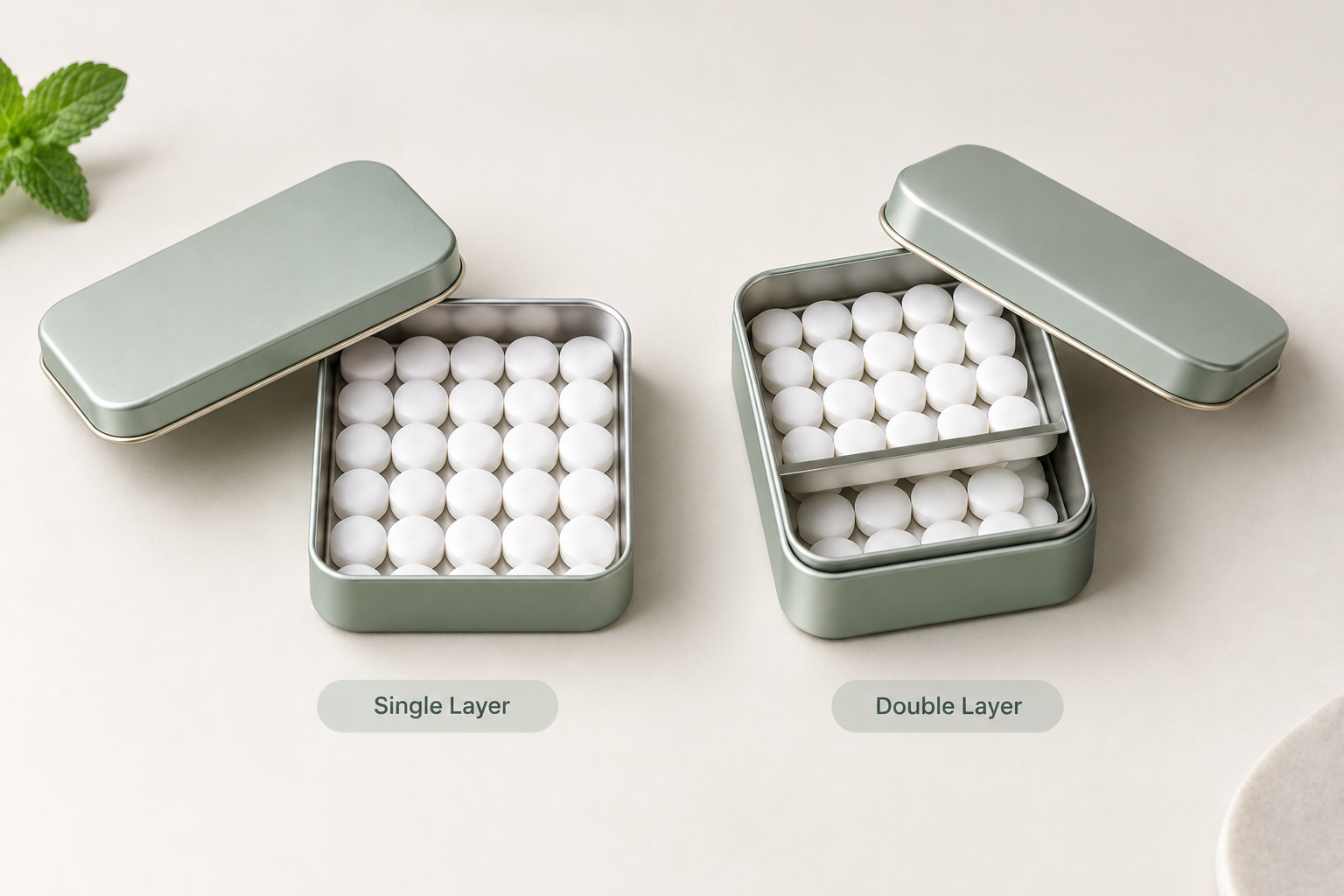
The same 30 pieces can require very different internal space depending on the arrangement.
| Arrangement | Mints per layer | Nominal product footprint | Product stacking height |
|---|---|---|---|
| Single layer | 5 × 6 | 60 × 72 mm | 4 mm |
| Two layers | 3 × 5 per layer | 36 × 60 mm | 8 mm |
These are illustrative product dimensions, not final tin dimensions.
Place the image directly after the table.
The image should show the same 30 mints in two arrangements:
- 5 × 6 single layer
- 3 × 5 × 2 layers
Only show:
60 × 72 mm36 × 60 mmclearance
Do not show an invented final tin size.
The final internal dimensions also need to account for:
- Clearance around the product
- Clearance between the product and lid
- Tin wall construction
- Corner shape
- Lid structure
- Product movement
- Inner coating
- Any liner, tray, or insert
This is why “30 mints per tin” alone is not enough to determine the final tin size.
Two tins with similar external dimensions can also provide different usable internal space because of wall construction, corners, lid overlap and internal accessories.
For loose mints, use:
Target net weight → Approximate bulk volume → Fill capacity → Internal space → Physical filling check
Loose products can settle differently depending on their shape and packing conditions, so the final capacity should be confirmed through a physical filling trial rather than volume calculation alone.
What Lid Structure Works for a Mint Tin?
The lid should match how the mint tin will actually be used.
Depending on the project, structures can include:
- Removable lids
- Hinged lids
- Sliding lids
- Double-lid structures
- Clip-lid structures
- Window lids
The filled tin should be checked rather than evaluating the lid only on an empty sample.
Check:
- Can the user open the lid easily?
- Can the mints be removed without difficulty?
- Does the lid close consistently after filling?
- Does the product move excessively when carried?
- Is there enough internal height for the chosen structure?
For a broader explanation of lid structures, see our Rectangular Tins with Lids guide.
The key point for a mint tin is that the lid, internal clearance and product arrangement need to work together.
How Do Inner Coating, Aroma and Food-Contact Requirements Affect a Mint Tin?
For mints, the inner surface deserves particular attention because some products contain strong flavors, mint oils or menthol-related ingredients.
The relevant question is not simply whether a tin is described as “food grade.”
The actual coating and food-contact system should be considered according to the product, intended use and target market.
Can mint flavor affect the inner coating?
Strongly aromatic products make taste and odor considerations more important.
For EU food-contact applications, Regulation (EC) No 1935/2004 requires food-contact materials to be manufactured so that, under normal or foreseeable conditions of use, they do not cause an unacceptable change in the composition or organoleptic characteristics of food.
For a mint product, the inner coating should therefore be considered together with the actual product characteristics.
What should EU buyers check?
For an EU project, confirm the applicable food-contact framework and the specific coating documentation for the intended application.
Regulation (EC) No 1935/2004 provides the general food-contact framework.
BPA requirements are addressed by Regulation (EU) 2024/3190, with the current consolidated text incorporating Regulation (EU) 2026/250.
As of September 29, 2026, the main July 20, 2026 transition date for most affected single-use final food-contact articles has passed.
Article 11(2) provides longer transitional treatment for specific single-use categories, including certain articles intended for fruits, vegetables or fishery products and articles where BPA-containing coating is applied only to the exterior metal surface.
Article 12(2) concerns a narrower category: repeat-use final food-contact articles used as professional food production equipment.
These exceptions should not be assumed to apply to a normal mint tin.
Also, a tin should not be classified as repeat-use simply because its lid can be opened and closed repeatedly. The regulatory classification depends on how the final food-contact article is defined and used. The applicable classification should be confirmed by the responsible compliance party.
For articles legitimately placed on the market under the applicable Article 11 transition periods, Article 11(3) allows them to be filled with food and sealed during the 12 months following expiry of the applicable transitional period. The resulting packaged food may then remain on the market until stocks are exhausted.
For a new mint tin project, the practical questions are:
- What market will the product be sold in?
- What coating will be used on the food-contact surface?
- Is the coating subject to the applicable BPA requirements?
- What compliance documentation is available?
For an EU project, ask the supplier for the applicable Declaration of Compliance and supporting material documentation rather than relying only on a generic “food grade” statement.
What should U.S. buyers check?
The FDA explains that the regulatory status of a food-contact material depends on the individual substances that make up the article and their intended conditions of use.
Possible regulatory bases include applicable Title 21 CFR provisions, GRAS status, prior sanctions, Threshold of Regulation exemptions, or effective Food Contact Substance Notifications.
For a U.S. mint tin project, provide:
- Intended market
- Mint type
- Whether the product directly contacts the inner surface
- Storage conditions
- Expected conditions of use
- Required compliance documentation
The important distinction is that there is not one generic concept of an “FDA-approved tin.” The relevant question is whether the specific materials and intended use have an applicable regulatory basis.
Are Mint Tins Airtight or Moisture-Proof?
A standard metal mint tin should not automatically be described as airtight or moisture-proof.
Moisture and aroma protection depend on the complete packaging system, including:
- Lid and closure structure
- Fit between lid and body
- Inner coating
- Individual wrapping
- Inner pouch
- Liner or insert
- Storage conditions
If moisture sensitivity or aroma retention is important, discuss the complete packaging configuration before finalizing the specification.
Do not assume that changing from paper or plastic packaging to a metal tin automatically creates an airtight package.
What Should You Check When Approving a Mint Tin Sample?
Whenever possible, approve the sample with the actual mints.
Product fit
Check:
- Quantity per tin
- Arrangement
- Clearance
- Ease of removal
- Product movement
Lid operation
Test the filled tin and open and close the lid several times.
Check whether:
- The lid closes consistently
- The product interferes with closing
- The mints are easy to access
- The opening experience matches the intended use
Inner surface
Inspect areas that may contact the product.
Look for:
- Complete coating coverage
- Scratches
- Visible defects
- Uneven areas
- Exposed metal in product-contact areas
Finished appearance
Also confirm:
- Tin shape
- Lid alignment
- Edges
- Surface finish
- Printing
- Overall consistency
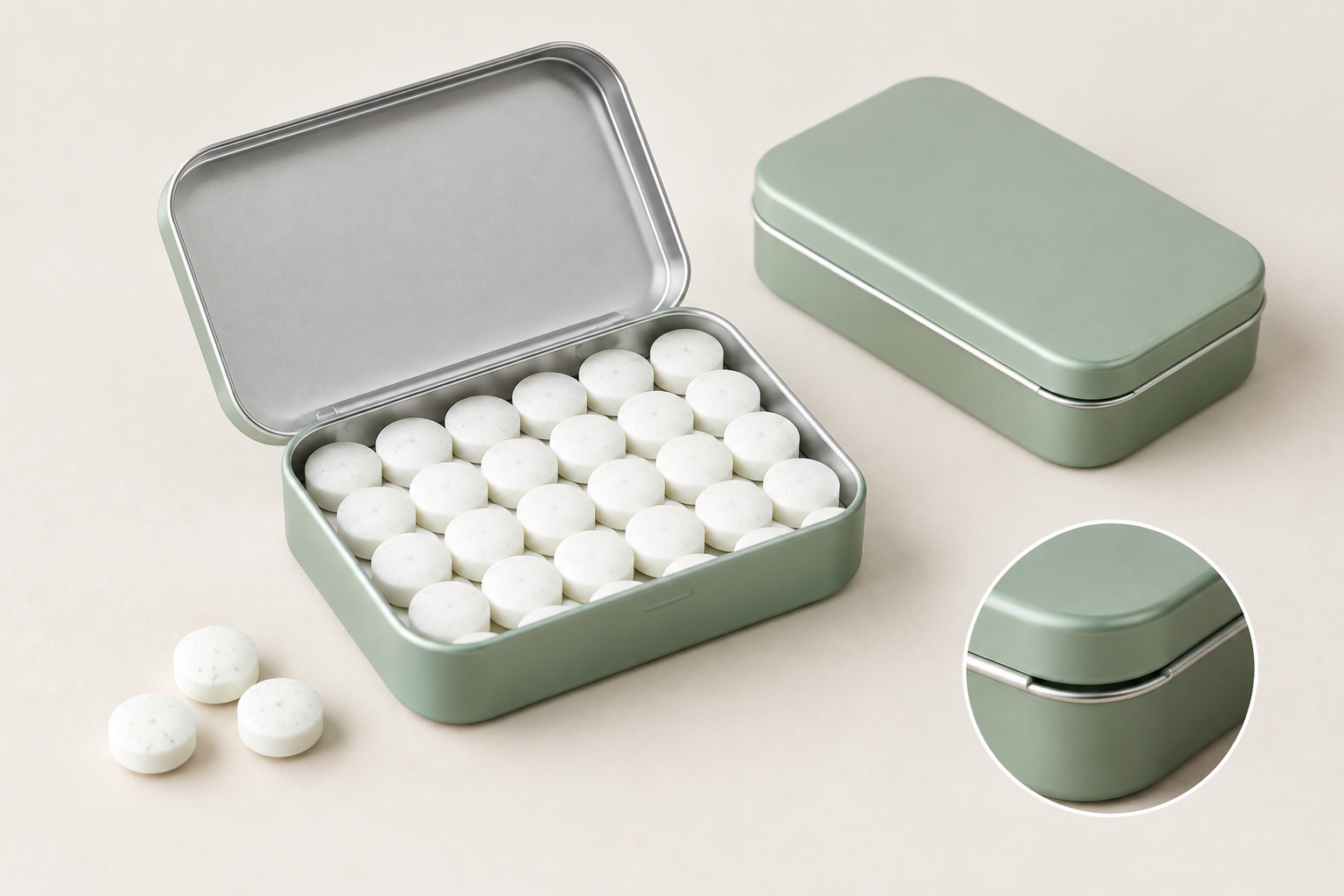
Place a real filled mint tin photo near the beginning of this section.
The image should show the actual mint quantity, internal arrangement, clearance and lid relationship. Avoid staged laboratory-style photography or invented testing evidence.
What Information Should You Send for a Custom Mint Tin Quote?
A useful inquiry gives the manufacturer enough information to evaluate the structure before the quotation is finalized.
| Requirement | What to provide |
|---|---|
| Mint type | Compressed, hard, wrapped, loose, etc. |
| Mint dimensions | Diameter × thickness or length × width × height |
| Quantity | Pieces per tin or target net weight |
| Packing method | Single layer, multiple layers, loose, wrapped |
| Product protection | Wrapper, pouch, liner, none, etc. |
| Lid | Removable, hinged, sliding, other |
| Target market | U.S., EU, UK, etc. |
| Storage | Normal retail storage or specific conditions |
| Order quantity | Estimated number of tins |
| Delivery | Required launch or delivery date |
Keep quantity per tin separate from order quantity.
For example:
30 mints per tin + 5,000 tins order quantity
is more useful than simply saying:
5,000 mint tins
If artwork is already being prepared, see our Candy Tin Artwork & Printing Guide for artwork, printing and finishing considerations.
How Can Liyipackaging Support Custom Mint Tin Development?
Dongguan Liyi Packaging Products Co., Ltd. is a professional tin packaging manufacturer with more than 25 years of industry expertise and a 3,000㎡ facility. Its current company information also lists a monthly production capacity of 2 million units and a full-service workflow from design and development through production and pre-shipment inspection.
The company works with customized tin containers and multiple tin structures, including:
- Square tins
- Rectangular tins
- Round tins
- Cylindrical tins
- Octagonal tins
- Heart tins
- Hinged-lid tins
- Sliding-lid tins
- Double-lid tins
- Clip-lid tins
- Window-lid tins
- Handle tins
For a mint project, the useful part of this process is being able to discuss the product, internal structure, lid, coating, sampling and production specification as one packaging project.
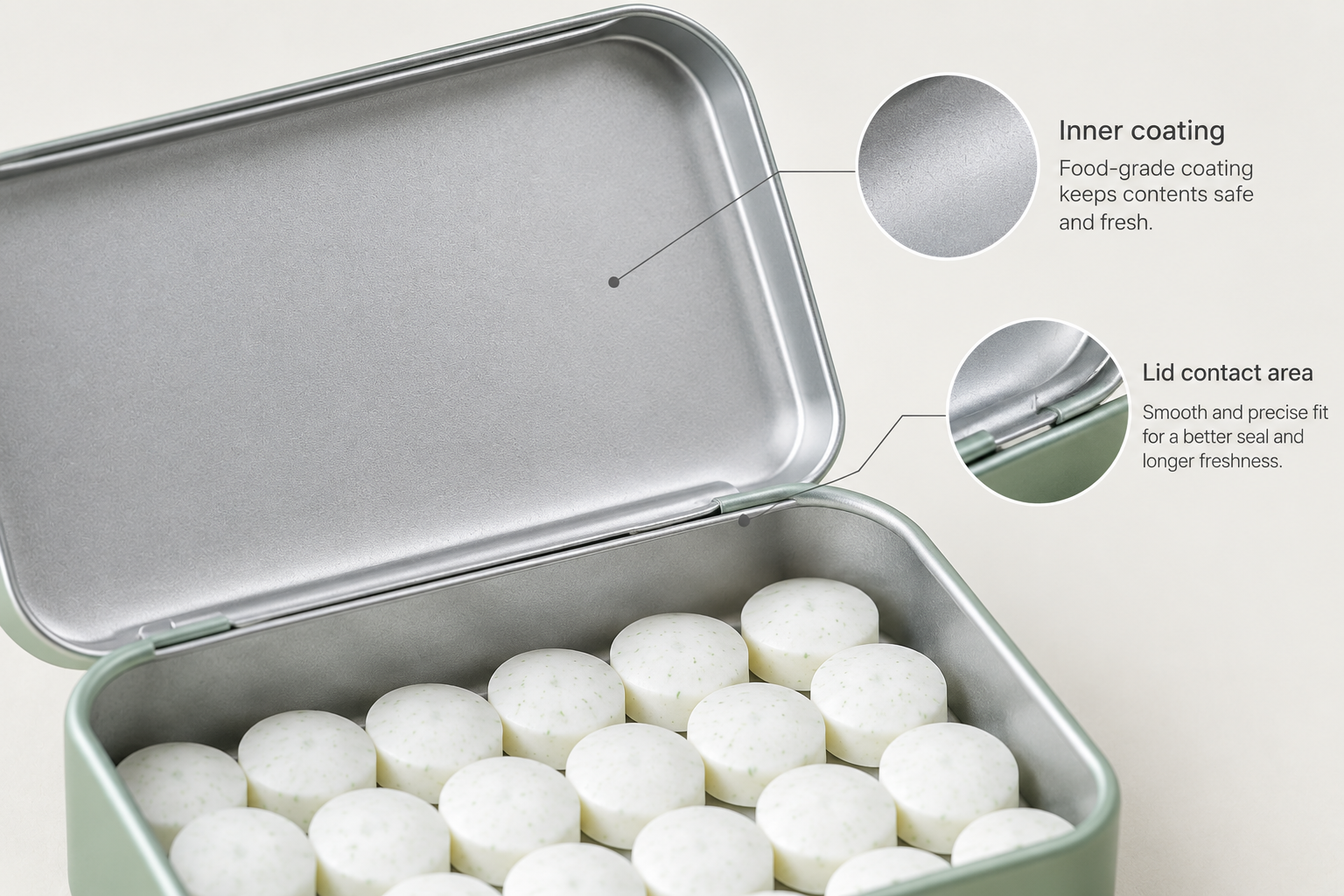
Place this close-up after the discussion of inner coating and before the sample approval section.
Show:
- Inner coating
- Lid contact area
- Tin edge
- Coating coverage
- Surface detail
Do not present the image as laboratory or compliance testing evidence.
FAQ
Are standard mint tins airtight?
Not automatically. A standard mint tin should not be described as airtight or moisture-proof unless the complete packaging system has been designed and evaluated for that purpose.
Does a mint tin become a repeat-use article because the lid opens repeatedly?
Not automatically. The ability to open and close a lid repeatedly does not by itself determine the regulatory classification. For BPA transition rules, the relevant classification depends on the final food-contact article and its actual use. The responsible compliance party should confirm whether the applicable provisions concern a single-use or repeat-use article.
Does a mint tin need to be BPA-free for the EU?
The applicable requirements depend on the scope and conditions of Regulation (EU) 2024/3190 and its amendments, including Regulation (EU) 2026/250.
For a new project, confirm the actual coating and request the applicable Declaration of Compliance and supporting documentation rather than relying only on a generic “BPA-free” or “food grade” statement.
Do aromatic mints affect the packaging?
They can make the inner coating and overall food-contact system more important because strong flavors and aromas can make taste and odor considerations relevant.
How many mints fit in a mint tin?
It depends on the mint dimensions, quantity, arrangement, wrapping and available internal space. The final quantity should be confirmed through an actual filling check when possible.
Request a Custom Mint Tin
If you already know the mint dimensions, quantity per tin, packing arrangement, preferred lid and estimated order quantity, send those details to Liyipackaging for the next step in development.