Written by: Liyipackaging Packaging Team | Published: November 27, 2026 | Last Updated: November 27, 2026 | Regulatory information reviewed: November 27, 2026
Quick takeaway: Most misunderstandings in a tin project come from vocabulary, not design. “Hinged lid,” “new mold,” “sample approval” and “internal size” each have a specific meaning in a factory quotation. This glossary explains the terms buyers meet most often, and each entry points to a deeper guide.
When a buyer and a factory use the same word differently, the cost shows up later as a wrong quotation, a sample that does not fit, or an artwork file that has to be redone. A shared vocabulary is the cheapest way to prevent that.
The terms below are grouped by the stage where they usually appear: construction, lids, printing, tooling, quality and shipping, and food contact.
Material and Construction Terms
Tinplate
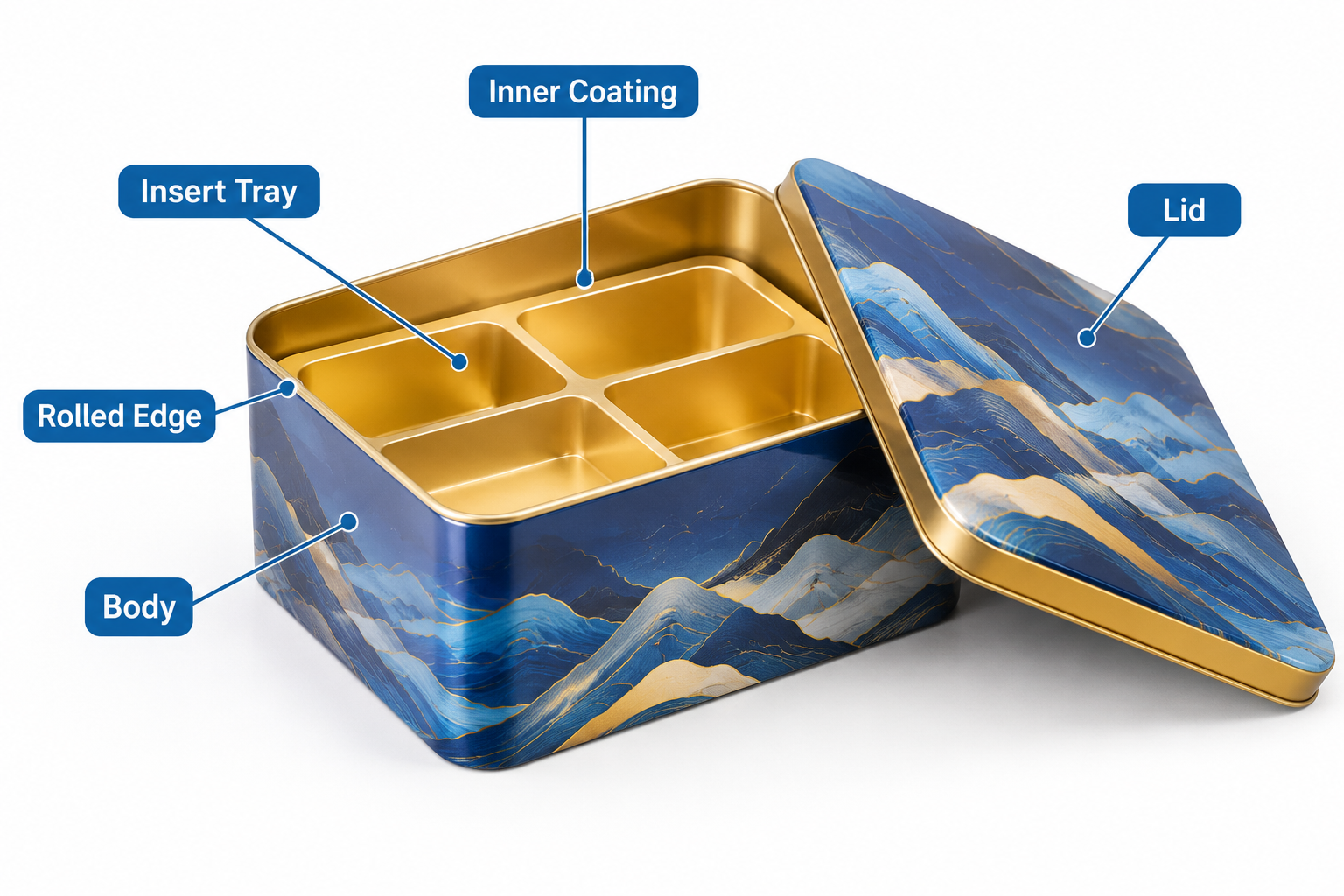
Tinplate is a steel sheet coated with a thin layer of tin to protect it from corrosion. It is the base material for most printed tin boxes and cans. For how material and coating relate to food packaging, see our food tin containers guide.
Internal coating (food-grade lacquer)
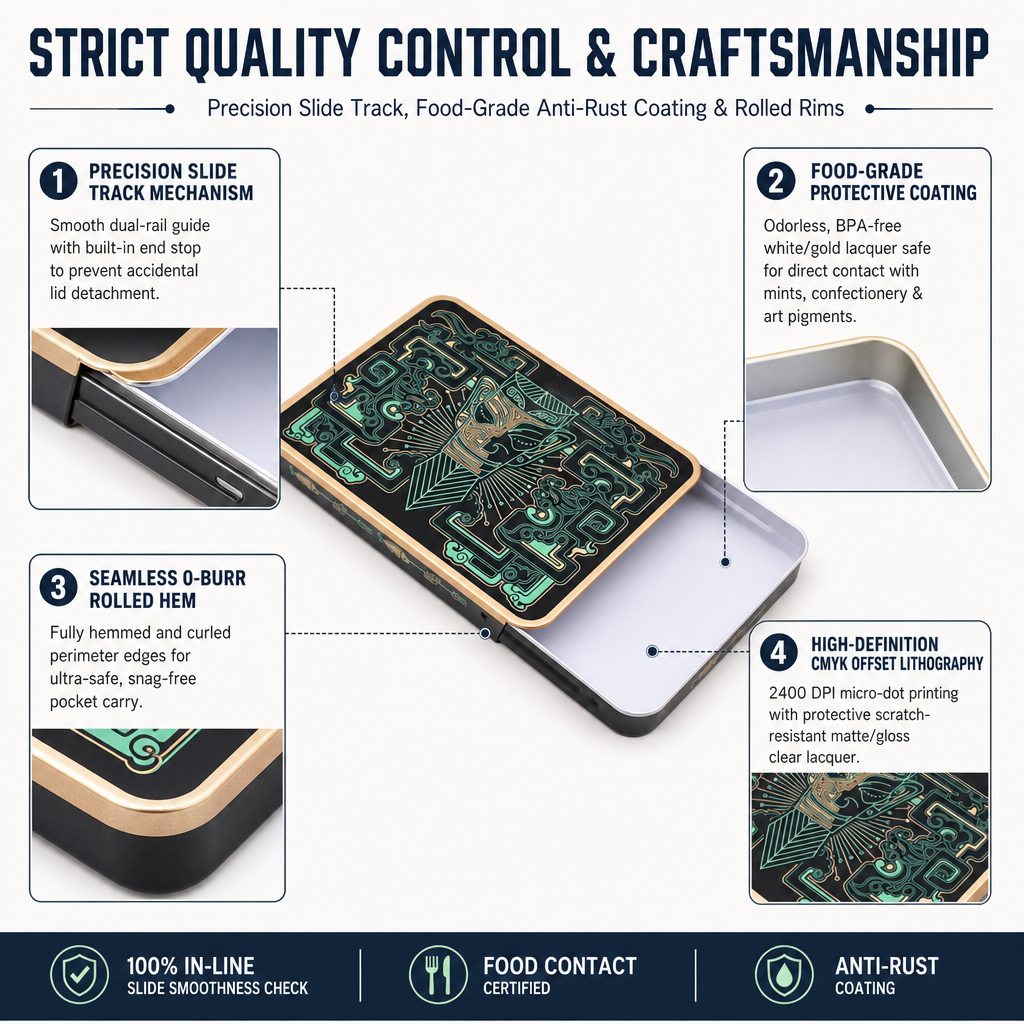
The internal coating is a lacquer applied to the inside of the tin so that food does not touch bare metal. Whether you need one depends on the product, the filling method and the destination market. Confirm it before sampling, not after.
Rolled edge
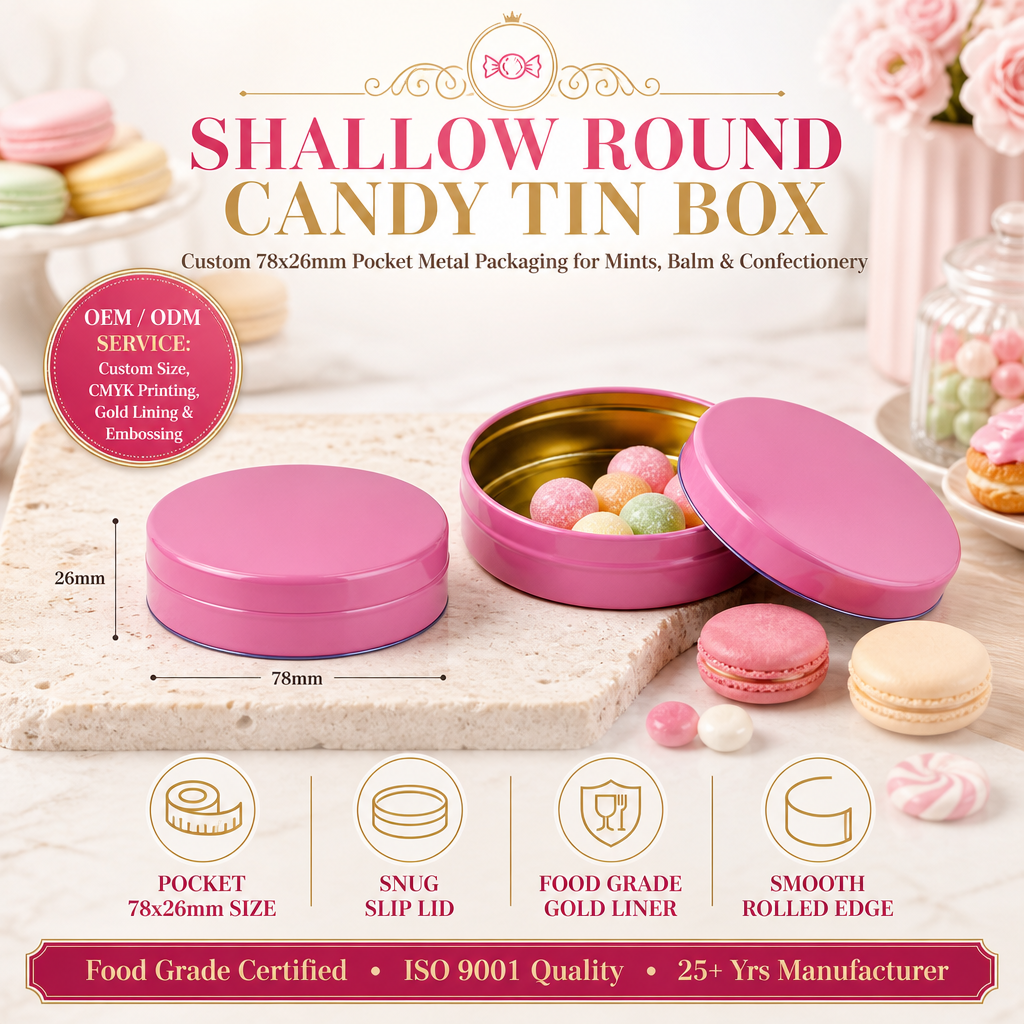
A rolled edge is the curled rim on the body or lid. It adds rigidity, softens the cut edge and affects how the lid seats. When a lid feels loose or tight, the rolled edge is one of the first places to check. Our guide to lid fit problems explains how.
Internal dimensions vs. external dimensions
External dimensions are the outside size of the closed tin. Internal dimensions are the usable space for the product. The difference comes from wall construction, lid structure and any insert. Always give the factory the internal size you need, or the product itself. The cookie tin case study shows what happens when internal height is assumed instead of measured.
Clearance
Clearance is the free space between the product and the tin wall or lid. Too little makes loading difficult and can press on wrappers. Too much lets the product move in transit.
Insert, tray and divider
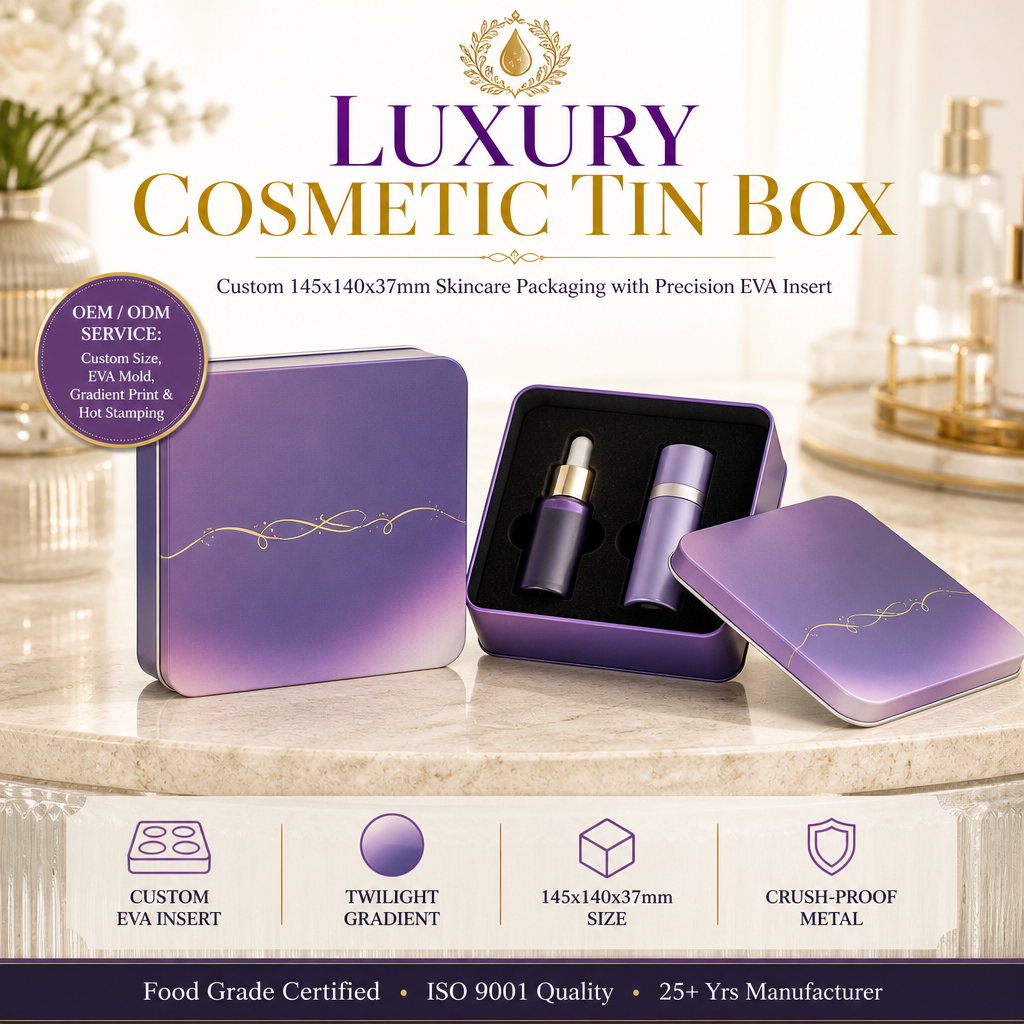
An insert holds products in a fixed position. Trays and dividers separate layers or items. Typical materials include foam, sponge, EVA, flocked blister trays and PVC or PET sheets. Inserts change the usable internal height, so they belong in the first specification, not the last.
Inner bag or liner
An inner bag or liner sits between the product and the tin. It is common for tea, powders and oily products. It affects both fit and food-contact planning.
Lid and Opening Terms
Slip lid (lift-off lid)
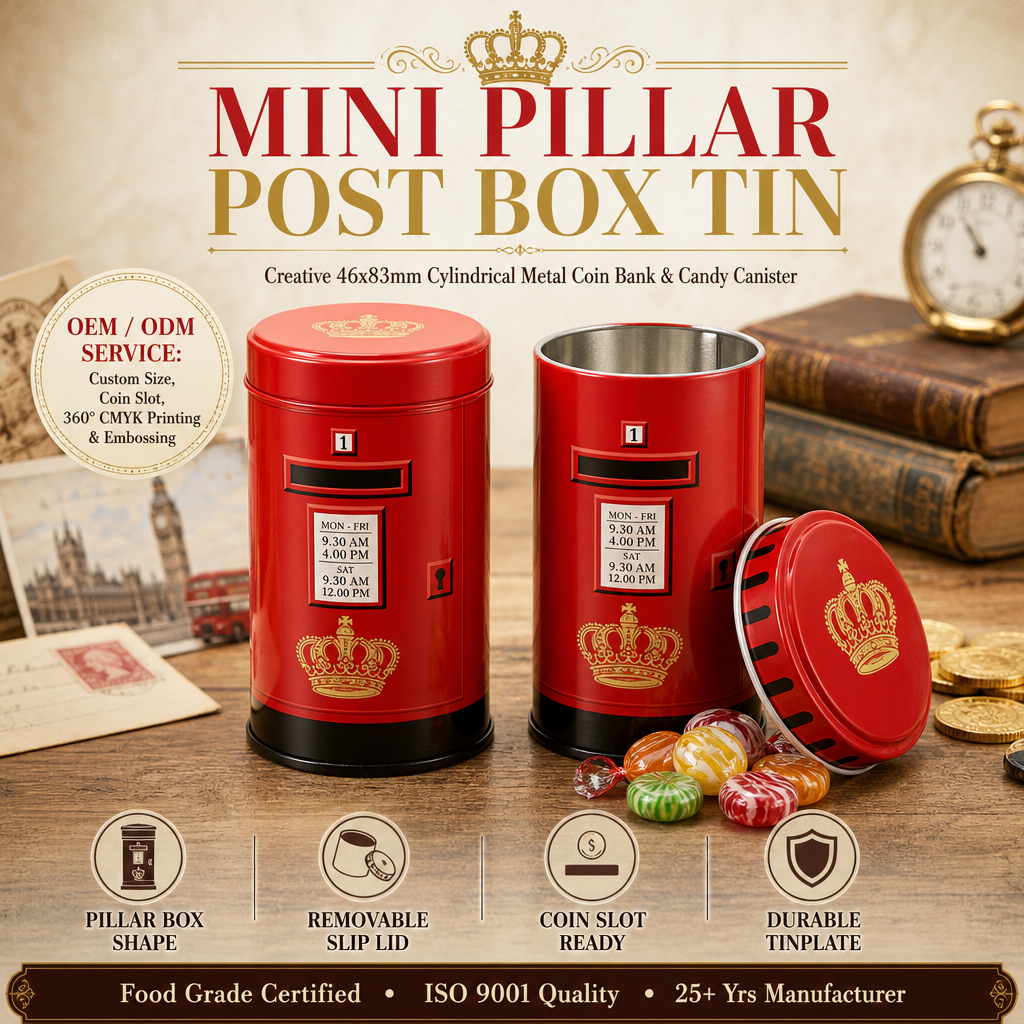
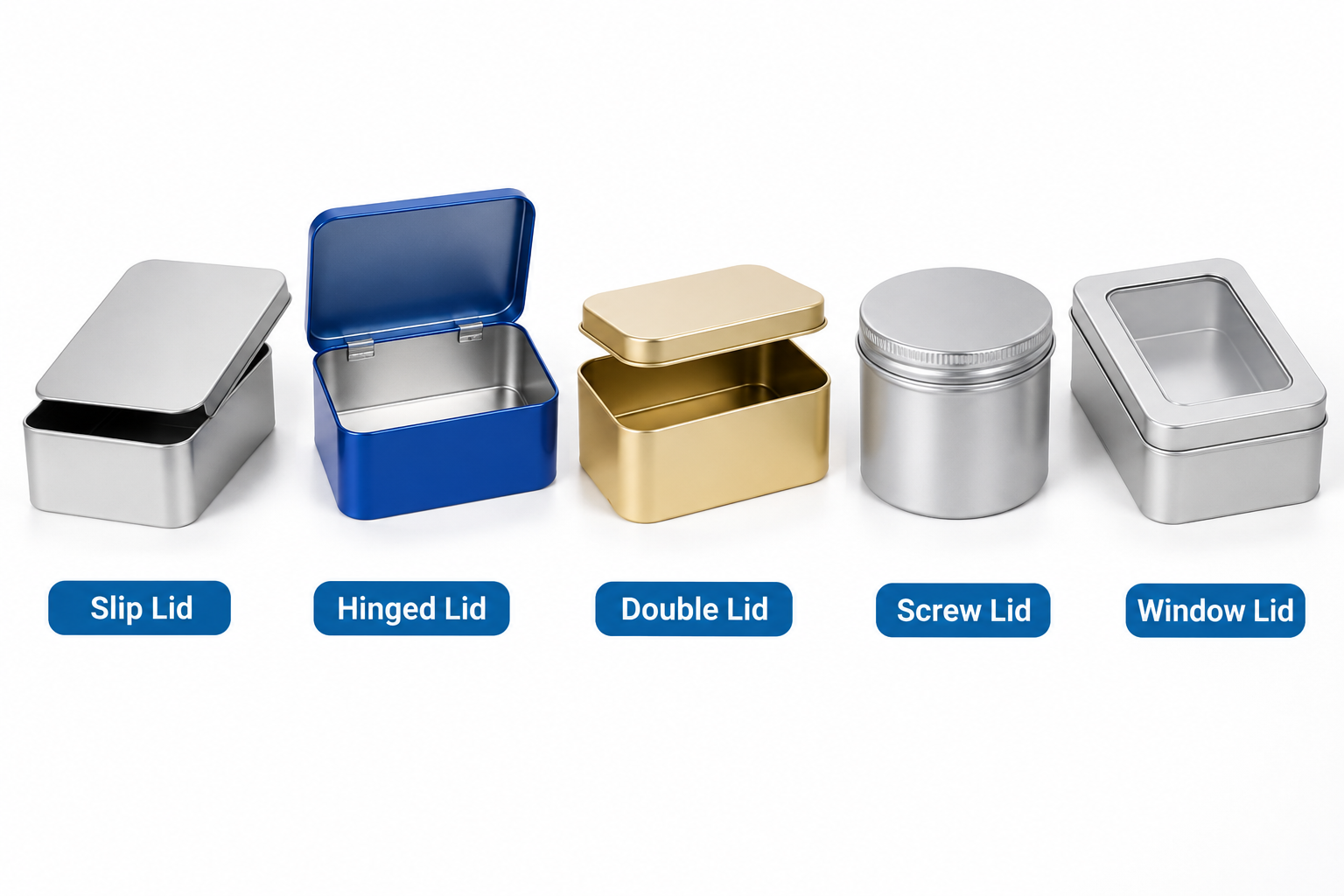
A slip lid is a separate lid that lifts or pulls off the body. It is simple, widely used and suited to many gift and food tins. For structure choices on rectangular formats, see our guide to rectangular tins with lids.
Hinged lid
A hinged lid stays attached to the body and swings open. It suits tins that customers open repeatedly. The hinge adds a structural detail that should be confirmed on the sample.
Double lid
A double lid combines an outer lid with an inner lid underneath. Buyers usually choose it for extra dust protection or a tighter closure.
Screw-top lid
A screw-top lid threads onto the body. It is common on round tins and gives a firmer closure than a simple slip lid.
Clip or buckle lid
A clip or buckle lid is held shut by a mechanical fastener. It is used on storage and gift tins where a secure closure matters.
Window lid
A window lid has a transparent panel so the product is visible without opening the tin. The window material and its food-contact status should be confirmed for food products.
Child-resistant (CR) closure
A CR closure is designed to be difficult for young children to open while remaining usable by adults. The applicable requirements depend on the product and the market. Read child resistant tin packaging and our comparison of CR tin structures before choosing a design.
Printing and Finish Terms
Template (die-line)
A template is the flat layout of the tin showing every printable surface, fold and edge. Artwork should be built on the factory’s template, not on a generic rectangle. The custom printed tin packaging guide explains the artwork workflow.
Safe area
The safe area is the zone inside the template where logos and small text will not be affected by forming or edge handling. Keep critical elements inside it.
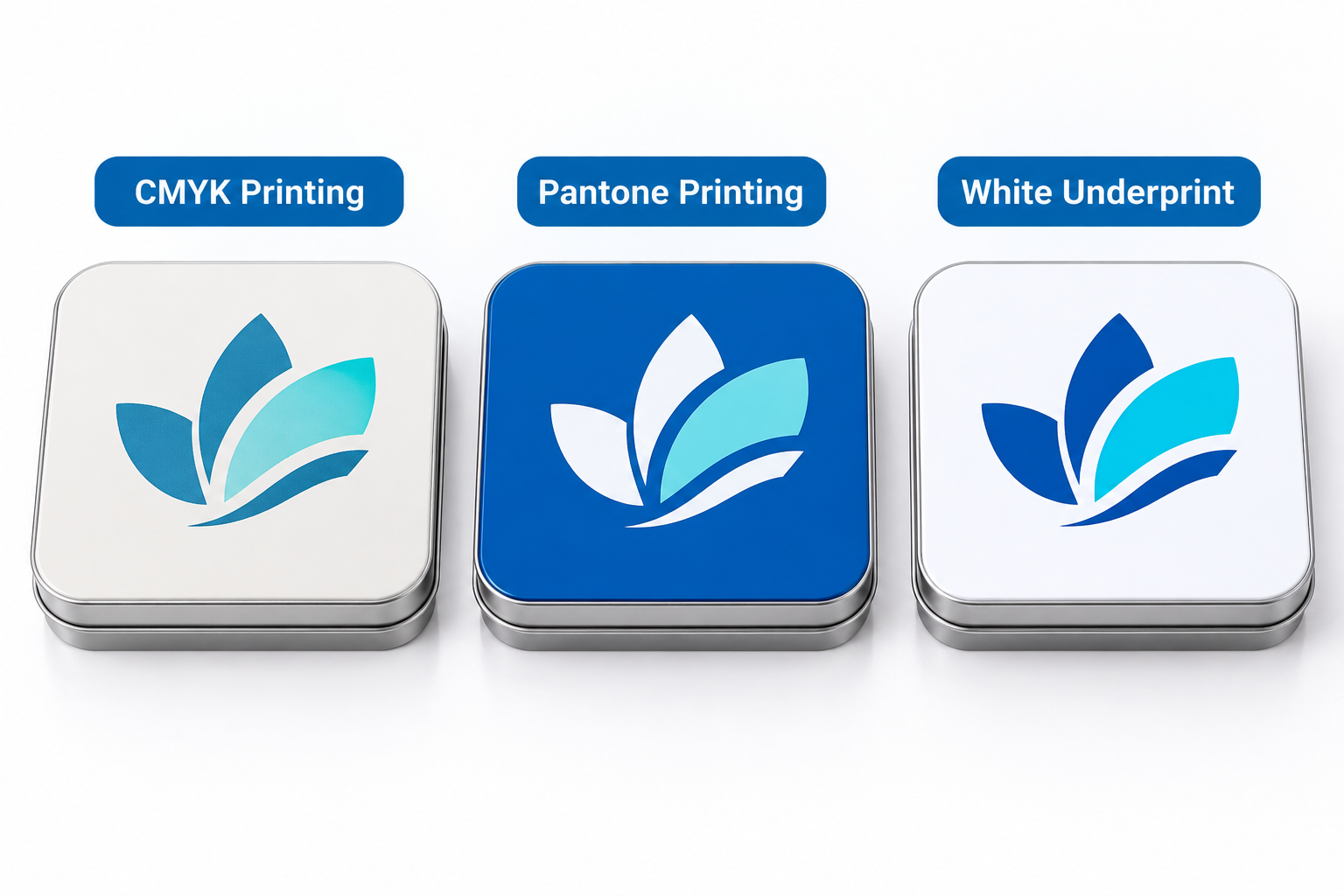
CMYK
CMYK builds color from four process inks. It suits illustrations, photographs and gradients where many shades are involved.
Pantone (PMS)
Pantone matching specifies a named brand color rather than a mix of process inks. Use it when a logo color must stay consistent across products.
White ink (white underprint)
White ink is a base layer printed under the artwork so colors sit on white instead of bare metal. It matters for bright colors, white areas and large solid fills. The candy tin artwork guide shows examples.
Matte and gloss finish
Matte gives a softer, less reflective surface. Gloss gives a brighter surface with stronger reflections. The same artwork can look noticeably different under each, so the finish should be chosen before artwork approval.
Embossing and debossing
Embossing raises part of the surface, and debossing presses it in. Both are usually applied selectively, for example to a logo, to keep the design clear.
Print registration
Registration is the alignment of the color layers relative to each other and to the tin. Poor registration shows as blurred edges or color shifts. See printed tin quality checks for what to inspect.
Tooling and Production Terms
Mold (tooling)
A mold, also called tooling, is the set of tools that forms a specific tin shape. A new structure needs a new mold, which adds development work and cost. Special shape tin packaging covers when that applies.
Existing mold vs. new mold
An existing mold is a structure the factory already has, so you can start from it. A new mold is built for your design. Existing molds are usually the more straightforward route. A new mold gives you a unique structure at the cost of extra development.
OEM, ODM and stock tins
OEM means the tin is made to your specification and design. ODM means you adapt a design the factory already developed. A stock tin is a ready-made tin from the factory’s existing range. Our OEM tin packaging guide compares the three routes.
MOQ
MOQ is the minimum order quantity the factory will produce for a given specification. It changes with structure, printing and tooling, so confirm it against your actual design. Current figures are on the cost, MOQ and lead time guide and the FAQ page.
Sample and sample approval
A sample is a physical tin made to your specification. Sample approval is your written confirmation that fit, lid action, printing and finish are acceptable. Mass production should not start before it.
Pre-production (reference) sample
A pre-production sample is the approved sample kept as the reference for mass production and inspection. It gives both sides one physical standard to compare against.
Quality, Order and Shipping Terms
Dimensional tolerance
Tolerance is the allowed variation from a stated dimension. Agree it in writing for any dimension that affects product fit or lid fit.
AQL and pre-shipment inspection
AQL is a sampling standard that defines how many pieces are inspected and how many defects are acceptable. Pre-shipment inspection applies a standard like this to the finished order before it ships. What to check, and when, is covered in our pre-shipment inspection guide.
RFQ
RFQ means request for quotation. A good RFQ names the tin type, internal size, lid, printing, finish, inserts, quantity and destination market. A template appears at the end of this glossary.
Factory lead time vs. door-to-door
Factory lead time covers production only. Door-to-door time also includes sample revisions, inspection, shipping and customs. Plan the launch date from the full chain. The custom tin packaging process shows the stages in order.
FOB and EXW
FOB (free on board) and EXW (ex works) are trade terms that define where the seller’s responsibility ends and who pays for each leg of transport. Always check which one a quotation uses before comparing prices.
Food-Contact Terms
Food-contact compliance
This means that the materials touching food, including the tinplate surface, coating, inks near the contact side, inner bags and liners, meet the rules of the market where the food is sold. The tin alone does not guarantee compliance of the finished packaged product.
For the EU, Regulation (EC) No 1935/2004 sets the general framework and Regulation (EC) No 2023/2006 covers good manufacturing practice. Regulation (EU) 2024/3190, applicable since January 20, 2025, restricts bisphenol A and other hazardous bisphenols in food contact materials, including varnishes and coatings, with transition periods that differ by article type. In the US, food-contact substances, including coatings, fall under FDA requirements. Confirm what applies to your product and destination.
Migration test
A migration test is a laboratory test that measures whether substances transfer from a material into food or a food simulant. Ask which tests were run and for which conditions.
Declaration of compliance
A declaration of compliance is a supplier document stating that a material meets the relevant food-contact rules. Ask which documents are available for your destination market before you order.
Terms Buyers Most Often Mix Up
| Pair | Difference |
|---|---|
| Internal vs. external size | Internal is the usable product space; external is the outside of the closed tin. |
| CMYK vs. Pantone | CMYK mixes process inks for detailed artwork; Pantone specifies one exact brand color. |
| Existing mold vs. new mold | Existing uses a structure the factory already has; new builds tooling for your design. |
| OEM vs. ODM | OEM follows your design; ODM adapts the factory’s design. |
| Sample approval vs. pre-shipment inspection | Approval confirms the design before production; inspection checks the finished order before shipping. |
How to Use These Terms in an Inquiry
A clear inquiry uses the terms above in one line. Copy and fill in:
[Tin shape] + [internal size L × W × H] + [lid type] + [printing: CMYK / Pantone / white underprint] + [finish: matte / gloss / embossing] + [insert or inner bag] + [quantity] + [destination market] + [target delivery date]
An illustrative example of the format: Rectangular tin, internal size 180 × 120 × 45 mm, slip lid, CMYK with white underprint, matte finish, EVA insert tray, destination EU. The dimensions are examples only. Use your own product measurements or send a physical sample.
If some items are still undecided, say so and ask for a recommendation rather than guessing.
Frequently Asked Questions
What is the difference between tinplate and an aluminum tin?
Tinplate is a steel base coated with tin. An aluminum tin uses aluminum instead. The choice affects weight, forming options and cost, so confirm it with the factory for your product.
What does “existing mold” mean in a quotation?
It means the factory already has tooling for that structure, so your project starts from a proven shape and only the artwork and finish are customized. A new mold means tooling is developed for your design.
What is the difference between OEM and ODM tins?
OEM tins are made to your specification and design. ODM tins start from a design the factory already developed, which you adapt with your branding. Our OEM tin packaging guide compares both with stock tins.
Should I specify CMYK or Pantone?
Use CMYK for illustrations, photographs and gradients. Use Pantone when one brand color must stay consistent. Many designs use both. Confirm the specification and any white underprint before artwork approval.
Why does sample approval come before mass production?
The sample is the first physical proof that the tin fits your product, opens and closes correctly and prints as intended. Approving it in writing gives both sides a reference for production and inspection.
Start a Tin Packaging Project with the Right Terms
Dongguan Liyi Packaging Products Co., Ltd. is a tin packaging manufacturer in Qingxi Town, Dongguan, with more than 25 years of industry experience and a 3,000㎡ factory. Our team supports projects from structure and artwork to sampling, production and pre-shipment inspection.
To get started, send your product information, target quantity and artwork through our contact page, or review our custom solutions first. If you are still choosing a shape, browse the rectangular, round, square and irregular tin ranges, or read the custom tin packaging guide.