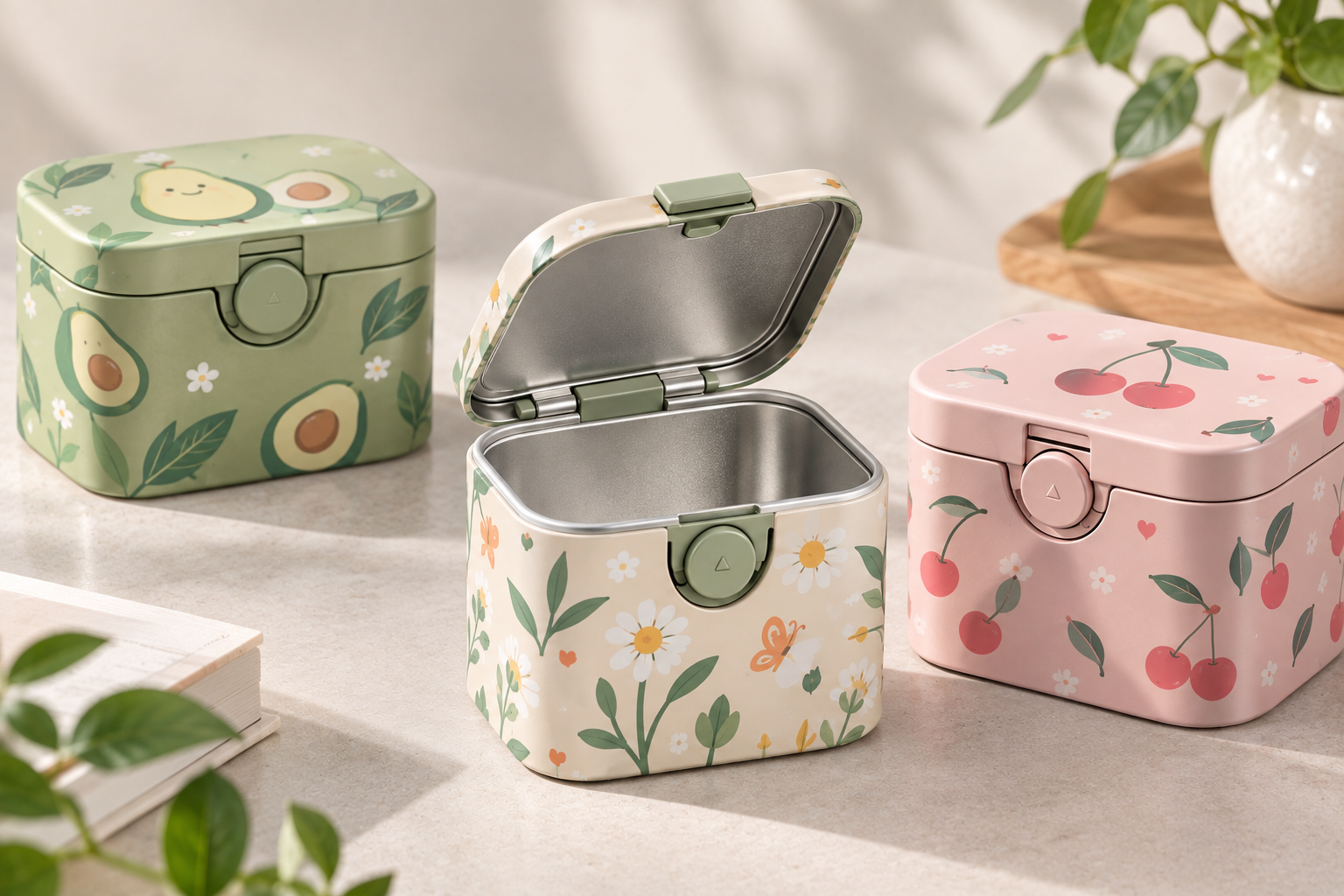
Last Updated: September 20, 2026
Child resistant tin packaging is designed to make access more difficult for young children while remaining usable by intended adult users. For regulated products, however, a tin does not become child resistant simply because it has a button, latch, or locking mechanism.
The complete package configuration, applicable regulation, and testing procedure determine whether a package meets a specific child-resistant requirement.
For buyers, choosing a CR tin means considering the target market, product, closure mechanism, dimensions, inserts, opening frequency, testing requirements, and final package configuration together.
At Liyi Packaging, we develop custom tin packaging around these requirements, from structural design and sampling to printing, accessories, testing coordination, and mass production.
What Makes Child Resistant Tin Packaging Different?
A standard tin mainly focuses on product protection, dimensions, appearance, printing, and general usability. Child resistant tin packaging adds a controlled-access requirement.
That means CR performance depends on the complete package configuration, not on one individual feature.
Important factors can include:
- Tin dimensions
- Lid and base construction
- Closure mechanism
- Button or release position
- Closure force
- Lid overlap
- Internal inserts
- Product contents
- Opening and closing requirements
- Manufacturing tolerances
- Applicable testing protocol
For U.S. special packaging, 16 CFR 1700.15 also addresses continued effectiveness during the life of the product and customary opening and closing, along with other requirements that may apply to specific regulated substances.
This is why adding a “child lock” to an existing tin does not automatically establish child-resistant compliance.
Which Child Resistant Packaging Standards Should You Check?
The applicable standard depends on the product, market, and regulatory framework. Three references commonly appear in CR packaging projects.
| Standard | Main purpose | What buyers should know |
|---|---|---|
| 16 CFR 1700.20 | U.S. special-packaging testing procedure | Key U.S. test protocol where PPPA requirements apply |
| ISO 8317:2015 | Child-resistant reclosable packaging | International testing standard; not a substitute for the U.S. PPPA protocol |
| ASTM D3475-20 | Classification of child-resistant packages | Classification standard, not proof of successful regulatory testing |
16 CFR 1700.20
For U.S. special packaging subject to the Poison Prevention Packaging Act, 16 CFR 1700.20 establishes the testing procedures for child, senior-adult, and younger-adult tests.
CPSC states that alternative tests such as ISO 8317 are not accepted as substitutes when determining compliance with U.S. special-packaging requirements.
ISO 8317:2015
ISO 8317 covers requirements and testing procedures for reclosable child-resistant packages.
It can be relevant for international packaging projects where the applicable market or customer specification calls for ISO testing. For a U.S. PPPA project, however, the applicable U.S. protocol should be confirmed rather than assuming an ISO report is sufficient.
ASTM D3475-20
ASTM D3475 is a classification standard for child-resistant packages. The current ASTM listing identifies D3475-20 as the active edition.
The classification covers Type I through Type XIII. For example, Type III includes snap-closure package concepts.
Importantly, classification does not mean that a package has successfully passed a regulatory child-resistant test. The classification of our specific flip-cover/button structure should be confirmed by the applicable testing laboratory.
What Are the U.S. Child-Resistant Testing Requirements?
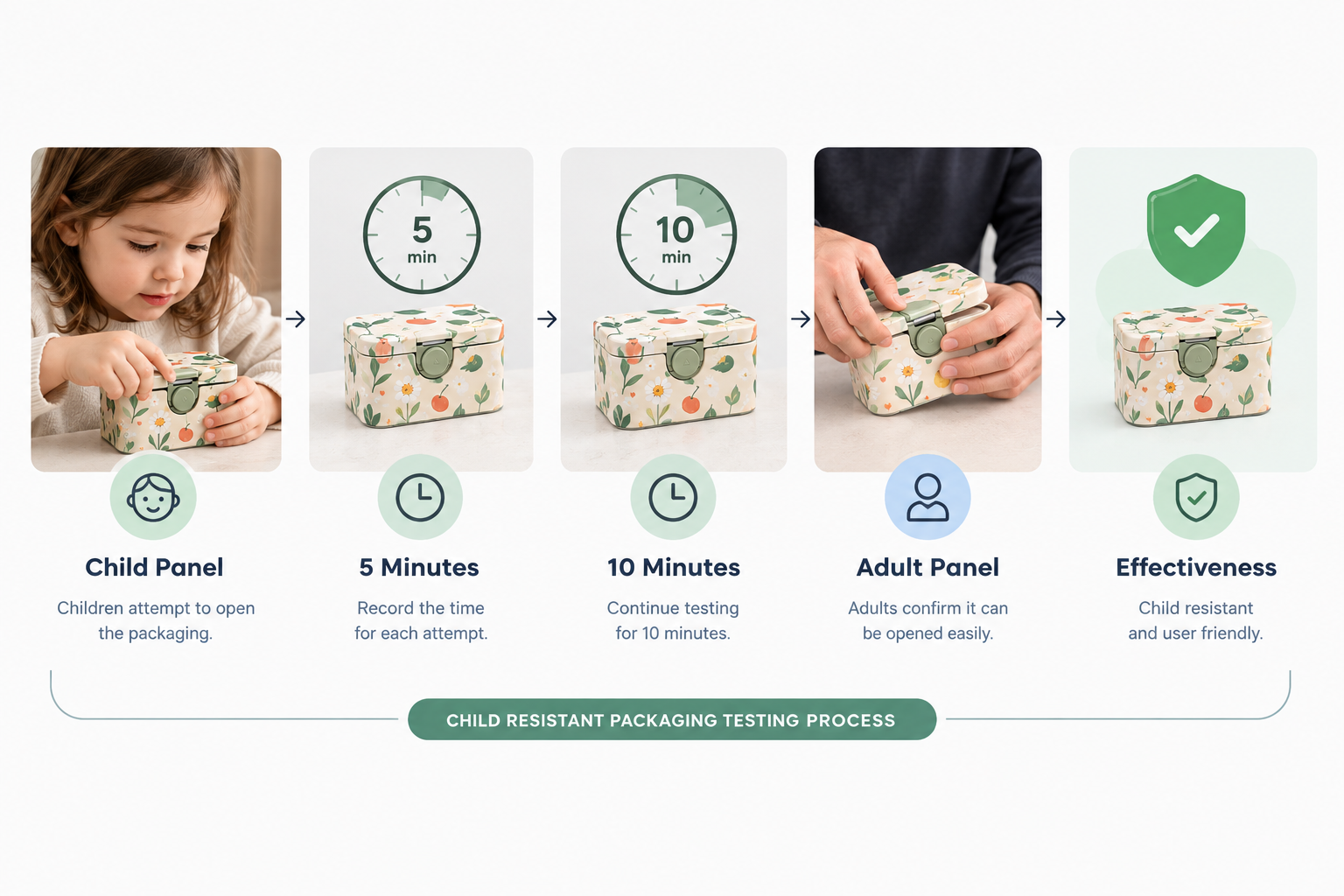
Where the U.S. PPPA requirements apply, the basic effectiveness requirements include:
| Test area | Requirement |
|---|---|
| Child-resistant effectiveness | At least 85% must not open during the first 5 minutes |
| After demonstration | At least 80% must not open during the full 10-minute test |
| Senior-adult effectiveness | At least 90% must successfully open the package within 5 minutes, including any applicable failure to properly resecure the second package |
For products that meet the specific regulatory conditions for a metal-container exception, the younger-adult test applies instead of the standard senior-adult test, with a 90% effectiveness requirement.
The exact testing sequence, test population, and pass/fail procedure are defined in 16 CFR 1700.20.
Important exception for certain metal containers
Metal packaging requires an additional regulatory check.
Under 16 CFR 1700.15(b)(2)(ii), certain products that are required to use metal containers are evaluated using a younger-adult test rather than the standard senior-adult test.
This provision applies only when the product meets the specific regulatory conditions for requiring a metal container. The regulation also contains a presumption concerning products previously marketed in nonmetal packaging.
Therefore, a metal tin should not automatically be treated as qualifying for the younger-adult test simply because it is made from tinplate.
For a specific project, we recommend confirming whether this provision applies with the responsible compliance professional or testing laboratory before testing.
How Do CR Tin Mechanisms Work?
Different child-resistant mechanisms use different user actions and require different structural clearances.
| Mechanism concept | Typical user action | Structural consideration |
|---|---|---|
| Push-and-twist | Press down and rotate | Requires sufficient grip and rotational clearance |
| Press-and-snap | Press a designated release area | Requires controlled pressure and structural support |
| Squeeze-and-release | Squeeze designated areas and open | Requires sufficient grip space |
| Dual-button | Operate two release points | Requires additional lid or side space |
| Press-and-slide | Press release and slide | Requires a defined sliding path |
| Side-button latch | Press a side button to release | Button and latch affect perimeter space |
These are mechanism concepts rather than certifications.
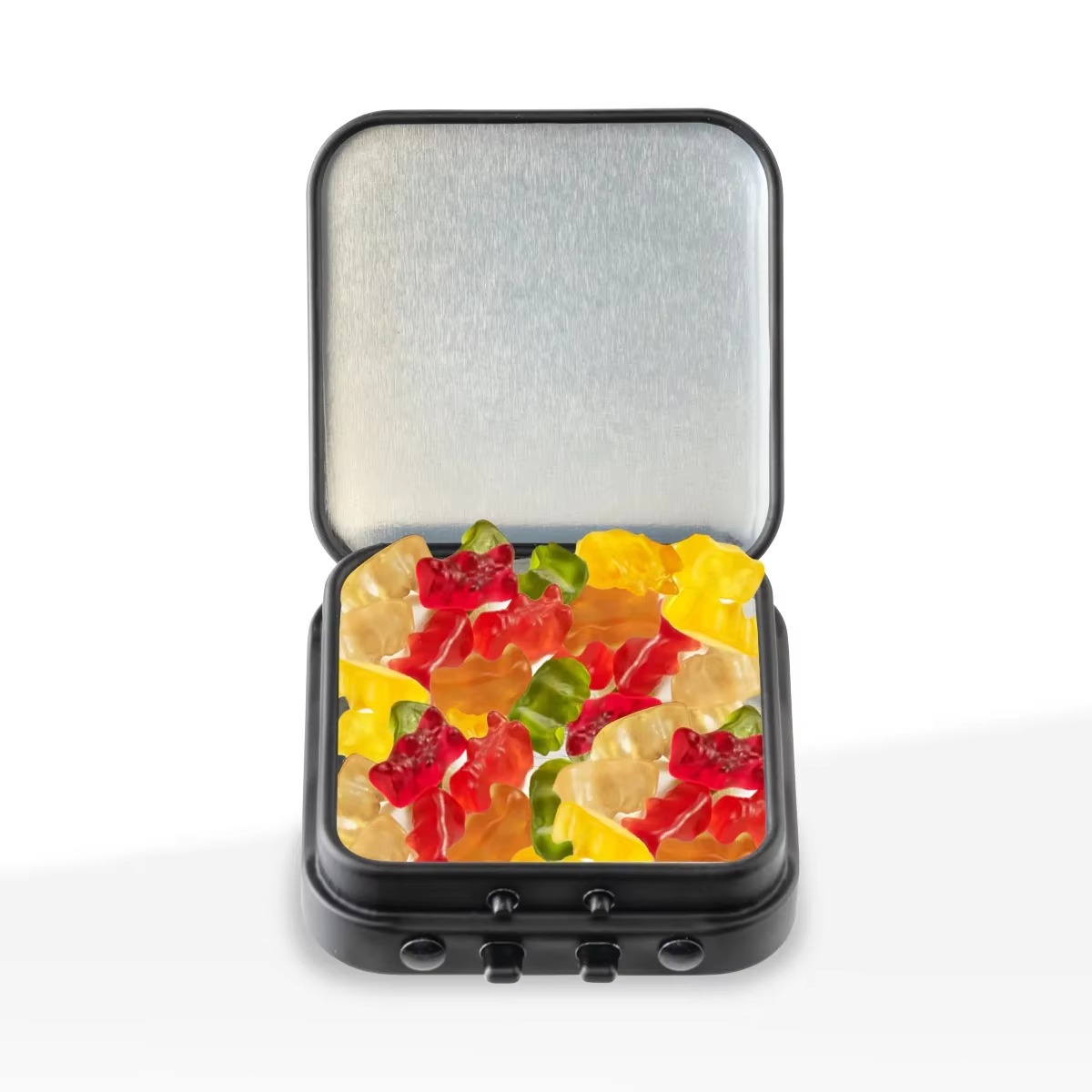
Our current CR tin structure uses a flip-cover lid with a button-style anti-child-lock mechanism. We can customize the tin size, shape, printing, finish, and internal accessories around the required product configuration.For businesses looking for a custom child resistant tin, we can develop the tin structure, dimensions, printing, and mechanism according to the project requirements.
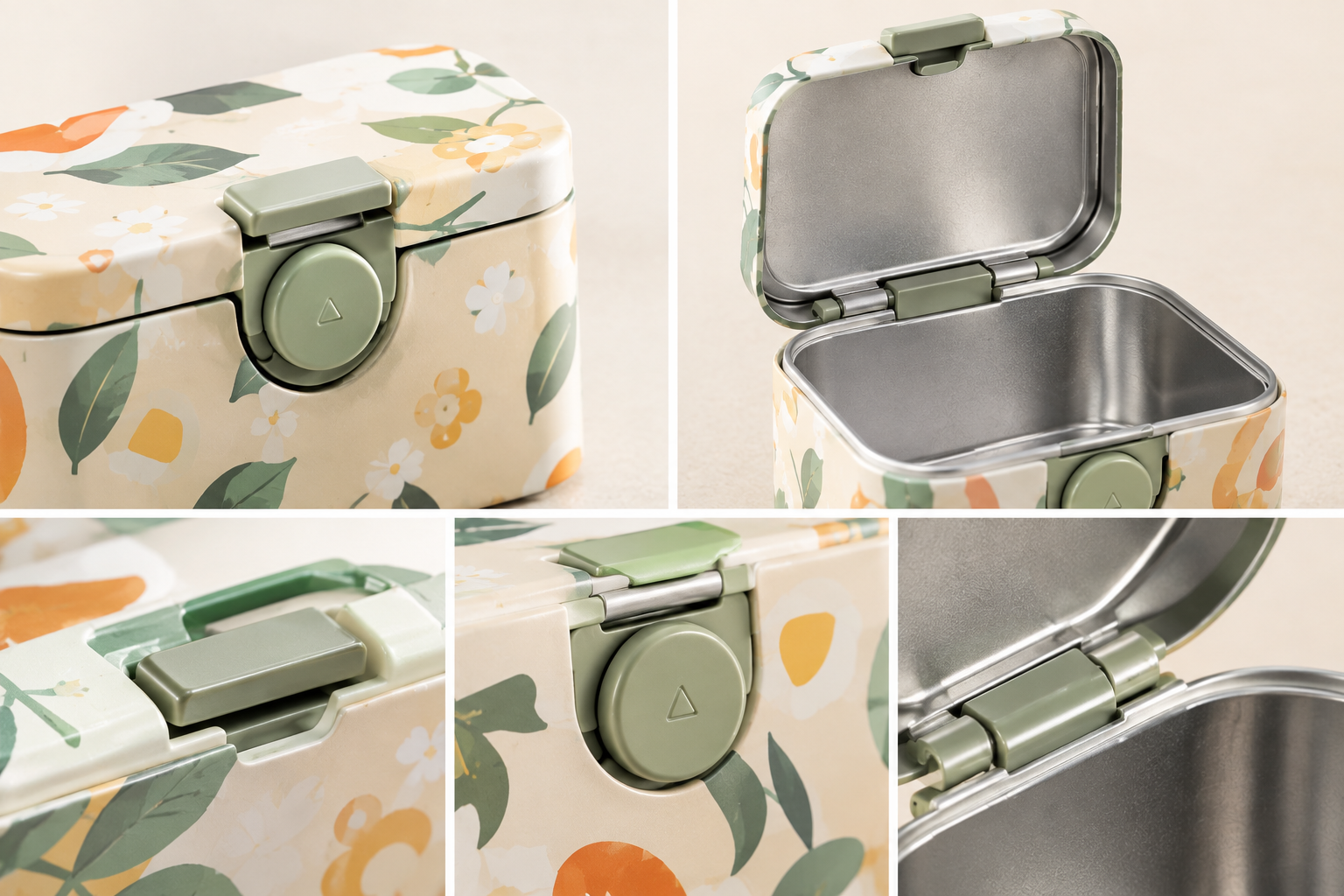
For testing projects, we can coordinate with testing laboratories such as SGS or TÜV according to the customer’s required testing scope. The applicable laboratory and protocol should be confirmed before final production.
How Should You Choose a CR Tin Structure?
The right structure should be selected from the product and compliance requirements outward.
1. Start with the product dimensions
Define the actual product before finalizing the tin:
- Product length, width, and height
- Quantity per tin
- Product orientation
- Required insert
- Internal clearance
- Required lid clearance
For a practical example of calculating internal space from product dimensions, quantity, packing layout, and clearance, see our How to Calculate Square Cookie Tin Size: Step-by-Step Guide.
The same principle applies to CR tins: determine the product and internal space first, then develop the external structure and closure.
2. Confirm the target market
Before tooling, confirm:
- Country and state
- Product category
- Applicable regulation
- Required CR standard
- Testing organization
- Documentation requirements
A package that works for one market may require different testing or documentation in another.
3. Consider opening frequency
For applicable U.S. special packaging, the package must continue to function effectively for the life of the product and for the customary number of openings and closings for its size and contents.
This makes closure durability, activation force, wear, and manufacturing tolerances important during structural development.
4. Check the product and insert together
Internal accessories can affect the operation of the CR mechanism.
Before sampling, we check:
- Product position
- Insert thickness
- Lid clearance
- Button clearance
- Closure travel
- Product removal
- Reclosing requirements
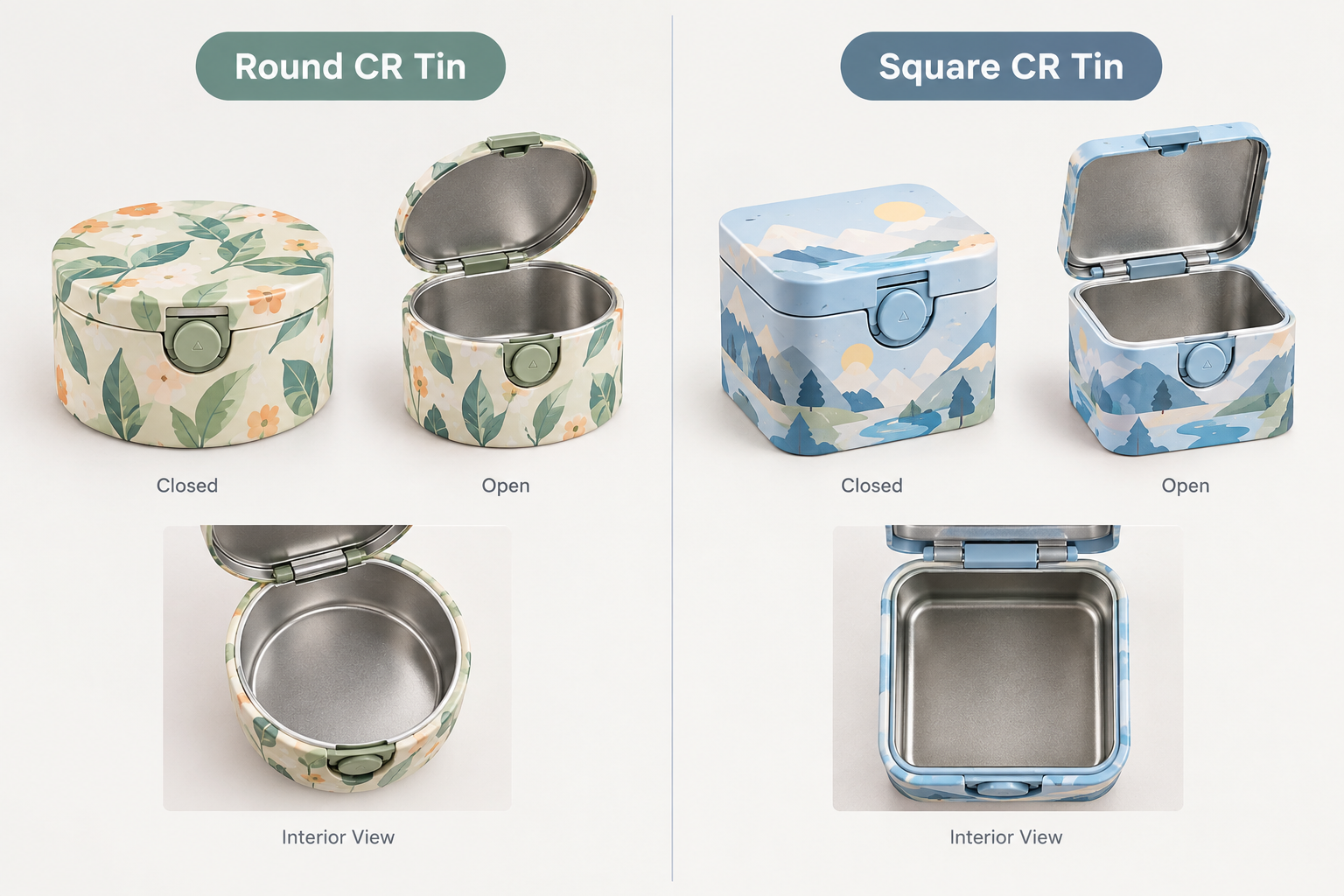
How Does Round vs. Square Shape Affect a CR Tin?
The tin shape can influence how the mechanism and internal components are arranged.
| Consideration | Round CR Tin | Square / Rectangular CR Tin |
|---|---|---|
| Mechanism placement | Often concentrated around the lid perimeter | More flexibility along straight edges |
| Insert matching | Suitable for circular product layouts | Often easier for rectangular inserts |
| Product arrangement | Useful for centered or circular layouts | Useful for rows, stacks, or rectangular layouts |
| Opening feel | Influenced by diameter and mechanism position | Influenced by edge placement and closure geometry |
| Space planning | Mechanism and insert work around curved walls | Straight walls can simplify some layouts |
The shape itself does not establish child-resistant performance. The complete package still needs to meet the applicable requirements.
Which Products May Require Child Resistant Tin Packaging?
Child-resistant packaging requirements depend on the product and jurisdiction.
Potential applications can include:
- Certain pharmaceutical products
- Controlled drugs
- Liquid nicotine packaging
- Cannabis products
- Cannabis edibles
- Pre-roll packaging
- Other regulated substances
These categories should not automatically be treated as subject to one identical federal requirement.
What does U.S. federal law say about cannabis?
CPSC staff’s March 2024 PPPA webinar slides discuss cannabis in the context of the PPPA and 16 CFR 1700.14(a)(4). The provision concerns controlled drugs in dosage form intended for oral administration that are subject to the federal Controlled Substances Act. The staff presentation discusses marijuana in relation to this provision and notes that states may incorporate 16 CFR Part 1700 into their own marijuana requirements.
The important limitation is the product form.
16 CFR 1700.14(a)(4) specifically addresses oral dosage forms. Other cannabis forms, including inhaled products such as pre-rolls, may not fall under that provision in the same way. Their federal and state requirements should therefore be evaluated separately.
For cannabis packaging, we recommend checking both the applicable federal provisions and the specific state requirements before finalizing the CR package.
16 CFR § 1700.14 — Substances Requiring Special Packaging
Rhode Island example
State requirements can be more specific than the general federal framework.
Rhode Island’s Office of Cannabis Regulation currently lists Child Resistant Packaging under its Packaging and Labeling Requirements. Its published guidance states that the packaging must be tested and certified as meeting the federal standards in 16 CFR 1700 by a qualified third-party testing firm. The guidance also states that the licensee is responsible for ensuring the packaging is certified and that documentation may be requested by the Office of Cannabis Regulation.
This is a Rhode Island state requirement example, not a statement that every U.S. state requires the same third-party testing process.
For other cannabis forms and other states, applicable requirements should be confirmed with the relevant state regulator and compliance professional.
Who Is Responsible for CR Packaging Compliance?
This distinction is important when working with a packaging manufacturer.
Under CPSC’s PPPA guidance, the entity that introduces the regulated substance into the packaging is responsible for the finished product’s applicable certification. An empty-package supplier is not the responsible manufacturer simply because it supplied the container.
In practice:
We manufacture the tin package. The company placing the regulated product into the package remains responsible for ensuring that the finished product meets the applicable requirements.
PPPA testing also does not have to be conducted by a CPSC-accepted third-party laboratory. The CPSC’s PPPA webinar explains that the required PPPA testing can be performed by an appropriate party following the applicable protocol.
This is different from a state rule, customer specification, or other program that specifically requires testing by a qualified third-party laboratory.
Can the finished-product manufacturer rely on our test data?
Potentially.
CPSC staff’s March 2024 PPPA webinar explains that the manufacturer of the finished product may rely on a third party’s test report or certificate when the requirements of 16 CFR Part 1109 are satisfied. However, the finished-product manufacturer must still issue its own General Certificate of Conformity for the finished product where required.
For a project where we conduct or coordinate testing, the parties should agree in advance on who maintains the underlying report and how the responsible manufacturer will access the supporting documentation.
What Is the Testing Status of Our Current CR Tin?
At present, we do not have a third-party test report for the listed flip-cover/button CR tin structure.
Our listed CR tin uses a flip-cover lid with a button-style anti-child-lock mechanism. We can arrange testing according to the customer’s required scope and applicable market.
We therefore do not represent the currently listed structure as having an existing third-party CR test report.
If a project requires formal testing, we can develop the specified configuration and coordinate the testing process according to the applicable market and protocol.
The final test configuration may include:
- Tin dimensions
- Closure structure
- Material
- Product contents
- Inserts
- Manufacturing tolerances
- Final packaging configuration
A change to these factors can affect whether previous test data remains representative.
How Can We Customize Child Resistant Tin Packaging?
Once the CR structure has been defined, we can customize the package around the required configuration.
Custom size and tooling
We support custom dimensions and new mold development for tin packaging.
For CR tins, the final quotation can depend on:
- Mechanism complexity
- Tooling
- Tin dimensions
- Material thickness
- Printing
- Surface finishing
- Internal accessories
- Testing requirements
- Order quantity
Printing and finishing
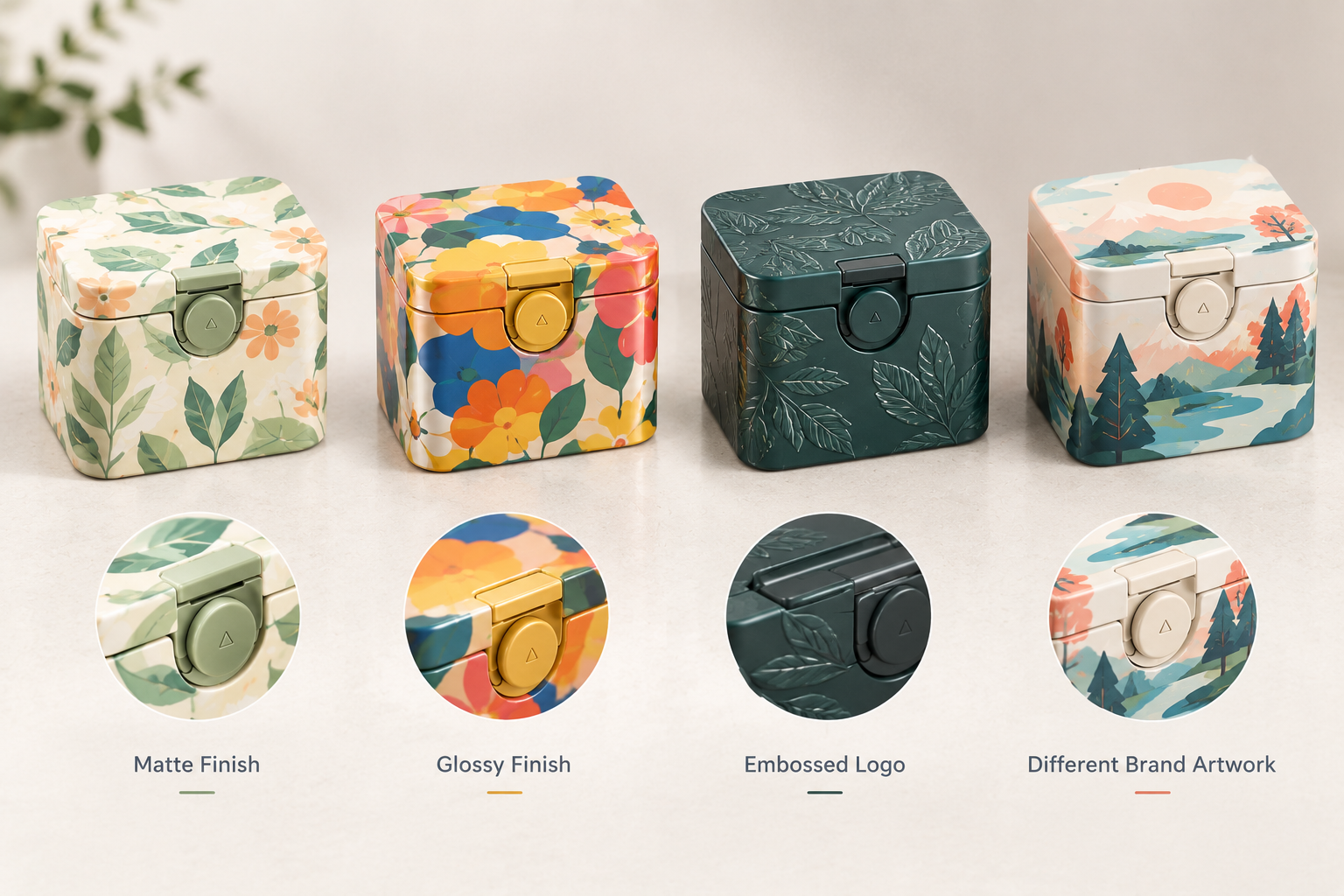
We can customize the exterior appearance with:
- CMYK printing
- Pantone colors
- Matte finish
- Glossy finish
- Embossing
- Varnish
- Other customized surface treatments
For artwork preparation, printing methods, finishing, and production requirements, see our Custom Printed Tin Packaging: Artwork, Printing Options & MOQ Guide.
Internal accessories
Depending on the product, we can provide:
- EVA inserts
- Foam
- Sponge
- PET sheets
- Cardboard inserts
- Paper components
- Trays
The insert should be reviewed together with the CR mechanism so that it does not interfere with opening, closing, or product access.
What Is the MOQ for Custom Child Resistant Tin Packaging?
MOQ is confirmed according to the tin structure, tooling, printing requirements, accessories, and order quantity.
For our current custom printed tin packaging projects, the published MOQ starts from 3,000 pcs, but CR tin projects may require a different quantity depending on the mechanism and tooling.
For a CR project, we recommend confirming MOQ after the structure and tooling requirements have been defined rather than applying one fixed number to every configuration.
For the broader printing and MOQ considerations, see our Custom Printed Tin Packaging: Artwork, Printing Options & MOQ Guide.
What Should You Confirm Before Ordering a CR Tin?
Before requesting a final quotation, prepare:
| Requirement | What to confirm |
|---|---|
| Product | What will be packaged? |
| Market | Where will the product be sold? |
| Regulation | Which CR requirement applies? |
| Shape | Round, square, rectangular, or custom |
| Dimensions | Internal and external dimensions |
| Mechanism | Preferred opening concept |
| Opening frequency | Single-use or repeated opening |
| Inserts | Tray or internal support requirements |
| Artwork | Logo, graphics, colors |
| Finish | Matte, gloss, embossing, etc. |
| Testing | Required protocol and laboratory |
| Quantity | Initial order and forecast |
Providing these details before tooling helps us develop the structure around the actual product and compliance requirements.
How Do We Support Custom CR Tin Projects?
At Liyi Packaging, we support custom tin projects from structural development through production.
Our company, Dongguan Liyi Packaging Products Co., Ltd., operates in Qingxi Town, Dongguan, near Shenzhen. We have more than 10 years of company operation and more than 25 years of industry experience. Our capabilities cover design and development, production, printing, accessories, and quality control through pre-shipment inspection.
For CR tin projects, our support can include:
- Structural consultation
- CR mechanism development
- Custom dimensions
- Structural samples
- Printing and finishing
- Internal accessories
- Testing coordination
- Mass production
Our goal is to develop the package around the actual product, market, and required testing—not simply add a “child lock” to a standard tin.
What Is the CR Tin Development Process?
A typical project can follow this sequence:
Product & Market Requirements
↓
CR Mechanism & Tin Dimensions
↓
Structural Prototype
↓
Final Artwork + Printing + Finish
↓
Representative Final Package Sample
↓
Applicable CR Testing
↓
Package Approval
↓
Mass Production
For regulated products, the test sample should represent the intended production configuration to the extent required by the applicable testing protocol.
Frequently Asked Questions About Child Resistant Tin Packaging
Does every CR tin size need to be tested separately?
Not necessarily.
CPSC explains that the PPPA does not specifically establish a formal “bracket testing” rule. However, CPSC staff may consider testing intervals when a manufacturer can make an informed determination using other test results, trends, or comparable information.
For a multi-size series, CPSC guidance discusses testing the smallest and largest sizes along with selected sizes between them. The final test strategy should be agreed with the responsible compliance party and laboratory.
Can CR packaging be used for products that are not regulated under the PPPA?
Yes.
CPSC states that it does not prohibit the use of special packaging for substances that are not regulated under the PPPA.
This can be relevant when a customer wants additional child-resistant access control even though the specific product is not subject to a federal PPPA packaging requirement.
Can the packaging supplier keep the underlying test records?
Potentially, depending on the project arrangement.
CPSC staff’s March 2024 PPPA webinar explains that a finished-product manufacturer may rely on a third party’s test report or certificate when the applicable 16 CFR Part 1109 conditions are met, while the finished-product manufacturer must still issue its own applicable GCC.
If we agree to maintain the underlying test records for a project, the responsible party should be able to obtain the supporting documentation when required.
This should be agreed during the project rather than assumed as a standard service.
Why do we use “child resistant” instead of “child proof”?
“Child resistant” is the appropriate regulatory concept because special packaging is designed to be significantly difficult for young children to open—not impossible for every child to open.
CPSC materials explicitly distinguish child-resistant packaging from child-proof packaging.
For this reason, we use Child Resistant (CR) Tin as the preferred product terminology.
Request a Custom Child Resistant Tin
If you are developing a child resistant tin for a regulated or sensitive product, start with the product, market, dimensions, and applicable testing requirement.
We can support the project from CR structure development and sampling through artwork, inserts, testing coordination, and mass production.
For a quotation, send us:
- Product type
- Target market
- Required tin dimensions
- Estimated quantity
- Preferred CR mechanism, if known
- Insert requirements
- Artwork or logo
- Required testing standard or regulatory reference
Request a Custom Tin Packaging Quote
Official Standards & Regulatory References
- CPSC — Poison Prevention Packaging Act (PPPA) Webinar, March 21, 2024 — CPSC staff presentation covering special packaging, testing, certification, and related questions.
- CPSC — PPPA Webinar Slide Deck — includes discussion of third-party test reports, GCC responsibility, and cannabis-related PPPA considerations.
- 16 CFR § 1700.14 — substances requiring special packaging.
- 16 CFR § 1700.15 — performance requirements for special packaging.
- 16 CFR § 1700.20 — testing procedures for special packaging.
- ISO 8317:2015 — child-resistant reclosable packaging.
- ASTM D3475-20 — classification of child-resistant packages.
- Rhode Island DBR — Bulletins and Guidance — state-level cannabis packaging guidance, including Child Resistant Packaging.
Information reviewed: September 20, 2026.