
Last updated: September 2026
Choosing a square cookie tin is not simply a matter of matching the cookie count to a standard tin size. The actual internal dimensions depend on the cookie dimensions, packing layout, number of layers, inserts, and clearance.
We work with cookie brands on this sizing question regularly, and the most reliable approach is to calculate the required internal space from the cookies first. This guide walks through that process step by step, including a practical clearance reference in millimeters.
How to Calculate Your Square Cookie Tin Size (Step-by-Step)
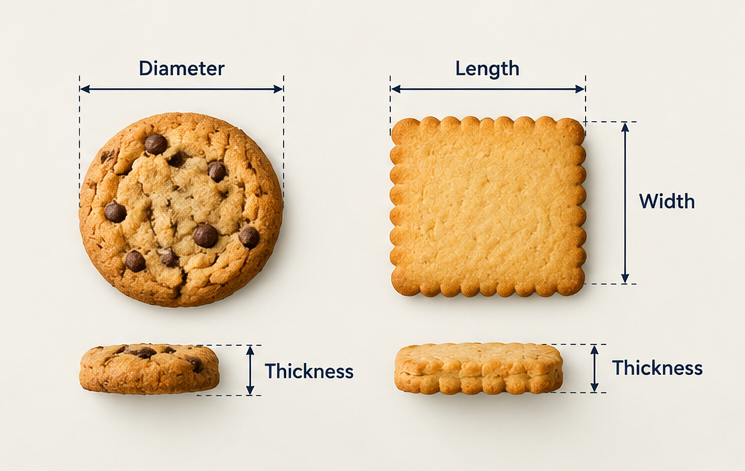
Step 1: Measure the Cookie
Start with the actual cookies you plan to pack.
For each cookie, confirm:
- Length
- Width or diameter
- Thickness
For round cookies, measure the diameter and thickness. For square or rectangular cookies, measure the length, width, and thickness.
If the cookies have irregular shapes, fillings, toppings, or delicate decorations, use the largest actual dimensions as the reference rather than the average size.
Step 2: Confirm the Cookie Quantity
Next, determine how many cookies the tin needs to hold.
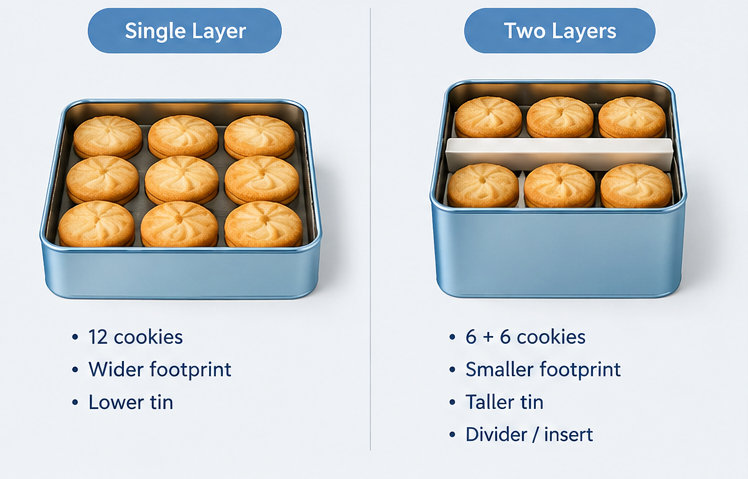
For example, a 12-cookie package could use:
- 12 cookies in one layer
- 6 cookies per layer in two layers
The quantity affects the required footprint and height, so confirm it before calculating the final tin dimensions.
Step 3: Choose the Packing Layout
The same number of cookies can require different tin dimensions depending on how they are arranged.
| Packing layout | Footprint | Required height | Insert |
|---|---|---|---|
| 12 cookies, single layer | Larger | Lower | Optional |
| 12 cookies, two layers | Smaller | Higher | Recommended |
A single-layer layout generally requires more internal floor space but less height.
A two-layer layout can reduce the footprint, but the tin needs additional height for the second layer and divider or insert.
The choice depends on the cookie shape, breakage risk, presentation requirements, and available shelf space.
Once you have selected the packing structure, you can also review our square tin packaging options for available square tin structures.
Step 4: Calculate the Required Internal Space
Once the cookie dimensions and packing layout are known, calculate the space required inside the tin.
A simple reference is:
Required internal space = cookie arrangement + necessary clearance + insert space
For the vertical dimension:
Required internal height = cookie thickness × number of layers + insert/divider space + clearance
For example, if a cookie is 10 mm thick and you are using two layers, the cookies alone require 20 mm of vertical space. You then need to account for the divider or insert and the necessary clearance.
Always confirm whether the manufacturer’s drawing shows internal or external dimensions. When calculating whether the cookies will fit, use the internal dimensions.
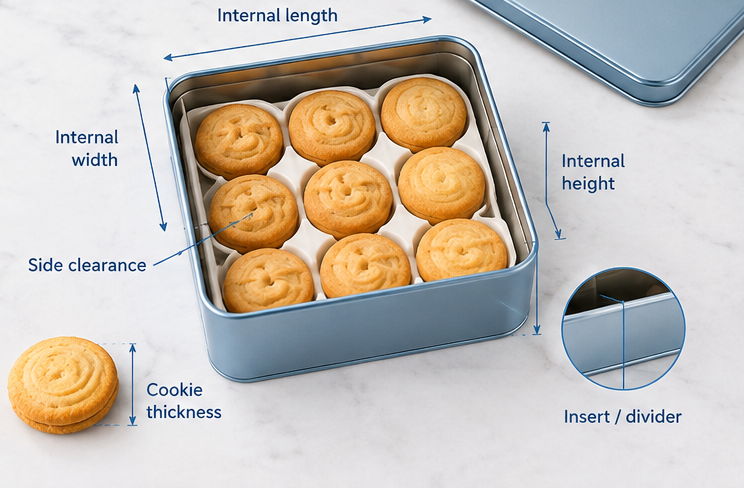
Step 5: Add the Right Clearance
The tin should not fit the cookies so tightly that they are difficult to place, remove, or protect during handling.
As a preliminary planning reference, around 3–5 mm of side clearance can be considered.
This is not a universal industry standard. The final clearance depends on the cookie shape, fragility, insert material, packing method, and transport conditions.
For multi-layer packing, also account for:
- Cookie thickness
- Divider or insert thickness
- Clearance between layers
- Clearance between the cookies and lid
If an insert is required, include its thickness and position before approving the final internal height.
What Is a Practical Square Cookie Tin Size Calculation?
Suppose you need to pack 12 round cookies, with each cookie measuring:
- Diameter: 60 mm
- Thickness: 10 mm
- Quantity: 12
There are two basic layouts to consider.
Single-layer calculation
All 12 cookies are arranged on the bottom of the tin.
This requires enough internal length and width for the complete cookie arrangement, plus the necessary side clearance.
The tin can remain relatively low because there is only one cookie layer.
Two-layer calculation
The 12 cookies are divided into two layers of 6 cookies.
The footprint can be smaller, but the internal height must accommodate:
10 mm × 2 layers + divider/insert space + clearance
This example shows why cookie quantity alone is not enough to determine a tin size.
The calculation needs to consider:
Cookie dimensions + quantity + packing layout + clearance + insert requirements
Square Cookie Tin Size Calculation Checklist
Before sending the dimensions for a custom tin, confirm:
- Cookie length, width, or diameter
- Cookie thickness
- Total cookie quantity
- Number of layers
- Cookie arrangement
- Required internal length
- Required internal width
- Required internal height
- Insert or divider thickness
- Required clearance
- Whether the manufacturer’s dimensions are internal or external
Having these measurements ready makes it much easier to confirm the correct tin structure before production.
What Should You Do After Calculating the Tin Size?
Once your square cookie tin internal dimensions are confirmed, the next step is to determine the order requirements, including MOQ and lead time.
For the next stage of the process, see our square cookie tin customization and ordering guide.
If you are still comparing different square tin structures, you can also visit our Square Tin Box product page.
For other custom metal packaging requirements, see our custom tin packaging page.
Frequently Asked Questions
How do I calculate the internal size of a square cookie tin?
Measure the cookie dimensions first, then determine the quantity and packing layout. Calculate the space required for the complete arrangement and add the necessary clearance and insert space.
How much clearance should I leave in a cookie tin?
Around 3–5 mm of side clearance can be used as an initial planning reference. It is not a fixed standard, and the final amount depends on the cookie, insert, packing method, and transport conditions.
Does the number of cookie layers affect the tin size?
Yes. More layers can reduce the required footprint but increase the required internal height. Divider or insert thickness and vertical clearance must also be included.
Should I calculate using internal or external tin dimensions?
Use internal dimensions when determining whether the cookies will fit. External dimensions are mainly useful for understanding the finished tin’s overall footprint.
How do I calculate tin height for two layers of cookies?
Start with:
Cookie thickness × number of layers + insert/divider space + clearance
For example, two 10 mm cookie layers require 20 mm for the cookies themselves before adding the divider and necessary clearance.
Can a square cookie tin be made to a custom size?
Yes. Custom dimensions can be developed based on the cookie dimensions, quantity, packing layout, and insert requirements.
Last updated: September 2026