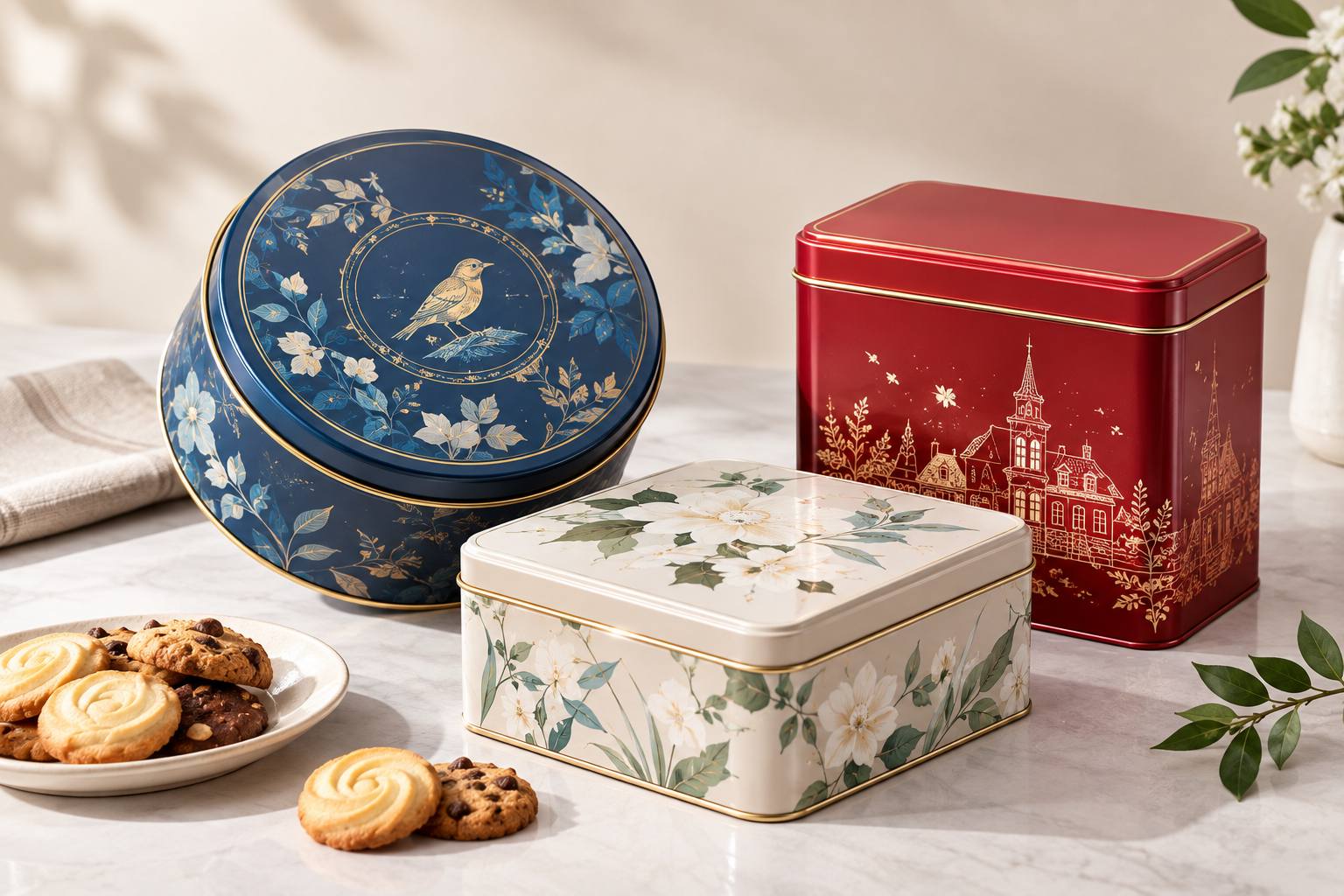
Choosing a cookie tin manufacturer is not simply about finding the lowest price. For food brands, wholesalers, and importers, the more important questions are whether the manufacturer can produce the required structure, meet food-contact requirements, control quality, and deliver consistently on schedule.
This guide focuses on the key points to check before placing a custom cookie tin order, so you can compare manufacturers using the same criteria and avoid costly changes later.
Quick Takeaway
When choosing a cookie tin manufacturer, compare these six areas:
- Production capability
- Material and printing specifications
- Food-contact compliance
- Tooling and sampling
- MOQ and lead time
- Total project cost
For a broader overview of tin packaging applications, you can also explore our Hot Sale Tin Packaging range.
What Should You Check Before Choosing a Cookie Tin Manufacturer?
The first thing to check is whether the manufacturer has a clear production process and can manage the project from artwork to finished tins.
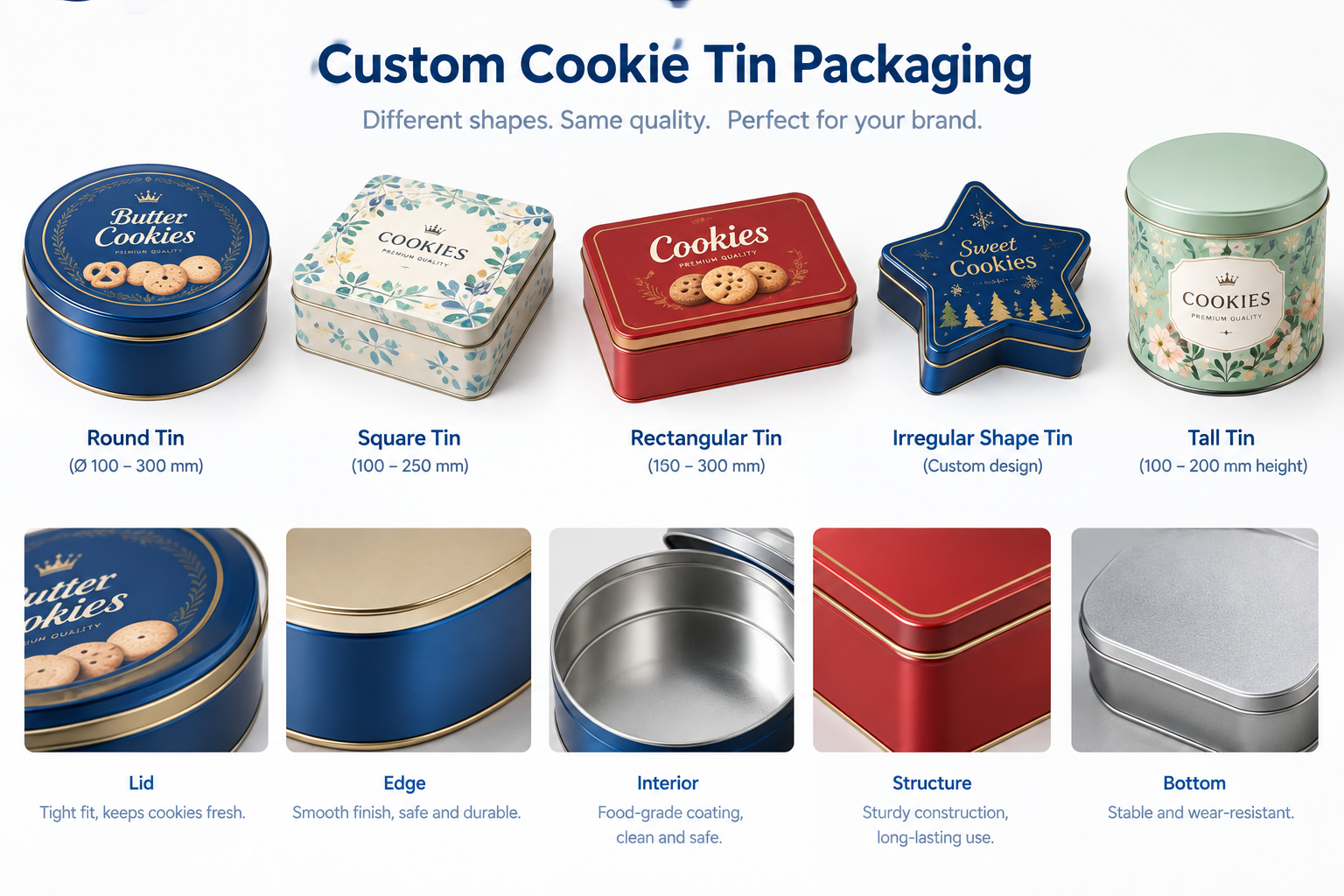
A typical cookie tin production process includes:
Material → Printing → Forming → Assembly → Inspection → Packing
A manufacturer should be able to explain what happens at each stage and identify potential problems before mass production.
For example, in one project, a rectangular tin designed for 24 individually wrapped cookies required more attention to the internal height than the initial specification suggested. The wrapping method and cookie arrangement affected the usable space inside the tin.
This is why the manufacturer should review the actual cookie dimensions, wrapping method, quantity, and stacking arrangement—not just the outside dimensions of the tin.
For rectangular applications, you can also review our rectangular tin box options.
Which Technical Details Matter in Cookie Tin Production?
The most important technical details are material, structure, printing, finishing, and food-contact requirements.
Material and Thickness
There is no single tinplate thickness that works for every cookie tin.
The required specification depends on the tin’s dimensions, shape, lid structure, stacking requirements, and expected use. A manufacturer should recommend the appropriate material specification based on the actual design rather than simply quoting one standard thickness for every project.
Printing and Finishing
Common options include:
- Offset printing
- Matte or gloss finishing
- Metallic effects
- Embossing
- Special surface treatments
For branded cookie tins, artwork should be checked together with the actual tin structure. A digital proof may not fully represent the final appearance of printed metal.
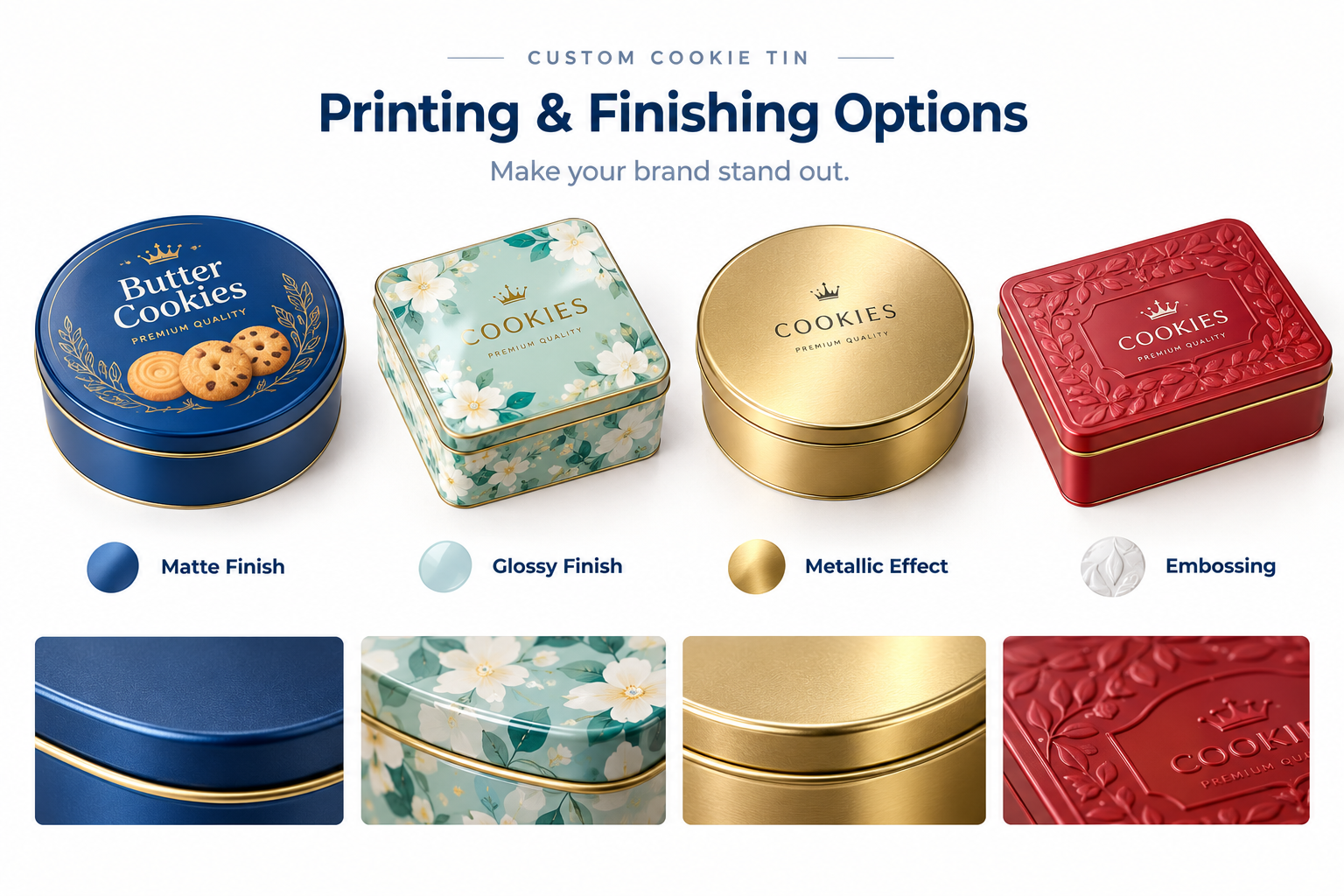
For different tin structures and customization options, see our Custom Solutions page.
Food-Contact Requirements
If the cookie tin will be used for food packaging, compliance should be discussed before production.
For products entering the European market, buyers should consider applicable EU food-contact legislation, including Regulation (EC) No. 1935/2004. See the European Commission – Food Contact Materials page for the relevant framework.
For the U.S. market, applicable FDA food-contact requirements should also be considered. Buyers should request the relevant supporting documentation for the materials and intended application rather than relying only on a general statement such as “FDA approved.” See the U.S. FDA – Food Contact Materials page for official information.
The exact documentation required can depend on the market, material, coating, and intended food-contact application.
How Should You Compare Cookie Tin Manufacturers?
The easiest way to compare manufacturers is to send the same specification to each manufacturer and compare the complete project cost instead of looking only at the unit price.
For example:
| Cost Item | Manufacturer A | Manufacturer B |
|---|---|---|
| Unit price | $0.80/pc | $0.86/pc |
| Order quantity | 10,000 pcs | 10,000 pcs |
| Tooling | New mold required | Existing mold |
| Sampling | Additional cost | Included |
| Packaging | Standard carton | Standard carton |
| Production lead time | 35 days | 28 days |
| Initial project cost | Higher tooling cost | Lower setup cost |
In this example, Manufacturer A has a lower unit price, but the new tooling increases the initial project cost and extends the production schedule.
When comparing quotations, check:
- Unit price
- Tooling cost
- Sampling cost
- Printing cost
- Packaging
- Production lead time
- Shipping terms
- Payment terms
- Reorder conditions
A slightly higher unit price may still make sense if it reduces tooling costs, shortens the timeline, or provides more predictable production.
What Should You Know About MOQ and Lead Time?
MOQ and lead time should be discussed together because production setup, tooling, sampling, and order quantity can all affect the schedule.
A typical project timeline is:
Artwork Confirmation → Tooling → Sample → Approval → Mass Production → Inspection → Packing → Shipment
Before requesting a quotation, provide:
- Estimated order quantity
- Target launch date
- Tin dimensions
- Cookie dimensions
- Packaging method
- Artwork status
- Required printing and finishing
- Destination market
This gives the manufacturer enough information to provide a more useful production schedule.
If you expect repeat orders, mention the estimated annual demand as well. It can help with tooling and production planning from the beginning.
What Should You Check for Cookie Tin Compliance in 2026?
In 2026, regulatory requirements should be considered during packaging development rather than after production has started.
For European projects, the Packaging and Packaging Waste Regulation (PPWR) entered into force in February 2025 and began applying on August 12, 2026. Buyers should therefore check how the regulation applies to their specific packaging and market requirements.
See the European Commission – Packaging and Packaging Waste Regulation page for official information.
A basic compliance checklist should include:
- Target market
- Intended food application
- Material specification
- Coating and printing materials
- Food-contact documentation
- Packaging requirements
- Required test reports or declarations
The important point is to confirm the requirements before mass production, because changing materials or coatings after production has started can affect both cost and delivery time.
What Should You Do Before Approving Mass Production?
The most important step before mass production is to approve a physical sample against one confirmed specification.
Check:
- Overall dimensions
- Internal dimensions
- Lid fit
- Opening and closing
- Cookie capacity
- Printing accuracy
- Surface finish
- Embossing or other details
- Structural stability
- Packaging method
For example, in a gift cookie project, the final sample needed to be tested with the actual cookies and their intended wrapping to confirm the internal space and stacking arrangement.
Once the sample is approved, keep the approved dimensions, artwork, material, finish, and structure as the production reference.
This helps reduce misunderstandings during repeat orders.
How Can Liyipackaging Support a Cookie Tin Project?
Liyipackaging can support the main stages of a custom tin packaging project, including specification confirmation, tooling, sampling, production coordination, and quality inspection.
The most useful starting point is to provide the basic project information:
Tin size + cookie size + quantity + artwork + target market + required delivery date
This allows the packaging requirements to be reviewed before quotation and production.
For a custom project, you can request a cookie tin quote and provide your packaging specifications for review.
FAQ
How early should I contact a cookie tin manufacturer before my product launch?
Start before the final production deadline. Tooling, sampling, approval, mass production, and shipping all need to be included in the schedule.
Can I use an existing mold for my cookie tin?
Possibly. If an existing structure matches your required dimensions and design, it may reduce tooling cost and development time. The manufacturer should confirm compatibility before quotation.
Should cookies touch the metal directly?
This depends on the complete packaging design and applicable food-contact requirements. If the cookies are individually wrapped or separated by an inner material, the contact conditions may be different. Confirm the intended application with the manufacturer before production.
What happens if the sample is different from my artwork?
The physical sample should be reviewed before mass production. If the printing, color, structure, or finishing does not match the approved requirements, corrections should be made before production begins.
Can I reorder the same cookie tin later?
Yes, repeat orders are generally easier when the approved artwork, dimensions, material, finishing, and production specifications have been properly documented.