By Liyipackaging Packaging Team | Published: November 3, 2026 | Last updated: November 3, 2026
Quick takeaway: A CR tin has two separate design decisions: the closure mechanism and the external shape. Choose the mechanism first, match the shape to how your product is arranged, then confirm the fit and closure clearance on a physical sample packed with the real product.
A tin can look right and still fail in use. The internal space, the opening mechanism and the way the product sits near the closure all affect loading, sample revisions and final usability. Choosing a structure from appearance alone is a common reason projects need an extra sampling round.
This guide focuses on structure selection. For standards, testing procedures and who is responsible for compliance, read our guide to child resistant tin packaging. For planning size, inserts, artwork and the specification checklist, see how to plan a custom child resistant tin.
What Is the Difference Between Closure Type and Tin Shape?
Two things define a CR tin, and they should be decided separately.
- Closure mechanism: how the lid is released and re-secured, for example a flip cover with a button lock, or a press-and-slide movement.
- External shape: square, round, rectangular or a custom outline.
A square or round tin is not child-resistant because of its shape. The closure mechanism, together with the rest of the package configuration, determines whether the tin can be developed and tested for a child-resistant requirement.
Which CR Closure Structure Should You Consider?
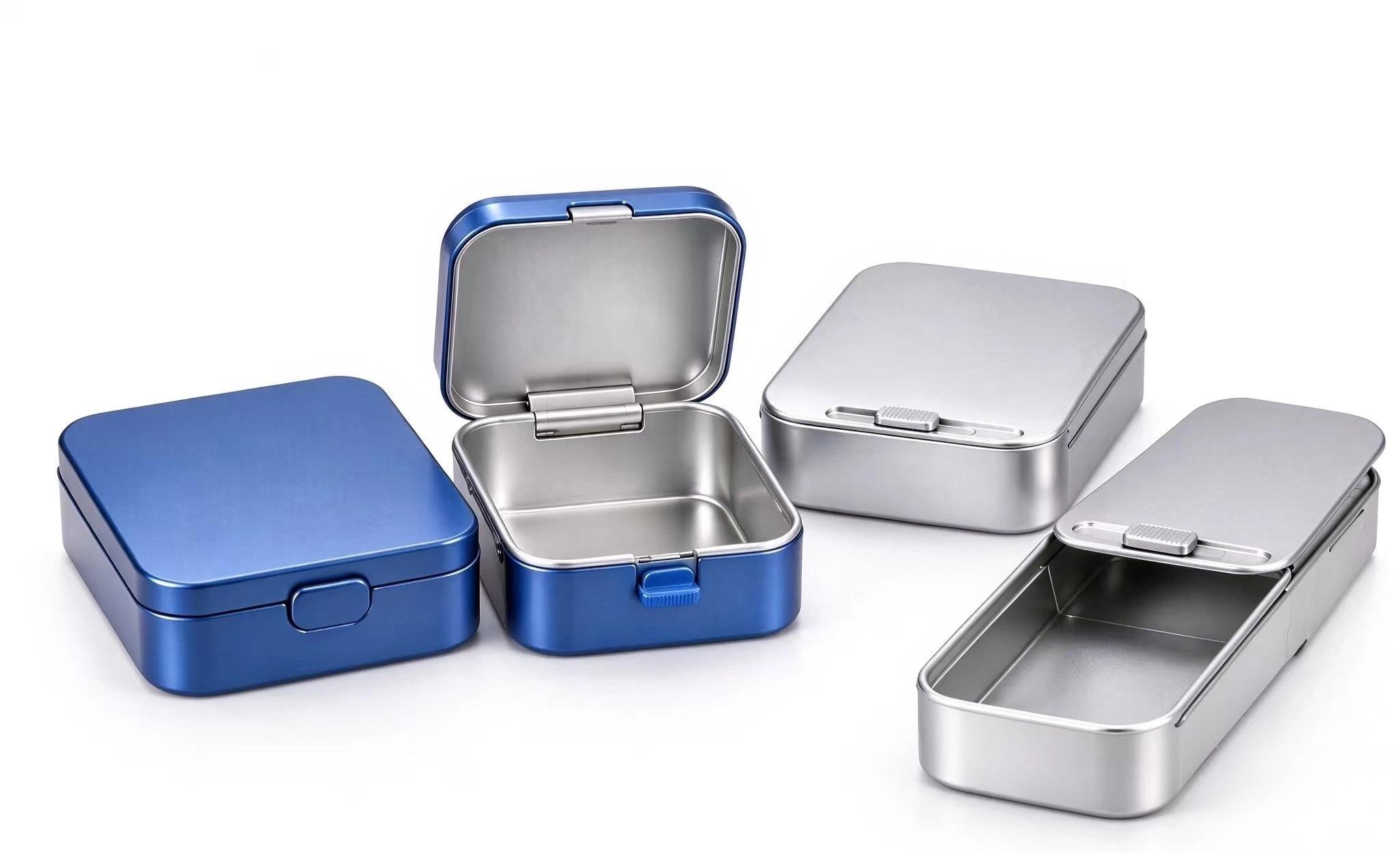
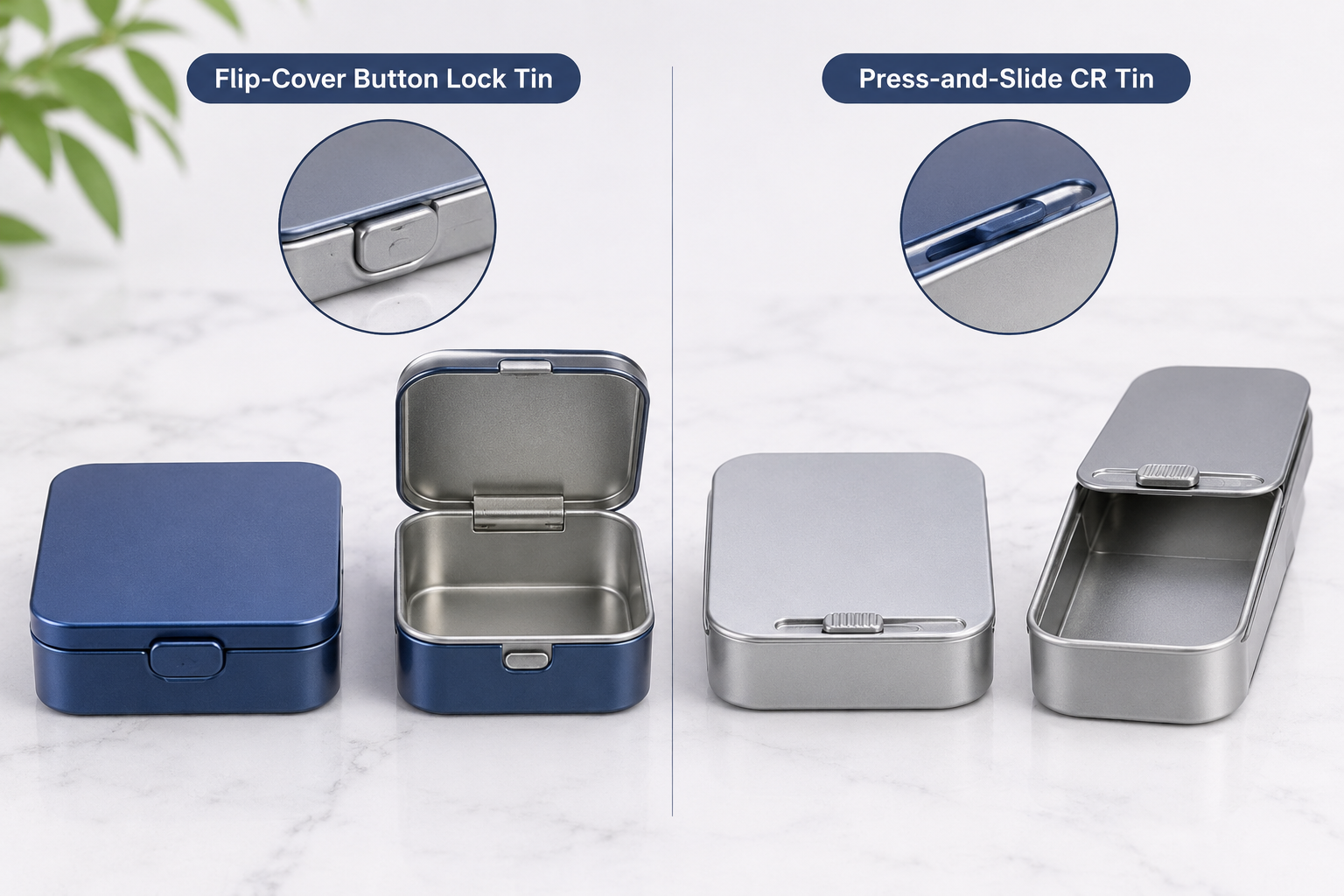
Flip-Cover Tin with Button Lock
Our currently listed CR tin, the T-1030, uses a flip-cover lid with a button-style anti-child-lock mechanism. It is made from 0.23 mm tinplate and accepts custom size, shape and printing. You can also browse the CR tin product range.
When evaluating a flip-cover structure, check:
- Button position and the force needed to operate it
- Hinge position and lid travel
- Clearance between the product and the underside of the lid
- Whether the lid returns to the closed position and stays there
Press-and-Slide Tin
A slide structure moves the lid into a defined position instead of lifting it off. It is one of several mechanism concepts covered in our CR tin guide. It is not part of our current listed range, so a slide structure would be developed and evaluated for each project.
When evaluating a slide structure, check:
- Sliding path and clearance
- Lid retention when closed
- Consistency of the movement from sample to sample
- Whether a product or insert can catch on the sliding path
A sliding lid alone does not make a tin child-resistant. The complete closure design has to be evaluated for the required performance.
How Does Tin Shape Affect a CR Structure?
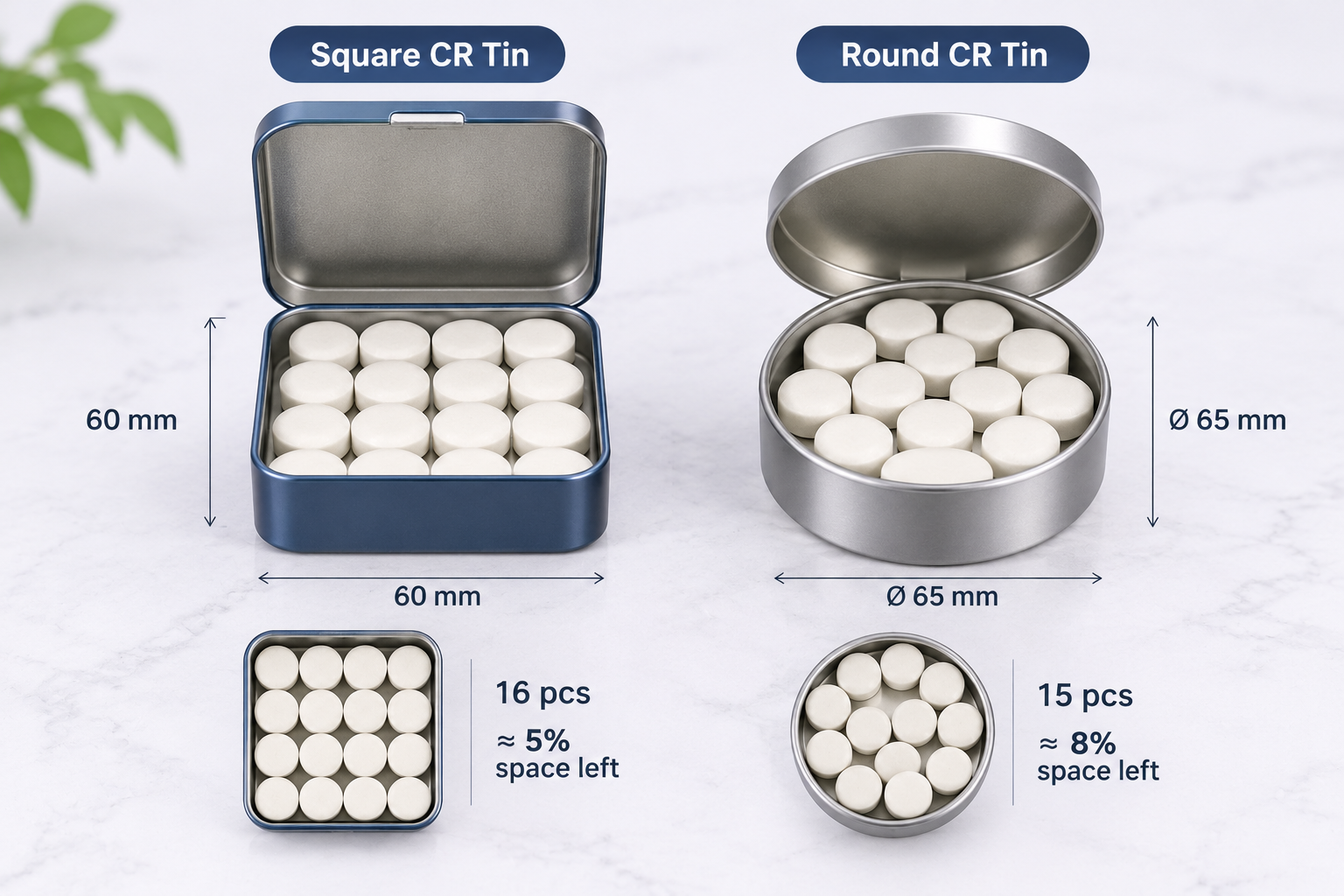
Shape changes how the mechanism and the product share the available space.
| Square or rectangular CR tin | Round CR tin | |
|---|---|---|
| Best product layout | Rows, stacks and flat items | Circular or centered layouts |
| Mechanism placement | More room along straight edges | Concentrated around the lid perimeter |
| Space use | Straight walls simplify layout calculations | Curved walls can leave unused space at the edges |
| Main check | Closure fit at the chosen dimensions | Usable diameter and internal height |
For shape-specific packing details, see our guides to square tin sizing, round tin packing layouts and rectangular tin lid types. Product ranges are available for square and round tins. If your product needs an unusual outline, see our guide to special shape tins.
How Do You Match a CR Structure to Your Product?
Start from the product, not the tin.
| Product format | Structure to discuss first | What to confirm |
|---|---|---|
| Flat, wrapped items in rows | Square or rectangular flip-cover tin | Headroom under the lid and finger access for removal |
| Round or cylindrical items | Round flip-cover tin | Usable diameter and height, plus gaps at the curved wall |
| Small items stored loose | Compact tin with a flip cover or slide mechanism | Whether items can reach the button, hinge or slide path |
| Items held in an insert | Square or round, depending on the insert outline | Insert thickness added to the cavity and closure travel |
For unusual products, start a conversation with product dimensions and a photo rather than a tin size.
How Do You Estimate the Product Cavity?
External dimensions cannot stand in for internal dimensions. Walls, rolled edges, lid overlap and the closure all take space, and there is no universal formula for turning product size into tin size. The final dimensions are developed around the product and the mechanism.
You can still estimate the product cavity before you contact a supplier. The example below is illustrative, not a production case.
| Item | Value |
|---|---|
| Wrapped product | 20 × 20 × 10 mm |
| Quantity and layout | 30 units, 6 across × 5 deep, single layer |
| Clearance between units | 1 mm |
| Clearance at each wall | 2 mm |
| Cavity length | 6 × 20 + 5 × 1 + 2 × 2 = 129 mm |
| Cavity width | 5 × 20 + 4 × 1 + 2 × 2 = 108 mm |
| Cavity height | 10 mm product + 2 mm headroom = 12 mm minimum |
This gives a product cavity of about 129 × 108 × 12 mm. Mechanism clearance, insert thickness and rolled edges are added during structural development, so the finished tin will be larger than this figure.
What Should You Check on a CR Tin Sample?
Test the sample with the real product, and with the insert if there is one.
- Loading: Can the full quantity be loaded without forcing items into place?
- Removal: Can an adult remove one item without disturbing the rest?
- Mechanism: Does the button, hinge or slide work consistently over repeated openings?
- Return and hold: Does the lid close to the intended position and stay there?
- Interference: Do the product or insert touch the button, hinge or slide path?
- Appearance: Do buttons, seams and forming areas affect where the logo and text can sit?
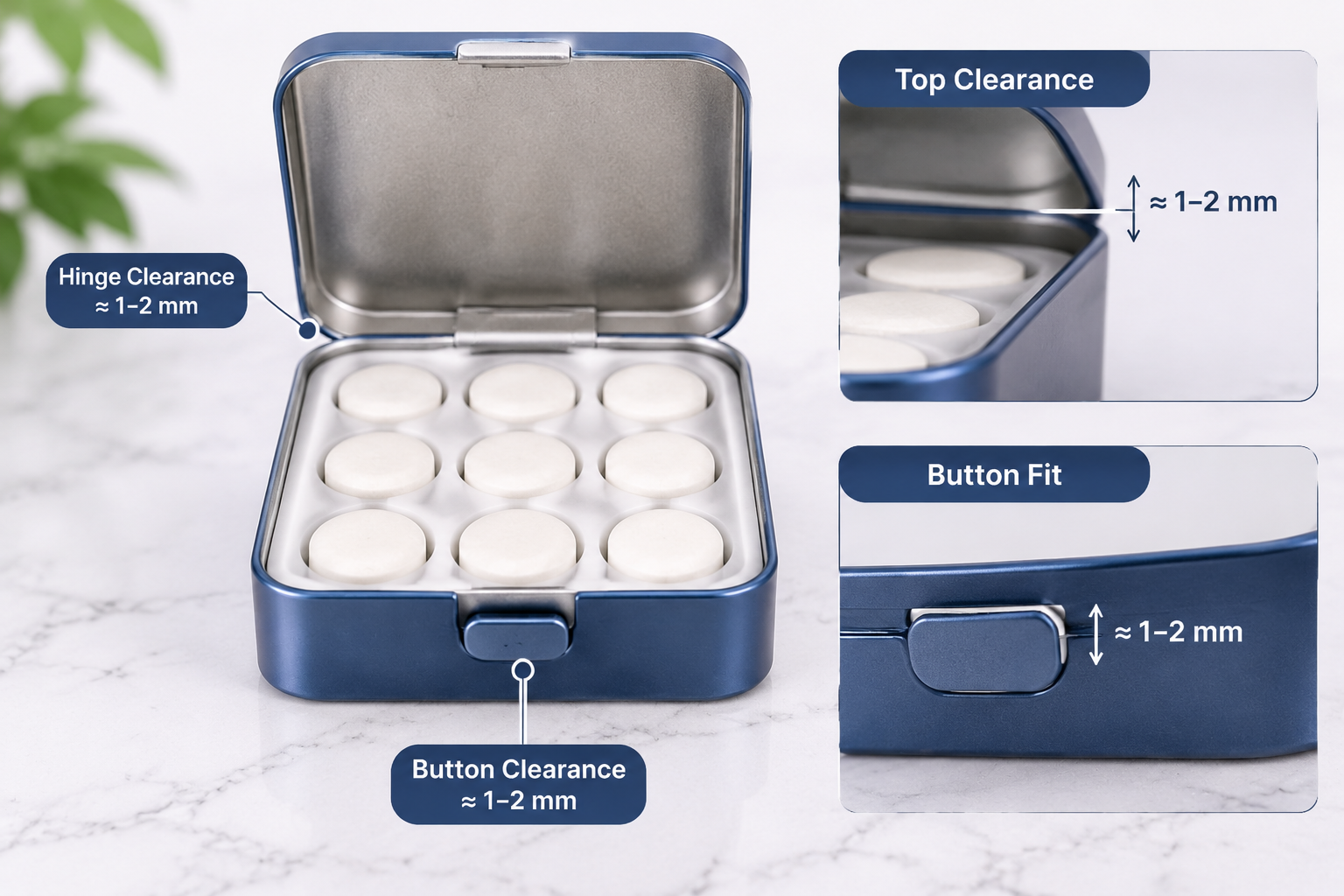
Passing these checks shows the structure works for the product. It does not establish child-resistant performance. Where testing is required, the applicable standard, protocol and laboratory depend on the target market and product, so confirm them before production. We do not have a third-party test report for the listed flip-cover/button structure, and the CR tin guide explains how testing is handled.
What Should You Send to Start a CR Tin Project?
Send the wrapped product dimensions, quantity per tin, arrangement, preferred shape, insert needs, artwork and target market through our contact page. The full specification checklist is in our guide to planning a custom child resistant tin. For artwork preparation and finishes, see our custom printed tin packaging guide. For food products, our food tin container guide covers coatings, inner bags and documentation. To see how all tin types fit together, read the custom tin packaging guide, or learn more about Liyipackaging.
FAQ About CR Tin Structures
1. Is a flip-cover tin better than a slide tin?
Neither is automatically better. The right choice depends on the product, how it is removed, the space available for the mechanism and the requirement the package has to meet. Our listed CR tin uses a flip cover with a button lock, and a slide structure would be developed per project.
2. Does an insert change how a CR tin works?
It can. An insert uses internal height and can press against the button, hinge or slide path. Include its thickness in the cavity calculation and test the product, insert and tin together.
3. Can a round tin be child-resistant?
Shape alone does not decide this. A round tin needs a child-resistant closure developed for that size, and the finished package needs the applicable testing.
4. Does a successful sample check prove child-resistant performance?
No. A sample check confirms fit and operation. Child-resistant performance is established through the applicable testing for the target market.
5. What should I prepare before asking for a CR tin sample?
Prepare the wrapped product dimensions, quantity per tin, arrangement, preferred shape, insert requirements and target market. These let the structure be developed around your product instead of a standard tin size.