Written by: Liyipackaging Packaging Team | Published: November 20, 2026 | Last Updated: November 20, 2026 | Regulatory information reviewed: November 20, 2026
Quick takeaway: Approving artwork is only the first half of a printed tin project. The second half is confirming that the finished tin matches what was approved. Check four things in order: color, print position and registration, surface condition, and damage caused by forming or packing. Compare each against a signed reference sample and a written tolerance, first on the pre-production sample and again on the bulk batch.
A printed tin can look right on screen, pass a digital proof, and still arrive looking slightly different from the sample. The cause is rarely a mystery. Many disputes come from expectations that were never written down: which color matters most, how much variation is acceptable, and which scratches count as defects.
This guide covers what happens after artwork approval. It explains what print defects look like on tinplate, how to check them without laboratory equipment, and what to agree in writing before bulk production. For artwork templates, white ink and finish selection, start with our Custom Printed Tin Packaging: Artwork, Printing Options & MOQ Guide.
What Does “Printed Tin Quality” Cover?
Printed tin quality has three layers, and each has a different cause and a different fix.
- Specification: the artwork, color references and finish that were approved. Problems here are design-stage problems.
- Print execution: whether the printed result matches that specification, including color, registration, coverage and fine detail.
- Condition after printing: whether forming, handling and packing marked the printed surface.
This article focuses on layers 2 and 3. Separating them makes a complaint easier to resolve. A color that was never specified is a specification issue. A color that drifts away from an approved reference is an execution issue.
Which Print Defects Appear on Printed Tins?
The table below lists the defects buyers most often need to identify. The causes listed are general; the factory should confirm the actual cause for your project.
| Defect | What you see | Often related to | How to check |
|---|---|---|---|
| Color variation | Lid, body or bulk batch looks lighter, darker or warmer than the reference | Ink film differences between press runs, base color, finish | Compare against the signed reference under neutral light |
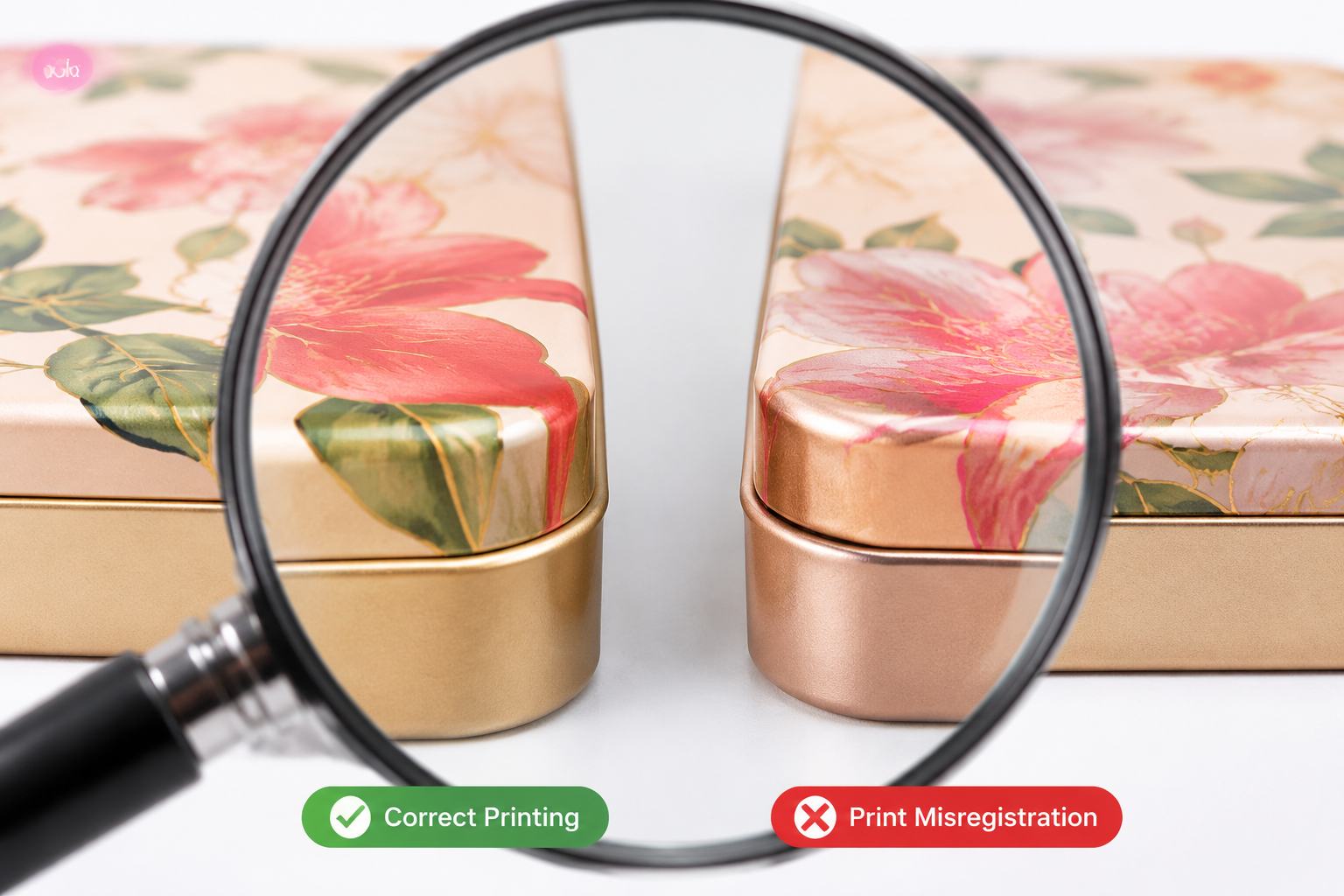
| Registration offset | Thin halo or white gap around logos and text; overprinted shapes look shifted | Layers not aligned during printing | Check edges of logos and small text with a loupe |
| Uneven coverage | Metallic base showing through light colors; patchy solid areas | Base layer or ink coverage | View large solid areas at an angle |
| Fine-detail breakup | Small text filling in; hairlines broken | Small detail too fine for the surface | Check the smallest text and thinnest lines |
| Coating marks | Dust specks, uneven gloss or matte patches | Coating application or surface contamination | Tilt the tin under a light source |
| Scratches and scuffs | Rub marks, especially on dark or glossy surfaces | Contact during forming, stacking or packing | Inspect high-contact edges and corners |
| Print cracking at bends | Flaking or hairline cracks at rolled edges, seams or corners | Stress where metal is formed after printing | Inspect folded and rolled areas |
| Pattern mismatch | Artwork that crosses the lid and body joint does not line up | Lid and body printed and assembled separately | Close the tin and check continuity |
| Dents | Local surface deformation | Handling or loose packing | Run a hand and light across flat panels |
How to Check Color Consistency Without a Lab
You do not need specialized equipment to run a useful color check, but you do need a fixed reference.
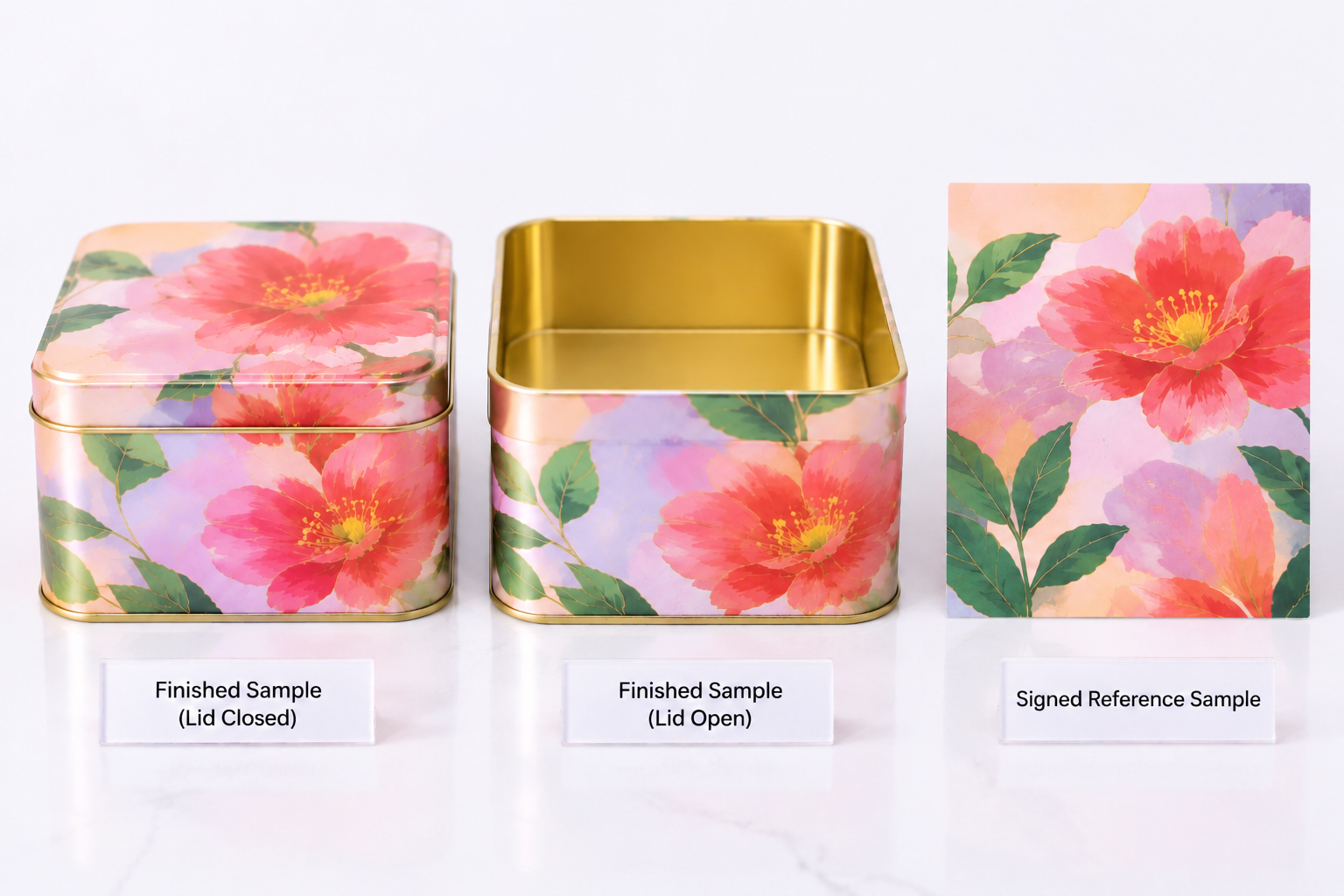
- Keep a signed reference sample. Approve a physical sample in writing and keep one with the buyer and one with the factory. The screen file is not the reference.
- Use neutral, daylight-balanced light. Avoid warehouse lighting and phone screens. A standard viewing booth is ideal if you have access to one.
- Compare lid and body side by side. Many color complaints appear when a lid and body that were printed separately are compared on the assembled tin.
- Check the colors that matter most. For most brands, this is the logo color and the largest solid area. Name them in the specification.
- Define what “acceptable” means. A spectrophotometer reading expressed as ΔE gives an objective measure of how far two colors are apart. If one is not available, boundary samples (one slightly lighter and one slightly darker example that both sides have signed) do the same job visually.
No printing process produces identical output on every run, so the useful question is not “is it identical?” but “is it within the range we agreed?” The agreed range should be stated per color and per finish, because the same color can look different on a matte surface than on a glossy one.
How to Check Registration and Small Details
Registration problems are easy to miss at normal viewing distance and obvious in a customer’s hands. Check them in two ways:
- At arm’s length: look for visible halos, shifted outlines or text that appears to double.
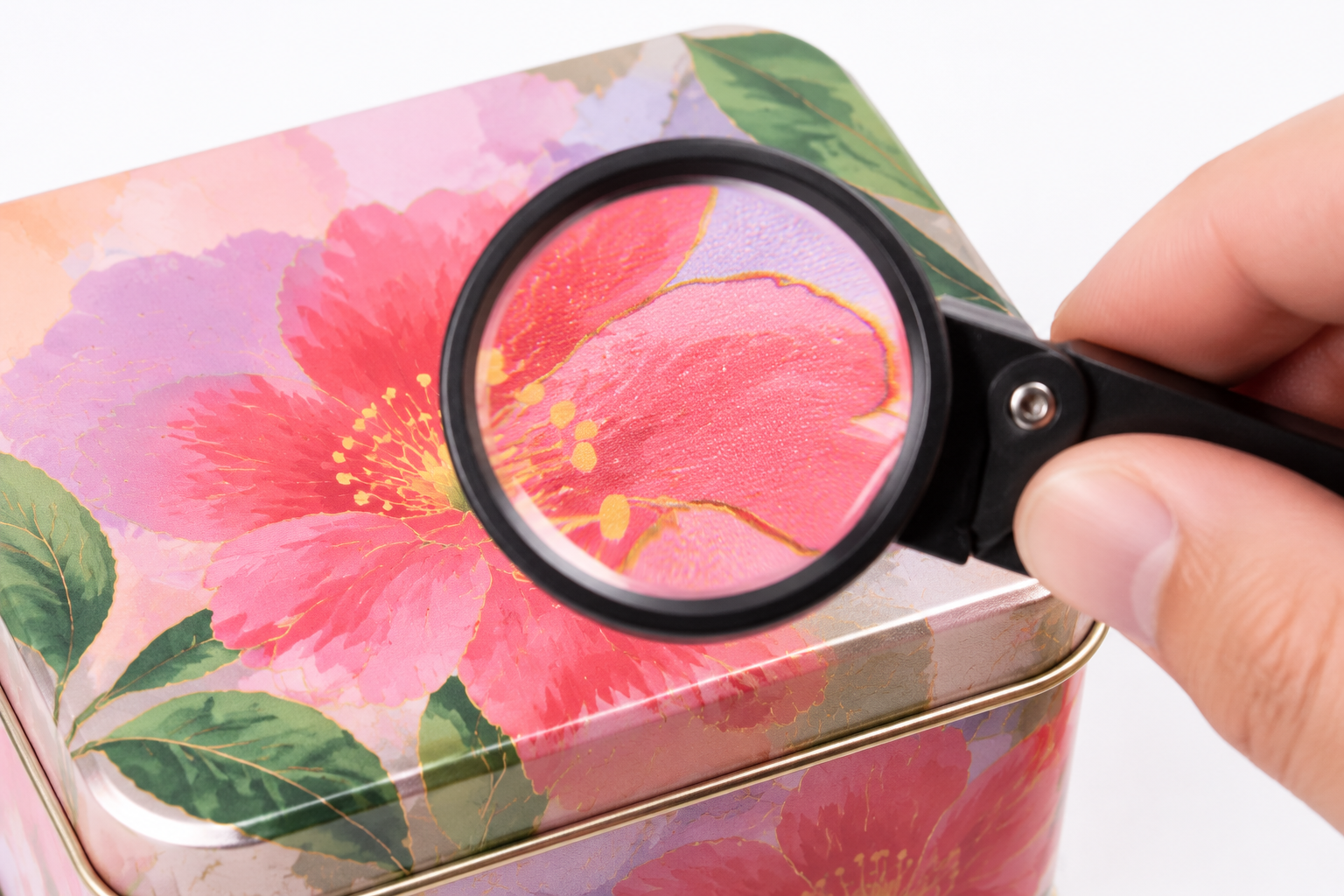
- Under a loupe: use an 8–10x loupe on logo edges, the smallest text and the junctions between two colors.
Pay particular attention to the smallest text on the tin, which usually includes net weight, ingredient references or website addresses. If small text is hard to read at normal distance, record it as a finding even if the print looks technically clean. A small-text proof taken during sampling is the most reliable way to settle this before bulk production.
What to Inspect on a Formed and Assembled Tin
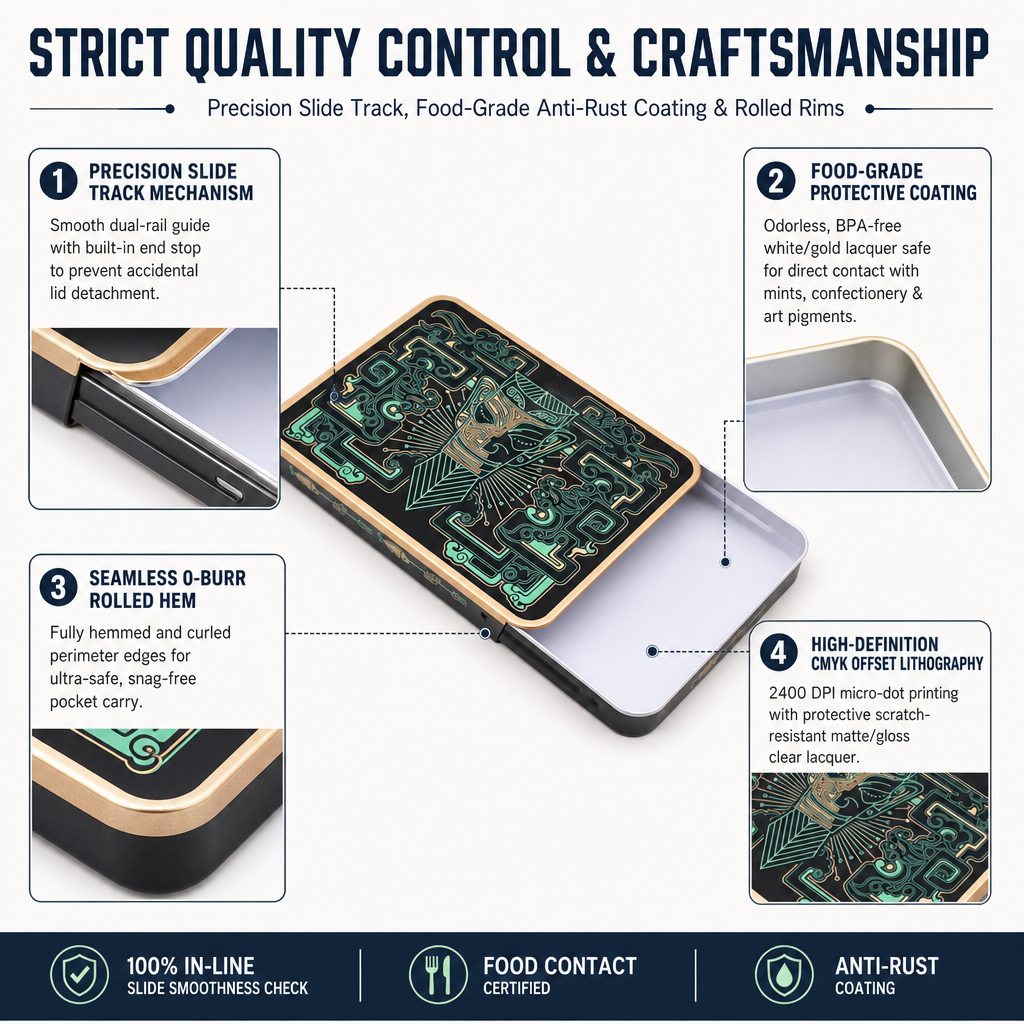
Print can be accurate when it leaves the press and still be damaged by forming or packing. Inspect the finished, assembled tin, not only a flat printed sheet:
- Rolled edges and corners: the most common places for rub marks or print cracking.
- Seams and hinge areas: check for flaking or exposed metal.
- Lid and body contact area: open and close the tin repeatedly and check whether the surfaces rub each other.
- Pattern continuity: if artwork wraps across the lid and body, close the tin and check that the pattern lines up.
- Bottom and inside lid: printed or coated areas that buyers often forget to check.
Lid fit and print damage are linked. A lid that is too tight can scuff the printed edge every time it is opened; our guide to lid fit problems and how to prevent them explains how to check this. The product-fit and clearance checks described in our irregular tin box sample approval guide also apply to other tin shapes.
How to Inspect a Bulk Batch
A bulk inspection is only reliable if the method is defined before production. A practical approach looks like this:
- Compare against the signed reference sample, not memory or a digital image.
- Draw samples from different cartons and positions, including top, middle and bottom of the pallet, so the check represents the whole batch.
- Inspect lids and bodies on assembled tins, using the same light and the same checks as the pre-production sample.
- Record defects by class, so a cosmetic mark is not treated the same way as a problem that affects use.
- Agree the sampling plan and acceptance limits in advance. Many buyers use an attribute sampling standard such as ISO 2859-1 (AQL), but the plan and limits should be confirmed with the supplier in writing for your project.
An example of how defects can be classified is shown below. Treat it as a starting point for discussion, not a fixed standard.
| Class | Examples | Typical handling |
|---|---|---|
| Critical | Damaged interior coating, sharp or unsafe edges | Not acceptable; the affected goods are rejected |
| Major | Visible color mismatch against the reference, clear registration offset, lid that does not close properly | Limited or no tolerance, as agreed |
| Minor | Small mark not visible at normal viewing distance | Acceptable within agreed limits |
For the wider project sequence around this stage, see our guide to the custom tin packaging process from brief to mass production.
What to Agree in Writing Before Bulk Production
Most printed tin disagreements can be avoided with a one-page specification that both sides sign. It should cover:
| Item | What to define |
|---|---|
| Approved reference | Physical sample, approval date, who holds a copy |
| Critical colors | Pantone or CMYK reference, finish and which areas matter most |
| Color tolerance | ΔE limit or signed boundary samples |
| Smallest text | Minimum size that must stay legible |
| Defect classes | What counts as critical, major and minor |
| Sampling plan | How many pieces, from where, at which stage |
| Packing method | Inner protection and carton layout for printed surfaces |
| If a batch fails | Rework, replacement or another remedy, and who bears the cost |
Packing deserves the same attention as printing. Glossy and metallic surfaces are more sensitive to rubbing during transport, so the packing method belongs in the written specification rather than being left to default practice.
Does Print Inspection Cover Food Safety?
No. Checking exterior print quality does not replace a food-contact review of the interior coating and any inner materials. Requirements depend on the market: in the United States, food-contact materials are regulated by the FDA, and in the EU the framework includes Regulation (EC) No 1935/2004 and Regulation (EC) No 2023/2006. Confirm the documentation you need for your own product and market. Our food tin containers guide explains the material, coating and food-contact questions to raise with a supplier.
How Liyipackaging Supports Print and Pre-Shipment Checks
Dongguan Liyi Packaging Products Co., Ltd. is a tin packaging manufacturer with more than 25 years of industry experience and a 3,000㎡ facility, as described on our About Us page. We support custom tin projects from design and development through production to pre-shipment inspection. See our custom solutions page for the services available, or browse the rectangular, round and square tin ranges to start from an existing structure.
To discuss quality expectations for a printed tin project, contact Liyipackaging with your artwork, your critical brand colors and any reference sample you already have. For the broader decision between tin structures, see the Custom Tin Packaging Guide.
FAQ
What is an acceptable color difference between a printed tin sample and the bulk order?
There is no single number that applies to every project. Some variation between press runs is normal in any printing process. What matters is whether the result falls within a range agreed in advance, usually a ΔE limit or signed boundary samples for each critical color.
Can a printed tin match my brand’s Pantone color exactly?
The result depends on the ink, the base layer, the metal surface and the finish. Ask for a physical sample with your color on the intended finish and approve that sample in writing. Our printed tin packaging guide explains how white ink and finish affect color.
How should I inspect printed tins when they arrive?
Open cartons from different positions, compare the tins with your signed reference under neutral light, check logo and text edges with a loupe, and open and close several lids to check for rubbing. Record anything that falls outside the agreed limits with photos.
Why does the same artwork look different on the lid and the body?
Lids and bodies are formed from separate pieces, can sit at different angles to the light, and may carry different surface treatments. Judge the artwork on the assembled tin, not on separate parts.
Who decides whether a defect is acceptable?
Both sides should decide before production by defining defect classes, sampling levels and acceptance limits in writing. For questions about lead time and order quantities, see our FAQ page.