Written by Liyipackaging Packaging Team
Published: November 16, 2026
Last Updated: November 16, 2026
Regulatory information reviewed: November 16, 2026
Most gift packaging decisions are made on looks, then corrected later by freight costs, crushed products or oil stains. Comparing tin vs plastic vs paper packaging before you commit to a design avoids most of those corrections, because each material fails in a different way.
This guide gives you a practical way to compare the three materials for food gifts, shows when tin is the better choice and when it is not, and lists the compliance checks that apply whichever material you pick. Liyipackaging has more than 25 years of experience in custom tin manufacturing, so we also say plainly where another material fits better.
Quick takeaway
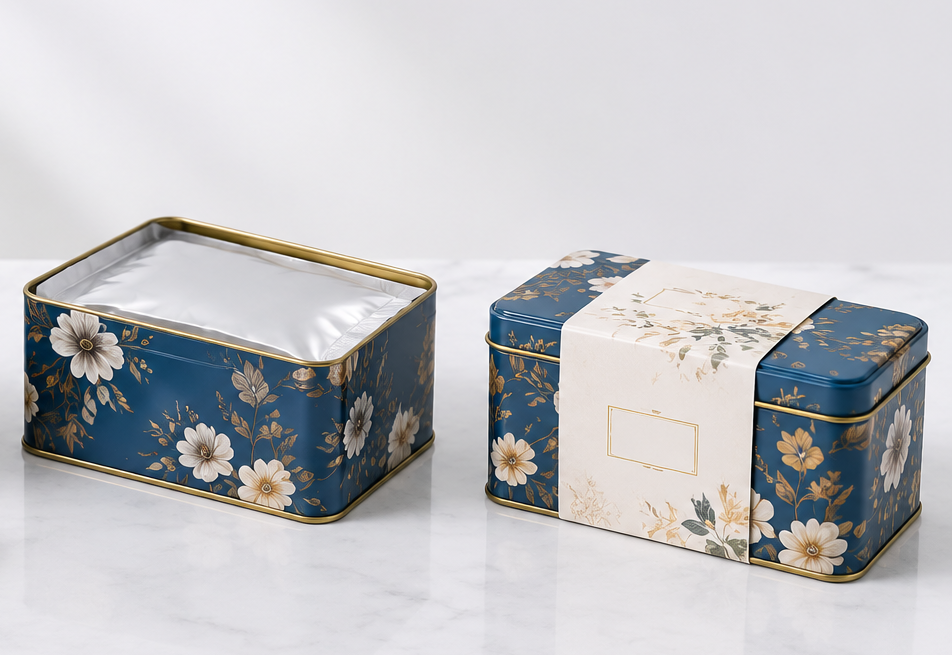
- Choose tin when the package should outlast the product, the contents need rigid protection, or the gift sits in a premium price tier.
- Choose plastic when product visibility, low weight and small first orders matter more than a premium feel.
- Choose paper when budget, flat-pack storage and fast design changes matter most, and add a liner if the product is oily or moisture-sensitive.
- Many gift sets work best as a combination, such as a tin outer with a paper or pouch inner.
1. How Should You Compare Packaging Materials for Food Gifts?
Start with six questions. Your answers usually point to a material before you look at any samples.
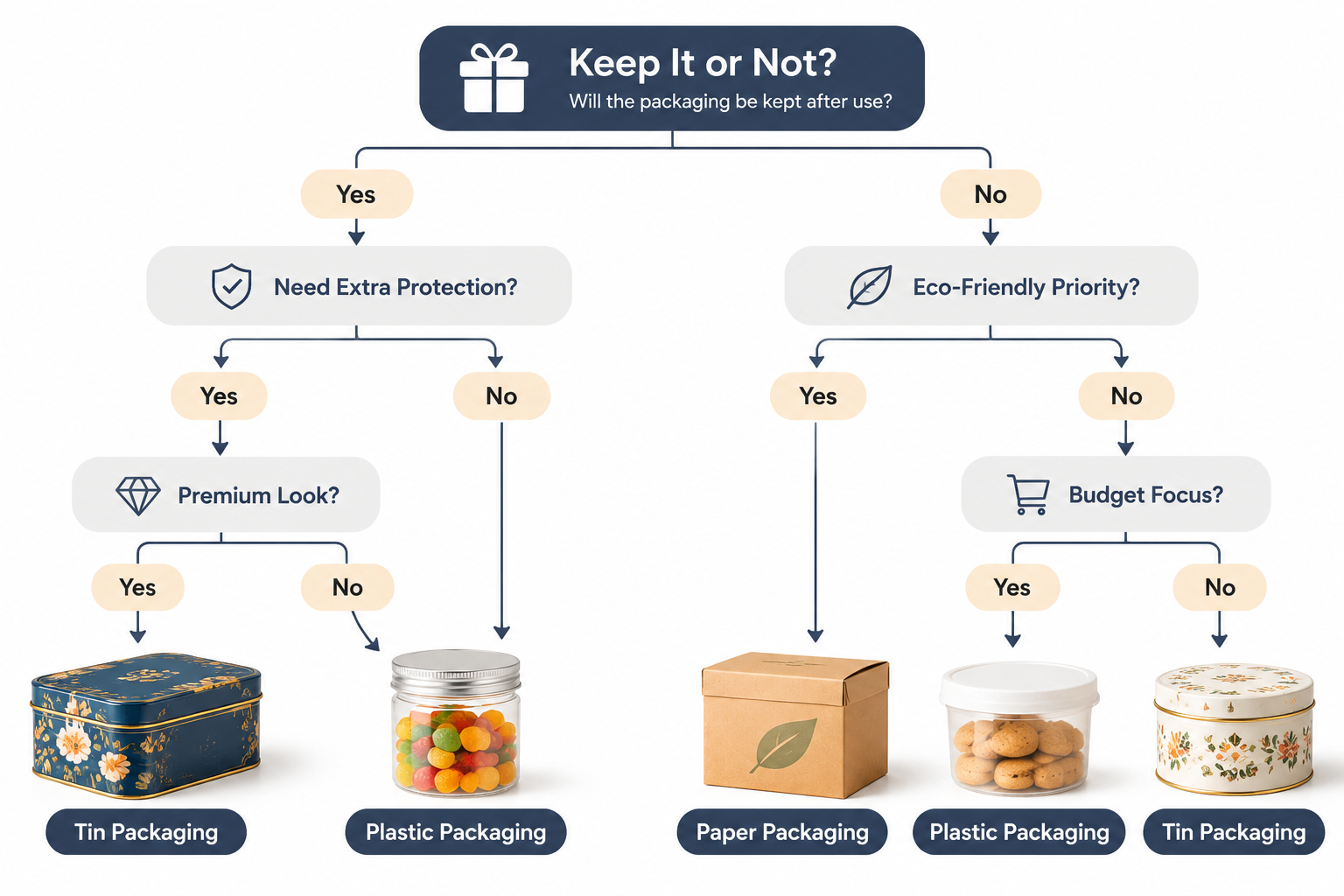
- Does the package stay with the customer after the food is gone? Keepsake value favors tin.
- What is the biggest risk to the product? Crushing, moisture, oil, aroma loss and light each favor different materials.
- How will it ship? Weight, stacking strength and flat-pack storage all affect freight and warehouse costs.
- What price tier is the gift? Packaging should match the perceived value of what is inside.
- Which market is it going to? Food-contact and packaging rules differ by destination.
- What is your order pattern? One seasonal run, a repeating collection and a small test launch call for different commitments.
2. How Do Tin, Plastic and Paper Packaging Compare Side by Side?
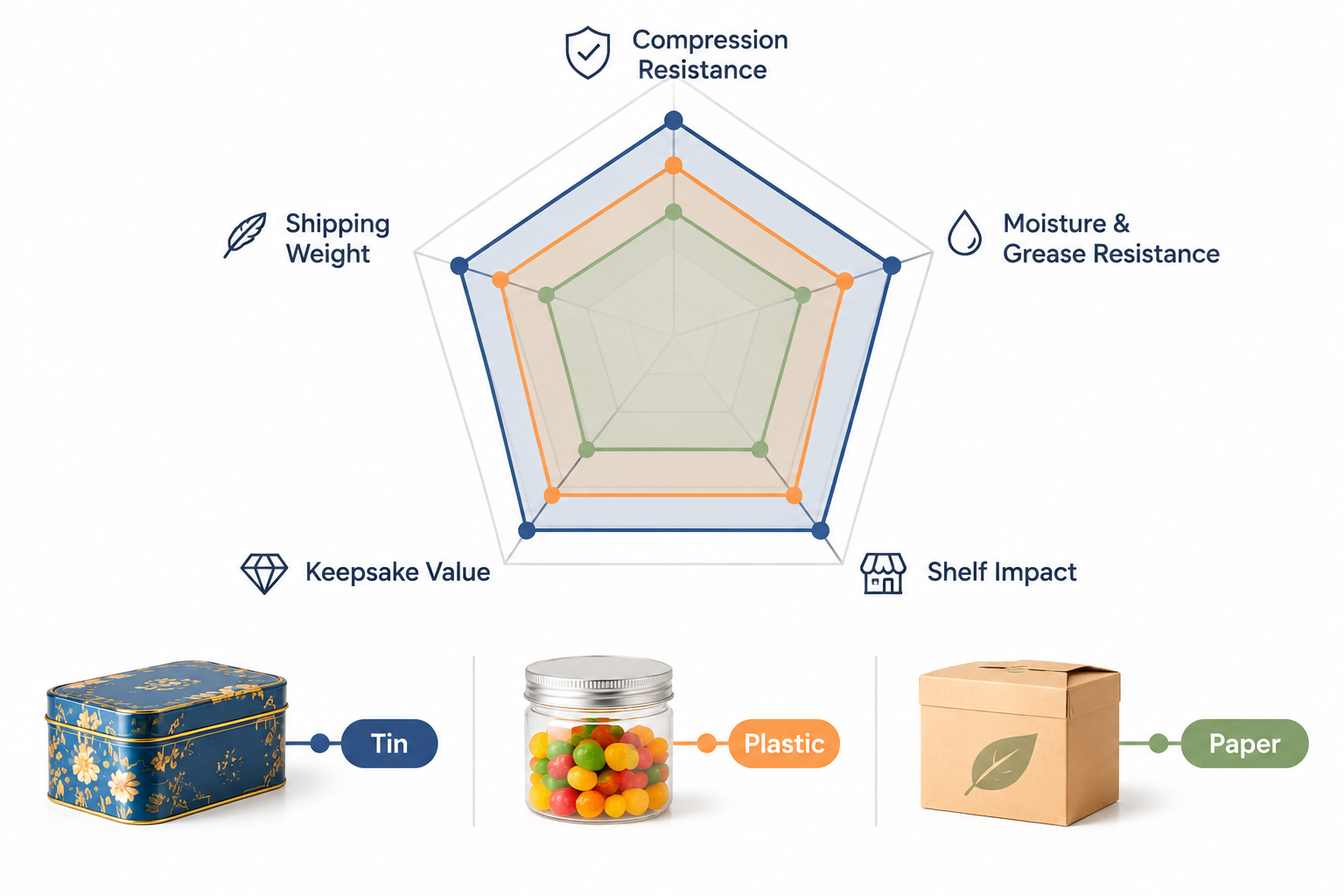
The table shows typical behavior. Exact results depend on wall thickness, lid or closure design, coating and the specific product.
| Factor | Tin | Plastic | Paper |
|---|---|---|---|
| Crush protection | High | Medium, depends on wall thickness | Low to medium; rigid boxes perform better than folding cartons |
| Moisture and oil resistance | Good with a well-fitting lid and suitable interior coating; not hermetic by default | Good, depends on resin and closure | Low unless lined or wrapped |
| Shelf impact | Strong, metallic look with embossing and printing options | Product visibility through clear walls | Large printable surface |
| Keepsake and reuse value | High | Moderate | Low |
| Weight in shipping | Heaviest of the three | Lightest rigid option | Light, and can ship and store flat |
| Customization | Lithographic printing, embossing, shaped structures | Labels, sleeves, direct printing | Widest range of print and structure options |
| Order commitment | Tooling and setup usually mean higher minimums | Stock containers with labels allow small orders | Low to moderate |
For tin, minimums and lead times depend on structure and printing. Our custom tin box cost, MOQ and lead time guide explains how those figures are set.
3. When Is Tin the Better Choice?
Tin earns its higher setup cost in four situations.
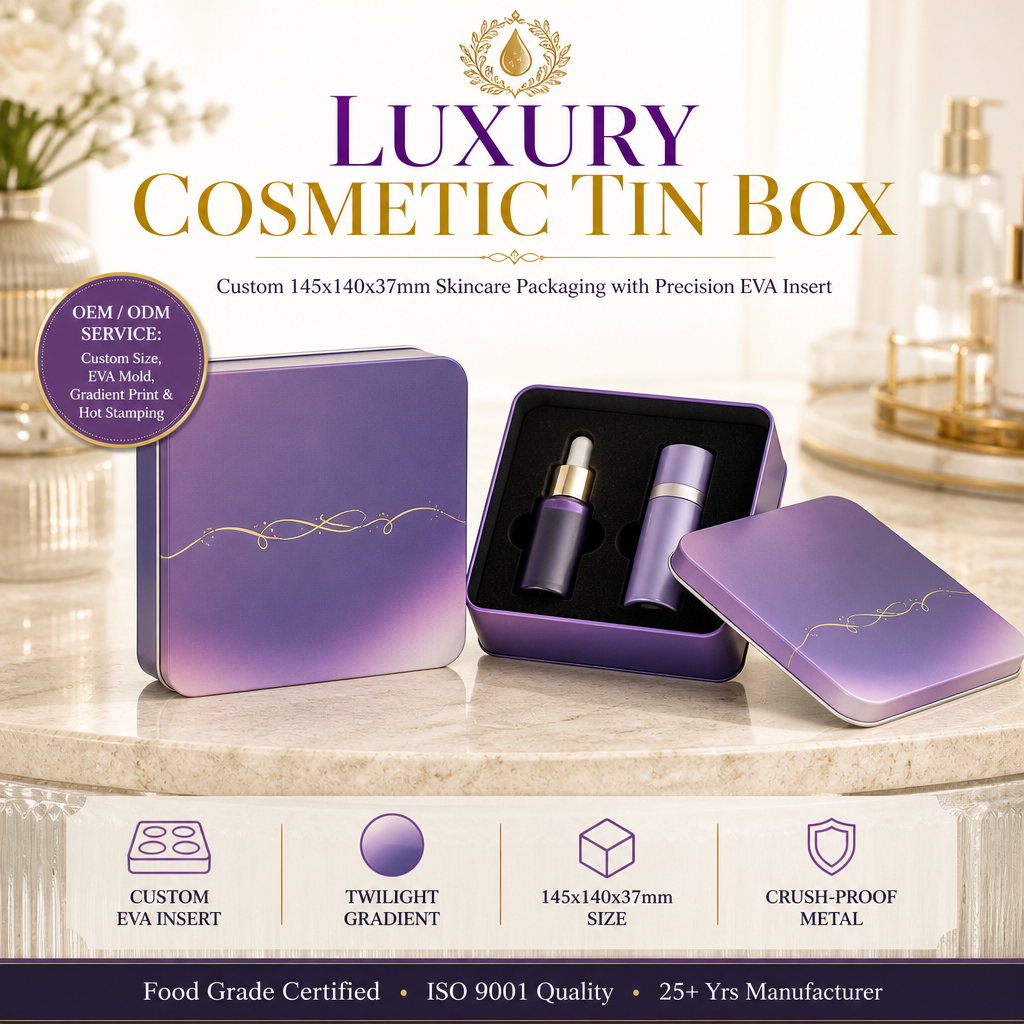
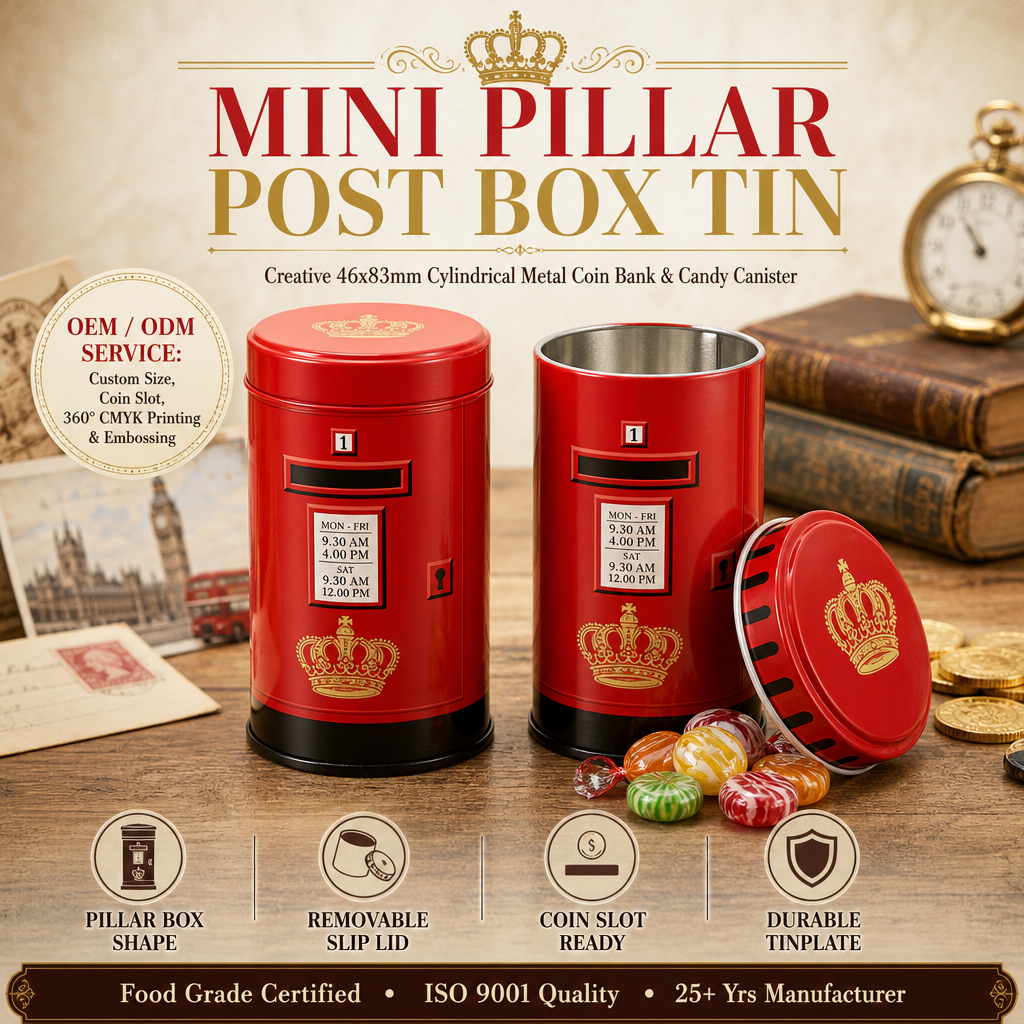
The package is part of the gift. A tin that becomes a desk organizer or kitchen container keeps your brand in the customer’s home long after the product is gone. This is why tins work well for collectible tins and limited editions.
The product breaks or crushes easily. Biscuits, crackers, filled chocolates and layered confectionery need a rigid shell. Tin protects against stacking pressure in cartons and on retail shelves.
The gift sits in a premium price tier. Customers read weight, sound and finish as quality signals. A printed and embossed tin supports a higher price point than a thin carton does, and our gift tin box guide shows how brands use tins in gift ranges.
You run a repeating collection. If you release seasonal designs on one structure, the tooling investment is spread over several runs. Our custom tin packaging guide shows how brands build around one structure.
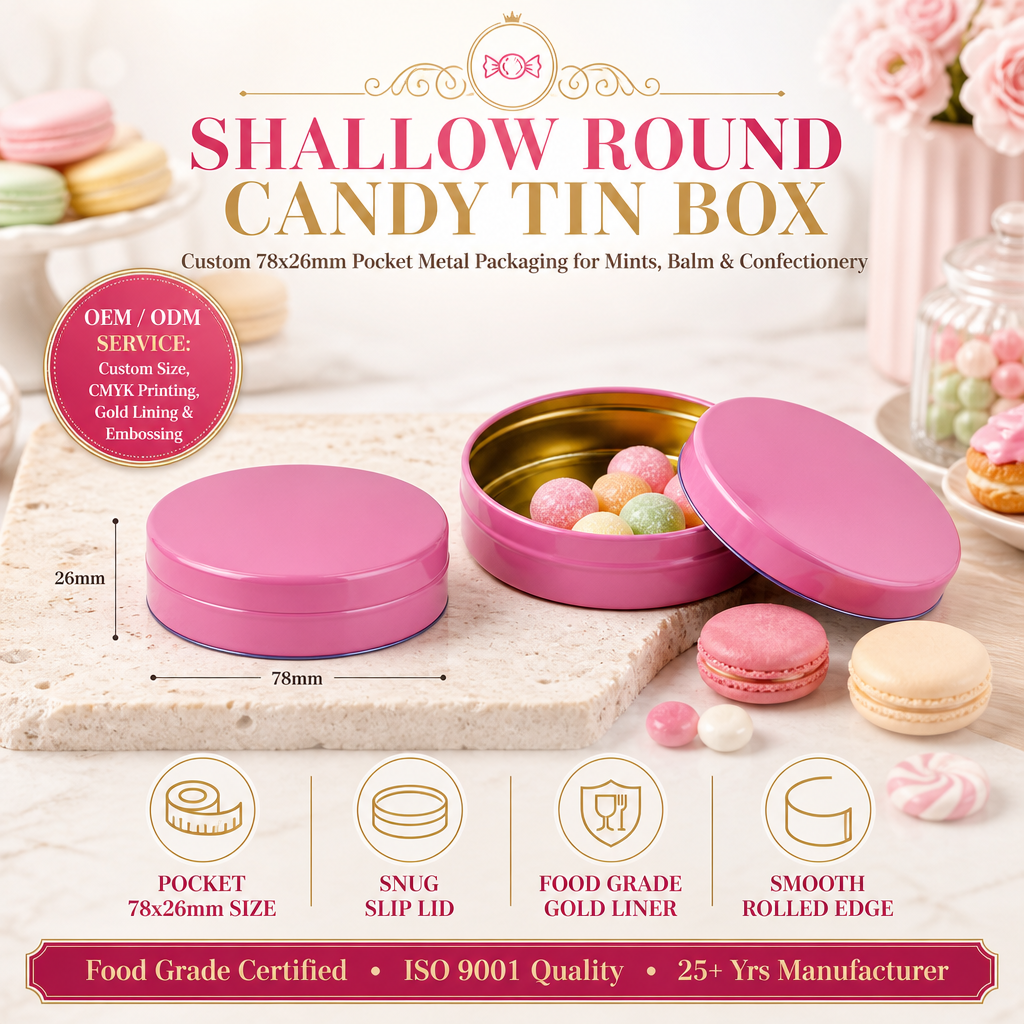
For product-specific examples, see our guides to candy tins, tea tins, coffee tins and nut gift tins.
4. When Is Tin Not the Right Choice?
Tin is not always the best answer, and choosing it for the wrong job costs more than choosing another material.
- Very small test orders. Custom printed tin involves tooling and setup, so stock plastic or paper packs suit early market tests better.
- Products that must be seen. If customers decide by looking at the product, clear plastic or a paper box with a window does the job better.
- Products that need an airtight or vacuum seal. A standard tin lid is not hermetic. Freshly roasted coffee, for example, needs an inner pouch, and some products need a different package entirely.
- Very weight-sensitive freight. Heavy shipments, such as large e-commerce volumes by air, can erase the unit-price advantage.
- Short promotions. If the design changes every few weeks, flat-pack paper is more flexible.
Choosing the right material includes ruling out the wrong one.
5. Can You Combine Materials?
Yes, and for many gift sets this is the strongest option. Common combinations include:
- Tin outer with a paper liner or tray to keep oily products off the metal and hold items in position.
- Tin outer with an inner pouch for tea, coffee or loose products that need extra protection.
- Paper sleeve or outer carton around a tin for e-commerce shipping, which reduces scuffing in transit.
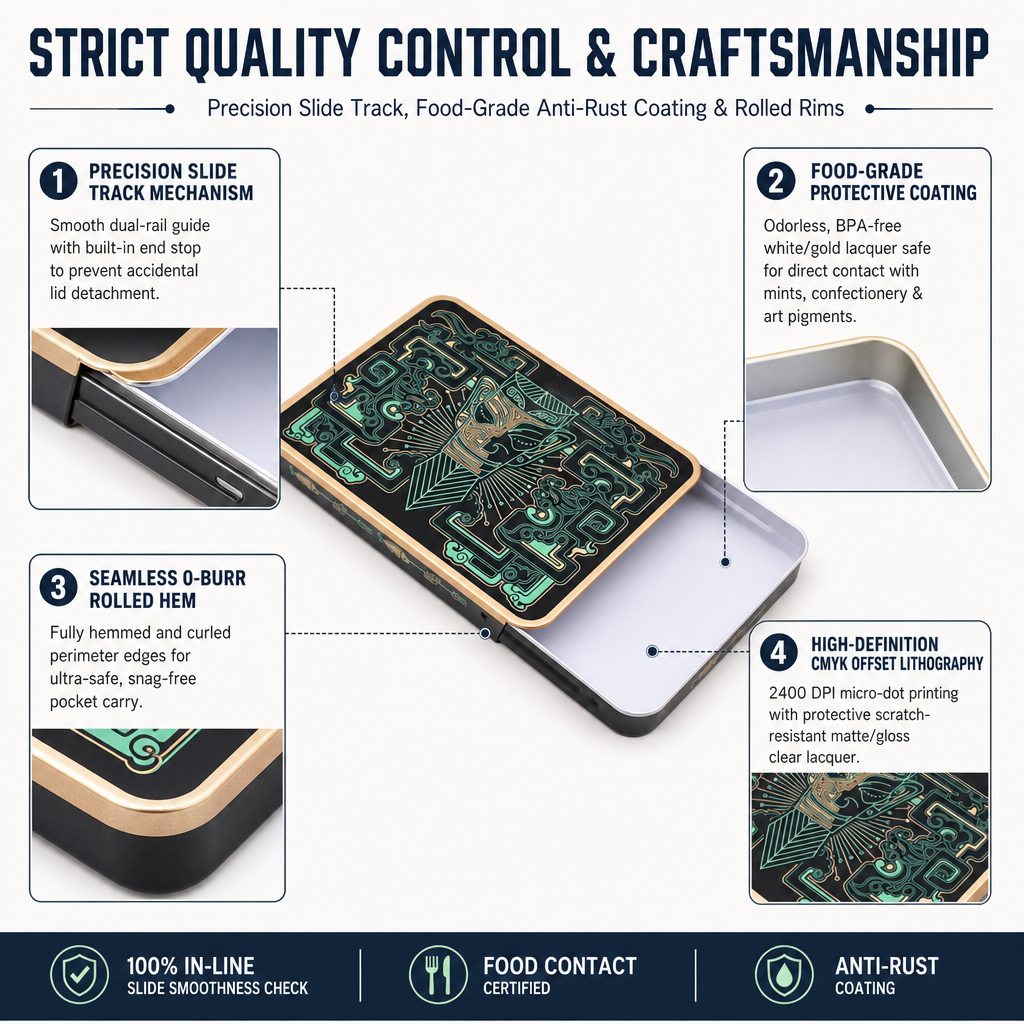
When the product touches the packaging directly, check the inner layer as carefully as the outer one. Our food tin container guide covers food-contact coating and inner packaging in detail.
6. How Can You Test the Three Materials Before Deciding?
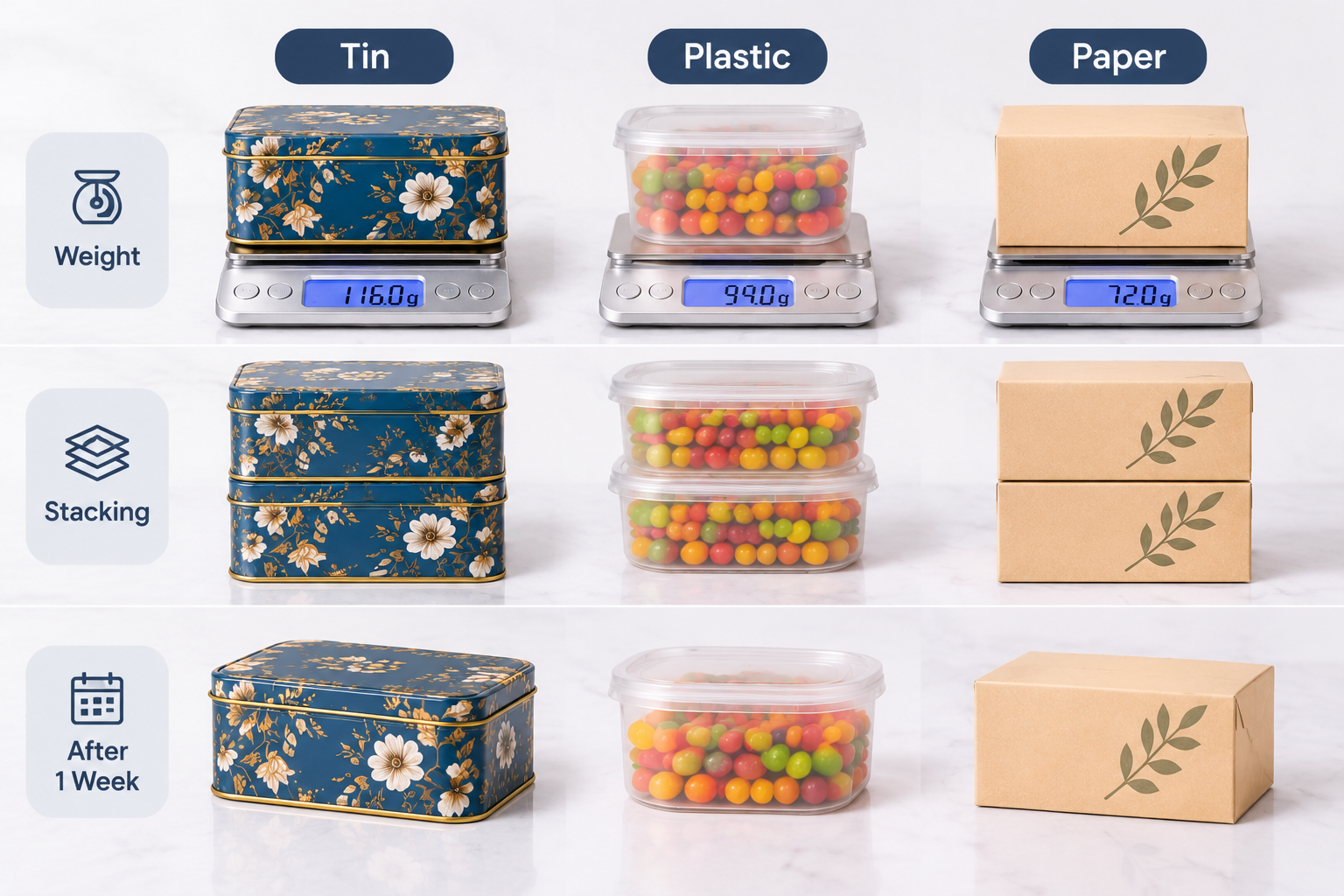
A short bench test beats a spreadsheet estimate. Fill one sample of each material with your actual product and compare:
- Packed weight and carton weight for the same quantity per carton.
- Stacking and drop behavior inside your real shipping carton.
- A one-week storage check in normal warehouse conditions, looking for oil marks, softening or odor transfer.
- An unboxing photo set under the same lighting, so you judge the shelf impact fairly.
- Delivered cost per unit, meaning unit price plus freight, inner packaging, breakage allowance and storage.
The fifth step often changes the ranking. A cheaper pack can cost more once breakage and inner packaging are counted.
7. Which Compliance and Claim Checks Apply to Every Material?
Material choice does not remove compliance work. Three points apply whichever material you pick.
Food-contact rules. For the US market, food-contact packaging falls under FDA regulations, and for the EU market under Regulation (EC) No 1935/2004 and Regulation (EC) No 2023/2006. For metal packaging, Regulation (EU) 2024/3190 on bisphenols in food-contact materials is relevant to interior coatings. The main transition period for most single-use articles ended on July 20, 2026, and longer transitions apply to some articles, so confirm the current position for your product.
EU packaging rules. Regulation (EU) 2025/40 on packaging and packaging waste has applied since August 12, 2026. Early requirements include PFAS limits and heavy-metal limits for food-contact packaging, plus conformity documentation, whatever the material. Detailed recyclability criteria are phased in later. Ask your supplier which test reports and declarations are available for your destination market.
Environmental claims. Since September 27, 2026, EU rules under Directive (EU) 2024/825 restrict generic claims such as “eco-friendly” or “green” unless you can show recognized environmental performance. Describe what is specific and true, for example “steel tin designed for reuse as storage,” and confirm wording with a compliance adviser for each market.
Steel is widely recycled, but actual recycling depends on local collection systems, and inks, coatings, inserts and plastic parts can affect sorting.
8. How Do You Move From Material Choice to a Quote?
Once you have narrowed the material, the next steps are structure, artwork and sampling. Our custom tin packaging process guide walks through the stages from brief to mass production, and the printed tin packaging guide covers artwork and finishes. Lid choices are covered in our lid types guide, and you can browse ready structures in our hot sale tin packaging.
If you are planning for spring gifting, allow extra time. Factory closures around Lunar New Year in early February 2027 can affect production and shipping schedules.
Ready to compare options for your product?
Share your product, target quantity and destination market with Liyipackaging, and our team can advise whether tin, a combination or another material fits your project. Contact us or review our FAQ first. You can also learn more about Liyipackaging, a Dongguan-based manufacturer with a 3,000㎡ facility and monthly capacity of up to 2 million units.
Frequently Asked Questions About Tin vs Plastic vs Paper Packaging
Is tin packaging more expensive than plastic or paper?
Usually the unit price and minimum order are higher for custom printed tin. Compare delivered cost per unit, and include the reuse value and the price tier the gift supports. See the cost, MOQ and lead time guide for how tin pricing is built.
Is tin packaging airtight?
Not by default. A standard slip or removable lid gives a good fit but is not hermetic. If your product is sensitive to air or aroma loss, add an inner pouch or confirm the closure with a sample.
Which material is best for shipping e-commerce gift orders?
It depends on the product. Tin protects against crushing but adds weight. Paper ships flat and light but protects less. Test each material in your real carton before deciding.
Can tin packaging be recycled?
Steel is a widely recycled material, but recycling depends on local collection systems, and coatings, inks and inserts can affect sorting. Avoid generic claims such as “eco-friendly” on EU-bound packs.
Do the same compliance rules apply in every market?
No. The US, EU and other markets have separate food-contact and packaging rules. Confirm the requirements for your destination before you finalize the design.
Final Recommendation
Choose tin when the package should be kept, protects a fragile product or supports a premium price. Choose plastic or paper when visibility, weight or flexibility matters more, and combine materials when one cannot do every job. Test real samples with your product, compare delivered cost per unit and check the compliance rules for your destination market before you commit.