Written by: Liyipackaging Packaging Team
Published: October 21, 2026
Last Updated: October 21, 2026
Regulatory information reviewed: October 21, 2026
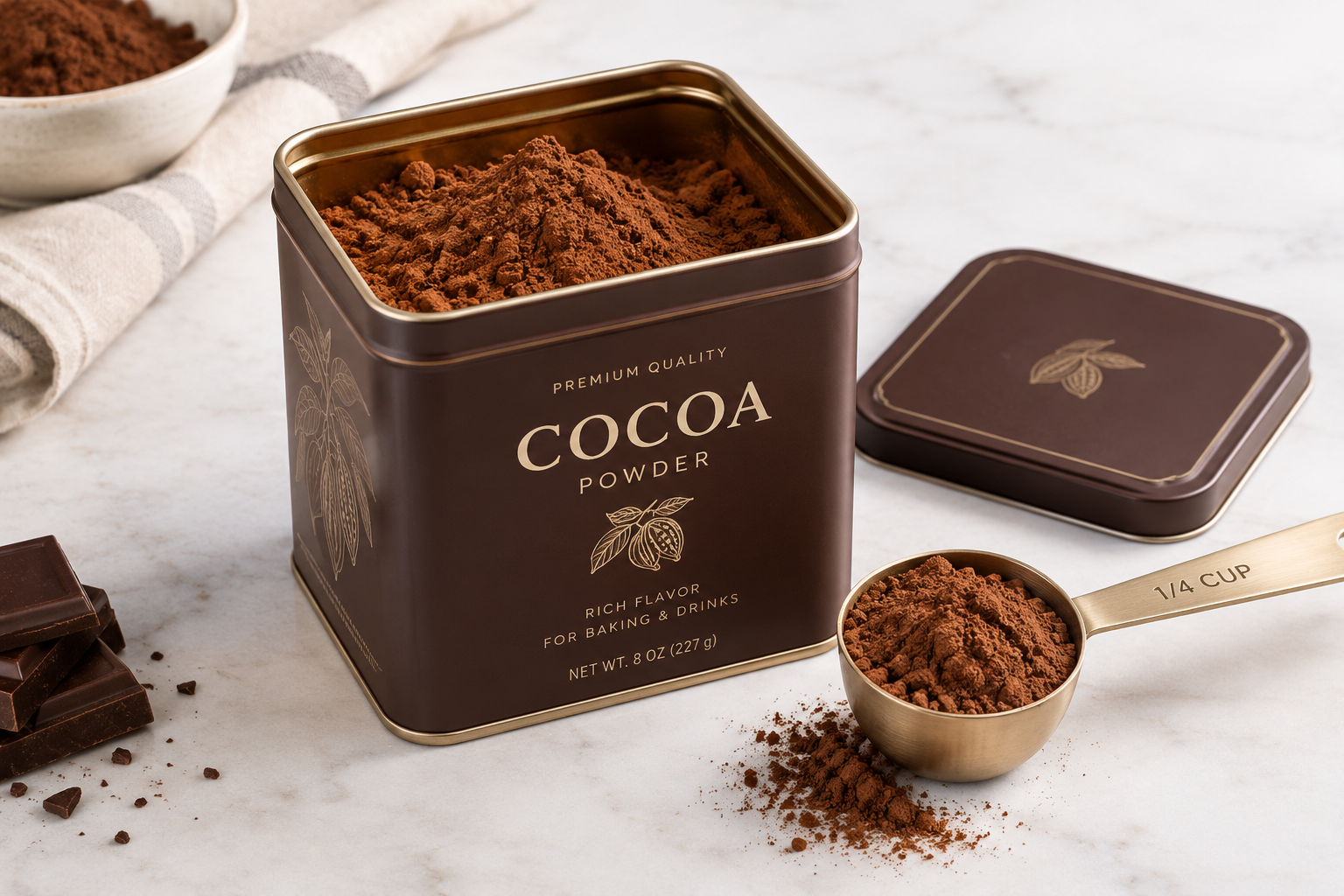
A custom cocoa tin should be developed around the powder inside it. Cocoa powder and hot chocolate mix can look similar on a shelf, but they fill a container differently, and a tin that matches the net weight on paper can still be too small once a scoop and a closing lid are added.
A practical development sequence is:
Product type → Net weight → Settled volume → Scoop → Internal space → Lid → Sample
This guide covers those cocoa-specific decisions before artwork, quotation and production.
How Is a Cocoa Tin Different From Other Food Tins?
Cocoa products are fine powders, and that changes the packaging questions.
- Settling: Powder settles after filling and transport, so the level at the filling line is not always the level the customer sees.
- Moisture: Cocoa powder and sweetened mixes can clump if exposed to humidity.
- Aroma: Cocoa is strongly aromatic, so the inner surface and any liner deserve attention.
- Scoop access: Customers usually measure powder by the spoonful, so the opening must allow a scoop to enter and turn.
Because of these points, a cocoa tin is not simply a candy tin with a different label. For a broader framework on food tins, see our custom candy tin guide.
Cocoa Powder or Hot Chocolate Mix: Why Does the Product Type Matter?
Pure cocoa powder, instant hot chocolate mix and blends with sugar, milk powder or small inclusions can have different bulk densities. Two products with the same net weight may occupy different volumes.
Confirm which of these the tin will hold:
- Unsweetened cocoa powder
- Instant hot chocolate mix
- Cocoa blended with sugar, milk powder or flavoring
- Hot chocolate mix with marshmallows or chocolate pieces
For example, a 250 g hot chocolate mix with marshmallow pieces behaves differently from 250 g of fine cocoa powder, because the pieces leave air gaps. The tin should be specified from the actual formulation, not from a similar product.
How Do You Calculate the Internal Size of a Cocoa Tin?
Start with the settled volume of the real product, then add the space needed for the scoop and the lid.
Step 1: Measure settled volume. Weigh the target net weight into a measuring container, tap it gently as the product would settle in transport, and read the volume.
Step 2: Convert volume to fill height. For a round tin, divide the volume by the internal base area.
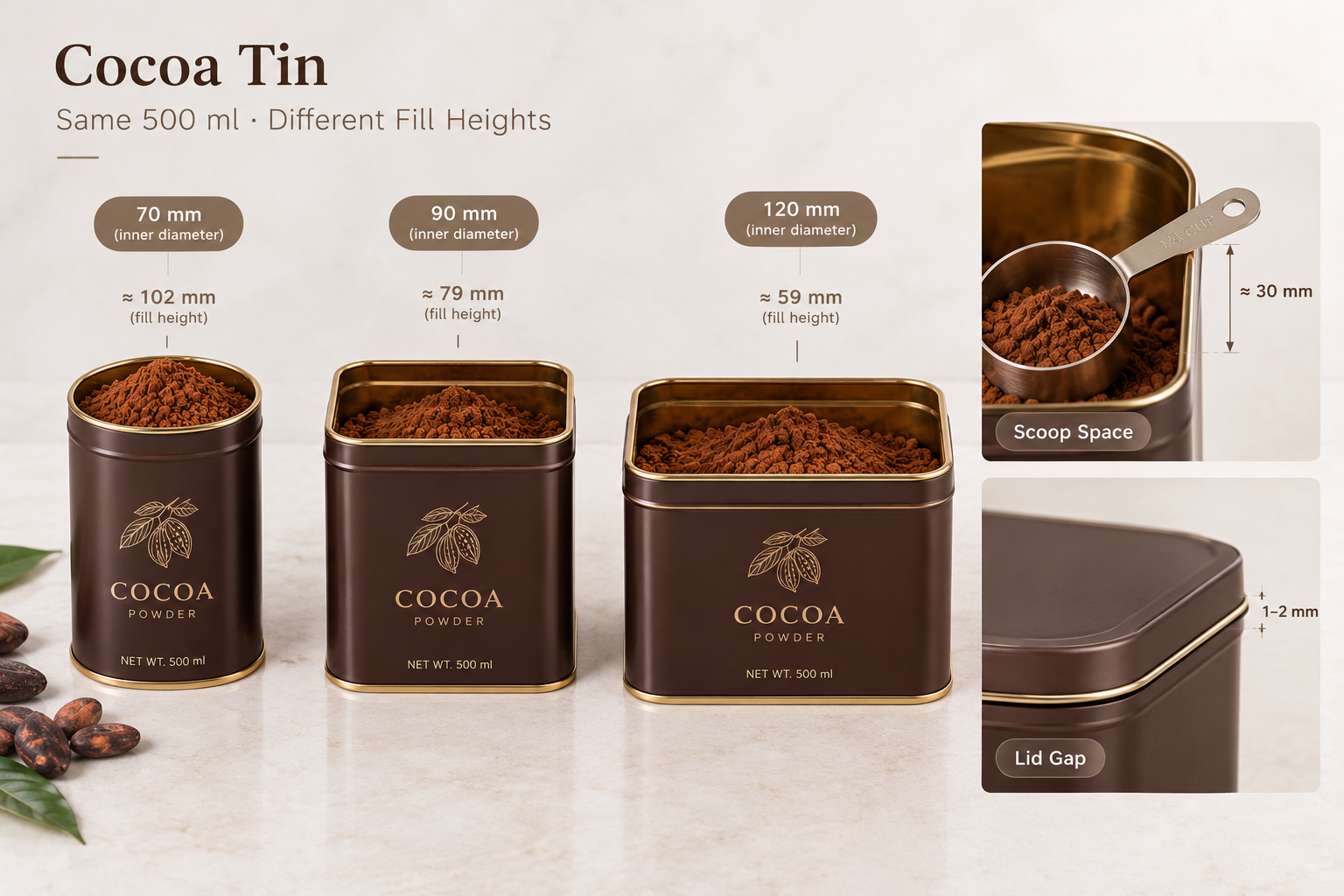
An illustrative example: suppose 250 g of a hot chocolate mix settles at 500 ml in a measuring cup.
| Item | Value |
|---|---|
| Settled product volume | 500 ml (500 cm³) |
| Assumed internal diameter | 90 mm (9 cm) |
| Internal base area | about 63.6 cm² |
| Resulting fill height | about 79 mm |
These figures are illustrative, not a recommended tin size. A different diameter changes the height, and a different product changes the volume.
Step 3: Add clearance. The final internal height also has to account for:
- Space between the powder surface and the lid
- Scoop height and how it is stored
- Tin wall construction and lid overlap
- Any inner bag, liner or insert
- Product settling during transport
This is why “250 g per tin” alone does not determine the tin size. Two tins with similar external dimensions can offer different usable internal space.
Where Should the Scoop Go?
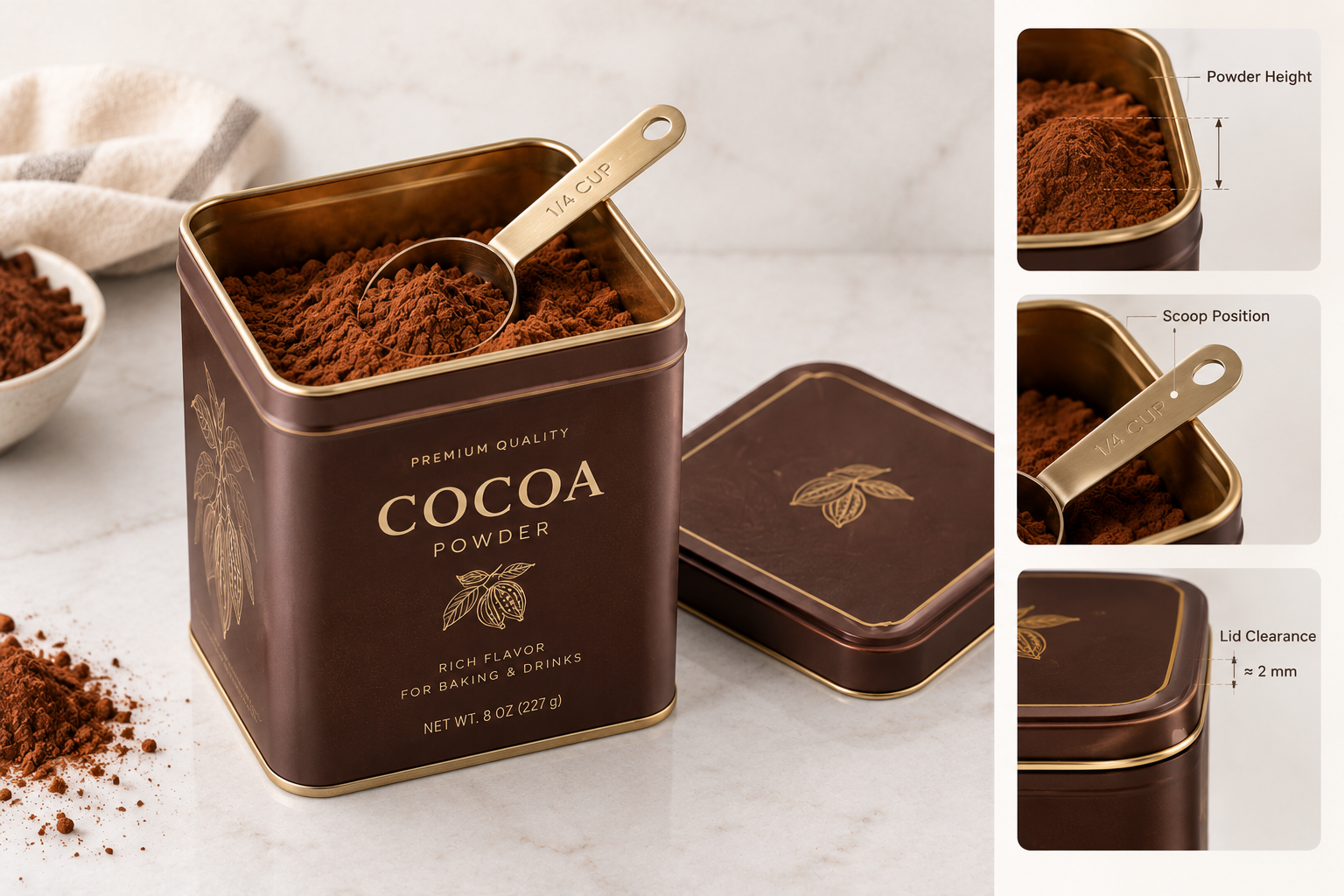
The scoop is the most overlooked part of cocoa packaging. Decide where it will live before fixing the internal height:
- Resting on the powder surface: This needs extra headspace and a scoop handle that does not interfere with the lid.
- Packed inside a small bag on top of the powder: This keeps the scoop clean but adds height.
- Packed separately or not included: This simplifies the tin but changes the customer experience.
Test the actual scoop in the actual tin. The opening should allow the scoop to enter, reach the powder and come out without scraping the rim.
What Lid Structure Works for a Cocoa Tin?
For cocoa tins, the lid is used again and again as the product is consumed, so its fit matters more than its appearance.
Common structures include removable lids, hinged lids and sliding lids. Check the filled tin rather than an empty sample:
- Does the lid open without excessive force?
- Does it close consistently after repeated use?
- Is powder trapped on the rim or lid contact area?
- Does the opening allow the scoop to be used comfortably?
For a broader explanation of lid structures, see our Rectangular Tins with Lids guide. If you are considering a round format, our Round Tin Boxcan range shows available structures.
Do You Need an Inner Bag or Liner for Cocoa Powder?
A metal tin should not be described as airtight or moisture-proof by default. Moisture and aroma protection depend on the whole packaging system:
- Lid and closure fit
- Inner coating
- Inner pouch or liner
- Storage conditions
- Powder moisture content at filling
If your cocoa product is moisture-sensitive or you need to preserve aroma, discuss the complete configuration before finalizing the specification. For an example of how an inner pouch affects internal space, see our Custom Tea Tins guide, where the same fit logic applies.
What Food-Contact Requirements Apply to a Cocoa Tin?
Cocoa powder touches the inner surface directly, so the coating and food-contact documentation should be confirmed for the target market. A generic statement such as “food grade” is not enough.
EU buyers: Regulation (EC) No 1935/2004 sets the general framework for food-contact materials, and Regulation (EC) No 2023/2006 covers good manufacturing practice. BPA requirements are addressed by Regulation (EU) 2024/3190. As of October 20, 2026, the main July 20, 2026 transition date for most affected single-use final food-contact articles has passed, so ask the supplier for the applicable Declaration of Compliance and coating documentation for your project. The responsible compliance party should confirm how the tin is classified.
U.S. buyers: The FDA explains that the regulatory status of a food-contact material depends on its individual substances and intended conditions of use. There is no single “FDA-approved tin.” Ask for documentation showing the regulatory basis for the specific coating and intended use.
When you request a quotation, state the target market, product type and whether the powder contacts the inner surface directly.
How Should You Plan Printing and Label Space?
Cocoa tins are often sold on shelf and as gifts, so the artwork has to carry the brand and the required product information.
Reserve space for the information your market requires, such as ingredients, net weight and allergen statements. The responsible food business or a regulatory adviser should confirm what is required before artwork is approved.
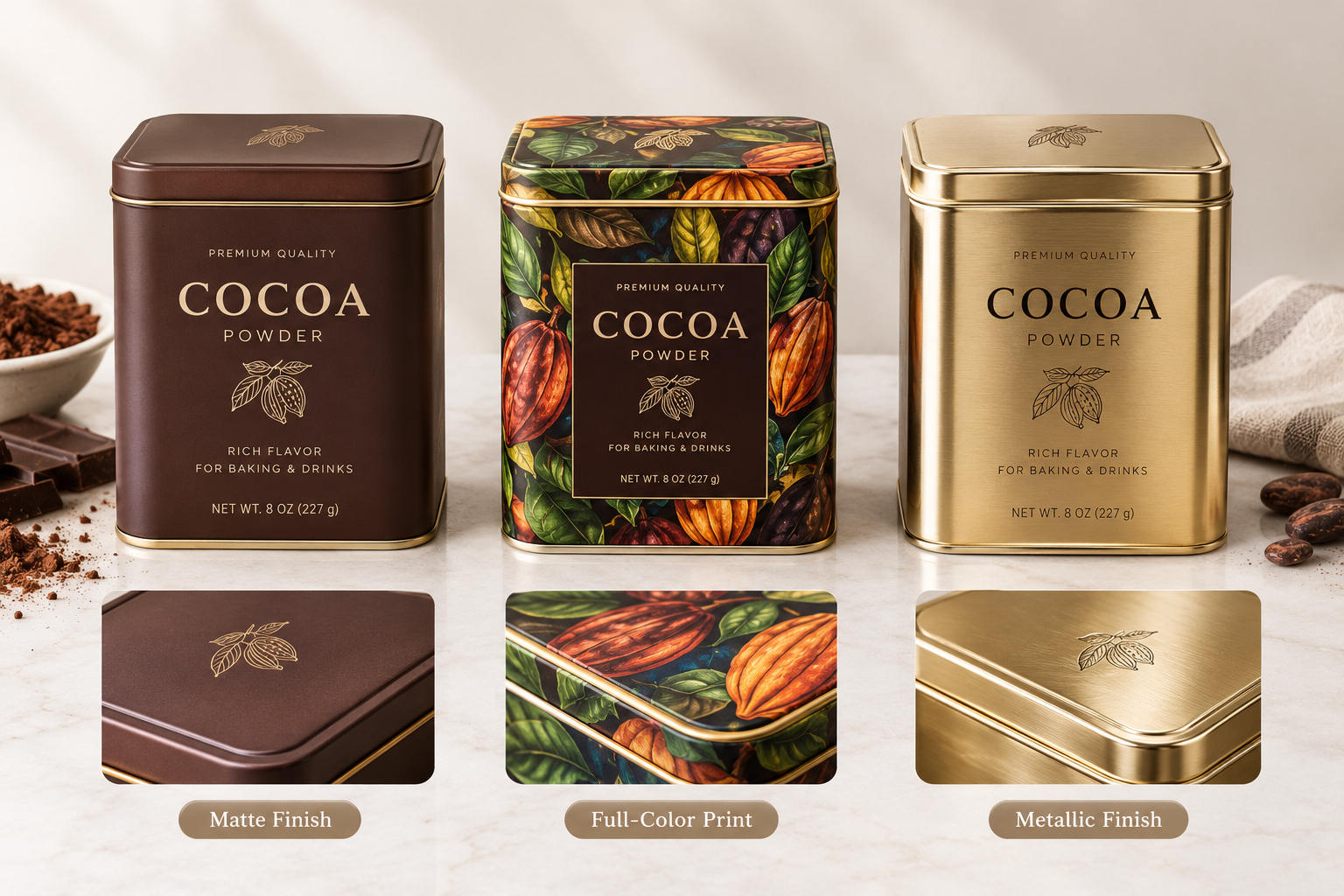
Review artwork on a physical sample or three-dimensional mock-up, since a design that looks balanced on screen can feel crowded when wrapped around a curved tin. For file preparation, color and finishes, see our Custom Printed Tin Packaging guide and the Candy Tin Artwork & Printing Guide.
What Should You Check When Approving a Cocoa Tin Sample?
Approve the sample with the real product and the real scoop whenever possible.
Product fit
- Net weight and fill level after gentle settling
- Space between powder and lid
- Inner bag or liner fit, if used
Scoop and opening
- Scoop enters and turns without scraping
- Powder is easy to reach as the level drops
- Lid closes without trapping powder
Lid operation
- Open and close the lid several times on the filled tin
- Check that the closure stays consistent
Inner surface and finish
- Complete coating coverage
- No visible scratches, exposed metal or uneven areas
- Printing, edges and lid alignment
Resolve any issues before approving mass production.
Which Cocoa Tin Fits Retail, Gifting or Refill Use?
The intended use shapes the specification.
| Use | What to prioritize |
|---|---|
| Retail shelf | Clear branding, label space, consistent fill |
| Gifting | Decorative printing, lid fit, presentation |
| Hot chocolate gift set | Space for mix, mugs, stirrers or accessories |
| Refill packaging | Easy repeated opening and a reliable closure |
For a hot chocolate set that includes extra items, define the layout of every component before fixing the tin size.
What Should You Send for a Cocoa Tin Quote?
A complete inquiry lets the manufacturer evaluate the structure before quoting.
| Requirement | What to provide |
|---|---|
| Product type | Cocoa powder, hot chocolate mix, blend with inclusions |
| Target net weight | For example, 250 g |
| Settled volume | Measured with the real product |
| Scoop | Included or not, size and storage position |
| Product protection | Inner bag, liner or none |
| Lid | Removable, hinged, sliding, other |
| Target market | U.S., EU, UK, etc. |
| Artwork | Ready or in preparation |
| Order quantity | Estimated number of tins |
| Delivery | Required launch date |
Keep quantity per tin separate from order quantity. For budgeting, MOQ and lead time, see our Custom Tin Box Cost, MOQ & Lead Time guide and our FAQ. Browse available structures in our Hot Sale Tin packaging range.
FAQ
What is the best tin for cocoa powder?
The best choice is the tin that fits the settled volume of your actual product, leaves room for the scoop and closes reliably after repeated use. Confirm it with a filled sample rather than with net weight alone.
How much cocoa powder fits in a cocoa tin?
It depends on the product’s bulk density, the internal dimensions and the headspace left for the scoop and lid. Measure the settled volume of the real product, then check the fill height against the internal height.
Is a cocoa tin airtight?
Not automatically. Moisture and aroma protection depend on the lid fit, inner coating and any inner bag or liner. Discuss the full configuration if the product is moisture-sensitive.
Do I need a scoop in a cocoa tin?
If customers will measure powder from the tin, a scoop improves usability, but it needs space and a defined storage position. Test the scoop in a filled sample.
What documents should I request for a cocoa tin?
Ask for food-contact documentation that matches your target market and the actual inner coating, such as the applicable Declaration of Compliance for EU projects, rather than relying on a generic “food grade” statement.
What is the MOQ and lead time for custom cocoa tins?
They depend on the structure, printing and whether an existing mold can be used. See our MOQ and lead time guide and FAQ for current information.
Request a Custom Cocoa Tin
If you already know your product type, net weight, settled volume, scoop plan, preferred lid and estimated order quantity, send those details to Liyipackaging for the next step in development.