Written by: Liyipackaging Packaging Team
Published: October 22, 2026
Last Updated: October 22, 2026
Regulatory information reviewed: October 22, 2026
A custom chewing gum tin should be developed around the gum, not simply chosen because the tin looks attractive. The same tin can feel right for one gum format and clumsy for another.
The practical questions are:
- Is the gum in pellets, sticks, slabs or individually wrapped pieces?
- How many pieces should each tin hold?
- How will the pieces be arranged?
- Can the user open the tin and take out one piece easily?
- Does the tin stay quiet and closed in a pocket or bag?
- Does the coating suit the intended food-contact use?
A useful development sequence is:
Gum format → Quantity → Arrangement → Internal space → Lid → Sample
Quick takeaway
- Measure the gum as it will actually be packed, including any wrapper.
- “12 pieces per tin” alone does not determine the tin size.
- Test the filled sample for one-handed opening, rattle and closure.
- Confirm the coating and food-contact documentation for your target market.
- Treat nicotine or other functional gum as a separate regulatory project.
How Is a Chewing Gum Tin Different From a Mint Tin or Candy Tin?
Gum is softer and stickier than most mints, and it is often wrapped or sold in strips. These differences affect the layout, the lid and the sample checks.
| Gum format | Main packing concern | Layout consideration |
|---|---|---|
| Coated pellets | Rattle and loose movement | Fill density, row arrangement, optional tray |
| Sticks or slabs | Bending and wrapper edges | Internal length, stack height, ease of removal |
| Individually wrapped pieces | Wrapper thickness and sticking | Measure with the wrapper; check how the piece lifts out |
| Strips or blister packs | Flat shape and removal | Internal footprint and opening space |
A chewing gum tin is also opened many times a day, often with one hand. The lid therefore matters more than it does for a tin that is opened once and stored.
For mint-specific coating and aroma decisions, see our custom mint tin guide. For a broader candy packaging framework, see our custom candy tin guide.
How Do You Calculate the Internal Size of a Chewing Gum Tin?
Start with the actual piece dimensions and the intended arrangement, then add the clearances the tin needs.
For example, suppose one coated gum pellet measures approximately:
18 mm × 10 mm × 6 mm
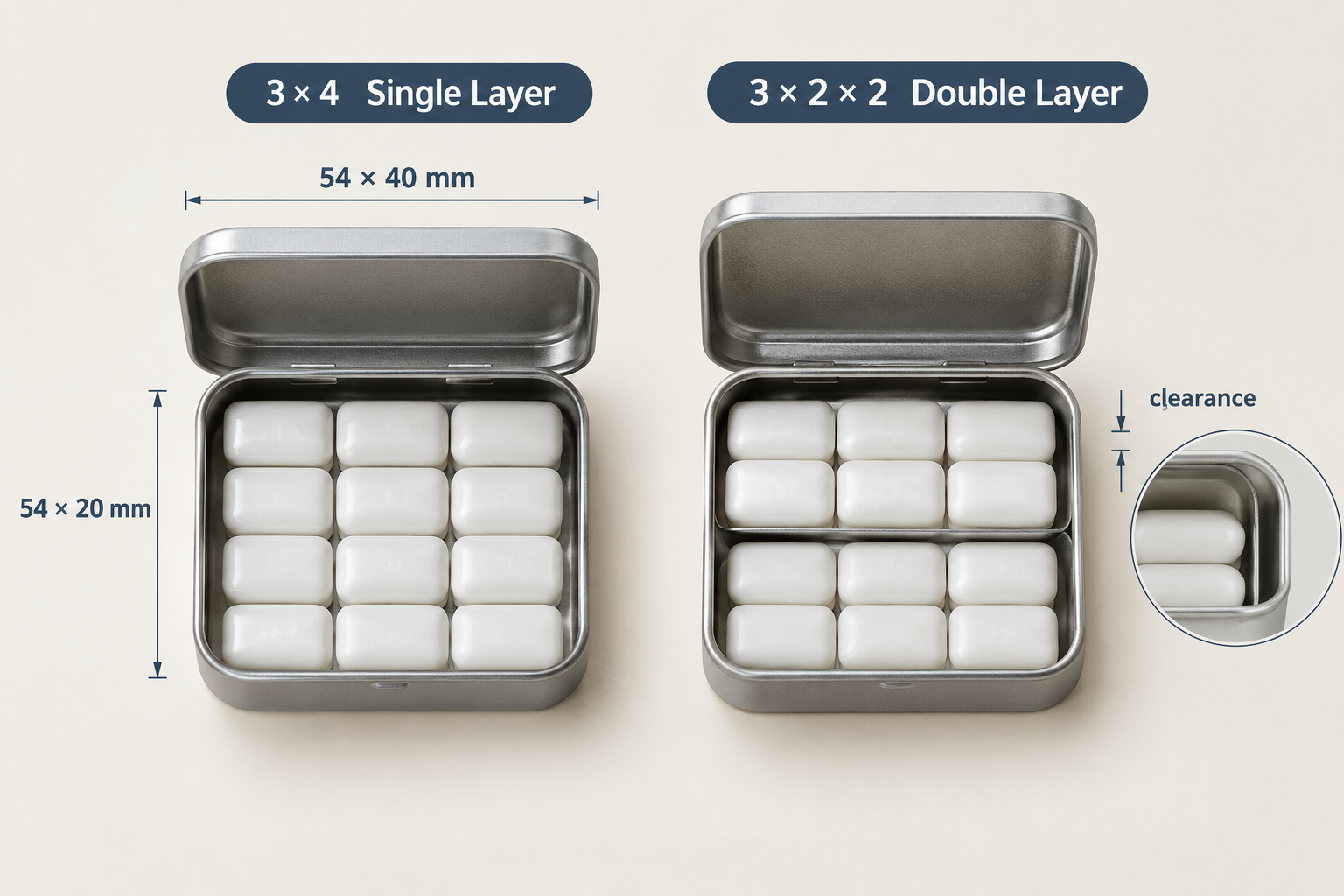
and the target quantity is 12 pieces. The same 12 pieces can need very different space depending on how they are arranged.
| Arrangement | Pieces per layer | Nominal product footprint | Stacking height |
|---|---|---|---|
| Single layer | 3 × 4 | 54 × 40 mm | 6 mm |
| Two layers | 3 × 2 | 54 × 20 mm | 12 mm |
These are illustrative product dimensions, not final tin dimensions. A single layer gives a wider, flatter tin that is easy to read at a glance. Two layers give a narrower, taller tin that carries more easily in a pocket but may be harder to reach into.
For sticks and slabs, measure the length, width and thickness of the wrapped piece, then multiply the thickness by the number of pieces to find the stack height. The internal length should be longer than the stick so that it does not need to bend when the tin closes.
The final internal dimensions also need to account for:
- Clearance around the gum
- Clearance between the gum and the lid
- Tin wall construction and corner shape
- Lid structure and overlap
- Any tray, liner or inner pack
- The room needed to lift out one piece
This is why the usable internal space can differ between two tins with similar external dimensions.
Which Lid Works Best for Chewing Gum?
Choose the lid for the way the gum will be used. For daily carry, three points matter most.
- One-handed opening: The user should be able to open the tin and take one piece without using two hands.
- Secure closure: The lid should stay shut in a pocket or bag, but not be so tight that it is hard to open.
- Controlled access: A smaller opening or a tray can make it easier to take out one piece instead of tipping out several.
Hinged lids keep the lid attached and are convenient for repeated use. Removable lids are simple, but the lid has to be held or set aside. Sliding lids can suit small flat pieces, depending on the structure. For a full comparison of structures, see our rectangular tin lid types guide.
How can you reduce rattle in a gum tin?
Rattle usually comes from empty space. A tin that is much larger than the arranged gum lets the pieces move and knock against the walls. Closer-fitting dimensions, a tray or a different arrangement can all reduce movement. Check the result with a filled sample, because an empty prototype cannot show how the pieces behave.
Does heat affect gum in a metal tin?
Gum can soften in warm conditions, and a metal tin does not insulate its contents. If the product will be carried or stored in warm environments, discuss the intended conditions with your packaging team and test the filled tin under realistic handling.
What Food-Contact and Wrapping Checks Matter for a Gum Tin?
First, decide whether the gum or its wrapper will touch the tin surfaces. Many gum products are wrapped or inner-packed, but the answer still depends on your actual product and design.
Then confirm the coating and documentation for your target market. Do not rely on a generic “food grade” statement.
- EU: Regulation (EC) No 1935/2004 provides the general framework for food-contact materials, and Regulation (EC) No 2023/2006 covers good manufacturing practice. BPA restrictions for food-contact materials are addressed by Regulation (EU) 2024/3190. For a detailed explanation of the BPA transition rules, see the regulatory section of our mint tin guide. Ask the supplier for the applicable Declaration of Compliance and supporting documentation.
- U.S.: The FDA assesses food-contact materials by their individual substances and intended conditions of use. There is no single “FDA-approved tin”; the question is whether the specific materials and use have an applicable regulatory basis.
Strong flavors and aromas can also make coating and odor checks relevant, so mention the flavor type when you request a quotation.
What about nicotine or other functional gum?
This guide covers conventional confectionery gum. Nicotine, caffeine or other functional gum may fall under different regulation, including packaging requirements such as child-resistant closures, and should be assessed separately for your market. If your project needs a child-resistant structure, see our child-proof tin range and confirm the requirements with your compliance adviser.
How Should You Plan Artwork and Finish for a Gum Tin?
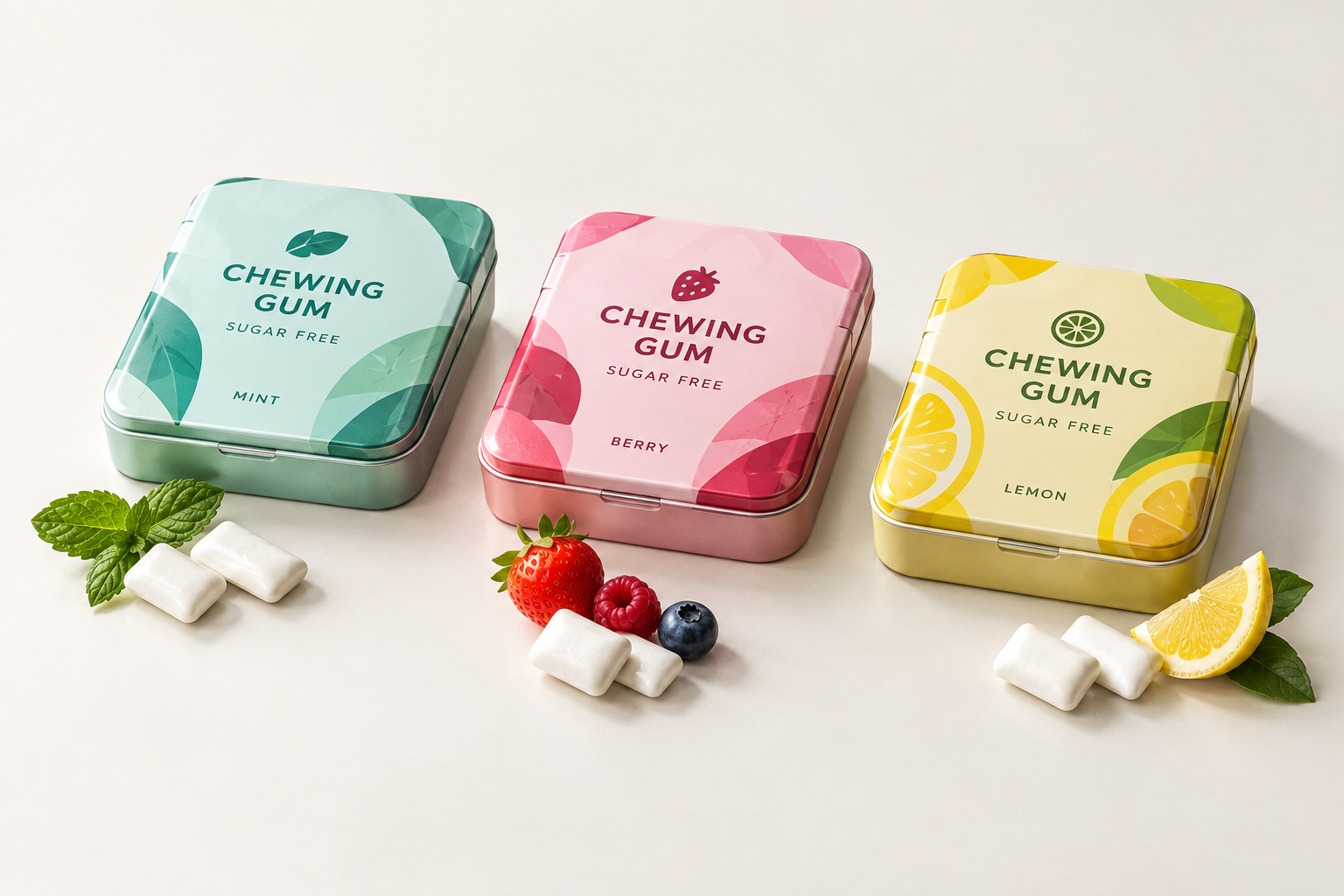
A gum tin has limited print area, so the design needs to stay legible at pocket size.
- Keep the brand name and flavor name large enough to read quickly.
- If you sell several flavors, use one tin structure with different colorways. This keeps development simple and makes the range easy to recognize.
- Confirm where required product information will appear, whether on the tin, a label or the outer packaging, according to your market.
For artwork files, color control and finishes, see our custom printed tin packaging guide.
How Should You Approve a Chewing Gum Tin Sample?
Approve the sample with the actual gum whenever possible.
- Fit: Check the quantity, arrangement and clearance.
- Access: Open the tin with one hand and take out one piece.
- Rattle: Shake the tin and listen for movement.
- Closure: Open and close the lid several times, then carry the filled tin in a pocket or bag.
- Inner surface: Inspect the coating coverage and look for scratches or exposed metal where the product may touch.
What Information Should You Send for a Custom Chewing Gum Tin Quote?
| Requirement | What to provide |
|---|---|
| Gum format | Pellets, sticks, slabs, wrapped, strips |
| Piece dimensions | Length × width × thickness, including wrapper |
| Quantity per tin | Number of pieces |
| Arrangement | Single layer, two layers, other |
| Lid and use | Hinged, removable, sliding; one-handed use |
| Protection | Wrapper, tray, inner pack, none |
| Artwork | Logo, flavor colorways, required text |
| Target market | U.S., EU, UK, etc. |
| Order quantity | Estimated number of tins |
| Delivery | Required launch or delivery date |
Keep the quantity per tin separate from the order quantity. For example:
12 gum pieces per tin + 3,000 tins order quantity
is more useful than simply saying “3,000 gum tins.”
As of 2026, custom printed tin packaging from Liyipackaging can start from 3,000 pcs, depending on the project requirements. For what affects cost, tooling and timing, see our custom tin box cost, MOQ and lead time guide.
How Can Liyipackaging Support a Custom Chewing Gum Tin Project?
Dongguan Liyi Packaging Products Co., Ltd. is a tin packaging manufacturer with more than 25 years of industry experience. Liyipackaging works with several tin structures, including rectangular, round and square tins, and with hinged, sliding and double-lid constructions.
For a gum project, the useful part of the process is reviewing the gum format, internal space, lid, coating, artwork and sample as one specification. You can browse our hot sale tin packaging range or review our custom tin packaging solutions before you send your inquiry.
FAQ
How many pieces of chewing gum fit in a tin?
It depends on the piece dimensions, wrapping, arrangement and available internal space. Calculate the footprint and stack height first, then confirm the quantity with a filled sample.
Why does chewing gum rattle in a tin?
Rattle usually comes from empty space around the pieces. Closer-fitting dimensions, a different arrangement or a tray can reduce movement.
Is a hinged lid better for chewing gum?
A hinged lid is convenient for repeated one-handed use, but the best choice depends on the tin shape, the gum format and the intended appearance. Test the filled sample.
Can a chewing gum tin be used for nicotine or functional gum?
These products may be regulated differently, including packaging requirements. Assess them separately for your target market before choosing a tin.
Can chewing gum touch the inside of the tin directly?
It depends on your product, wrapping and target market. Confirm the coating and the applicable compliance documentation before finalizing the design.
Request a Custom Chewing Gum Tin
If you already know the gum format, piece dimensions, quantity per tin, preferred lid and estimated order quantity, send those details to Liyipackaging for the next step.