Written by: Liyipackaging Packaging Team | Published: November 23, 2026 | Last Updated: November 23, 2026
Quick takeaway: The tin box manufacturer vs trading company question is not about which model is better. It is about knowing who controls your tooling, printing and quality checks, so you know who is responsible when something changes. No single document proves that a supplier makes your tins. Combine five checks: the legal entity, evidence of production, tooling ownership, technical answers, and consistency between the website, quote and invoice.
A custom tin project involves tooling, printing, forming, lid fitting and usually several rounds of sampling. Whoever manages those steps decides how quickly a change can be made and who is accountable when a sample or a batch does not match the approved reference. Many buyers only find out whether they dealt with a factory or an intermediary after something goes wrong.
This guide gives you practical checks to use before you pay a deposit. They apply to any supplier, including us. For a wider view of choosing a supplier for food packaging, see How to Choose the Right Cookie Tin Manufacturer in 2026. For the project stages that follow once you have chosen, see Custom Tin Packaging Process: From Brief to Mass Production.
Why Does It Matter Whether a Tin Supplier Is a Manufacturer or a Trading Company?
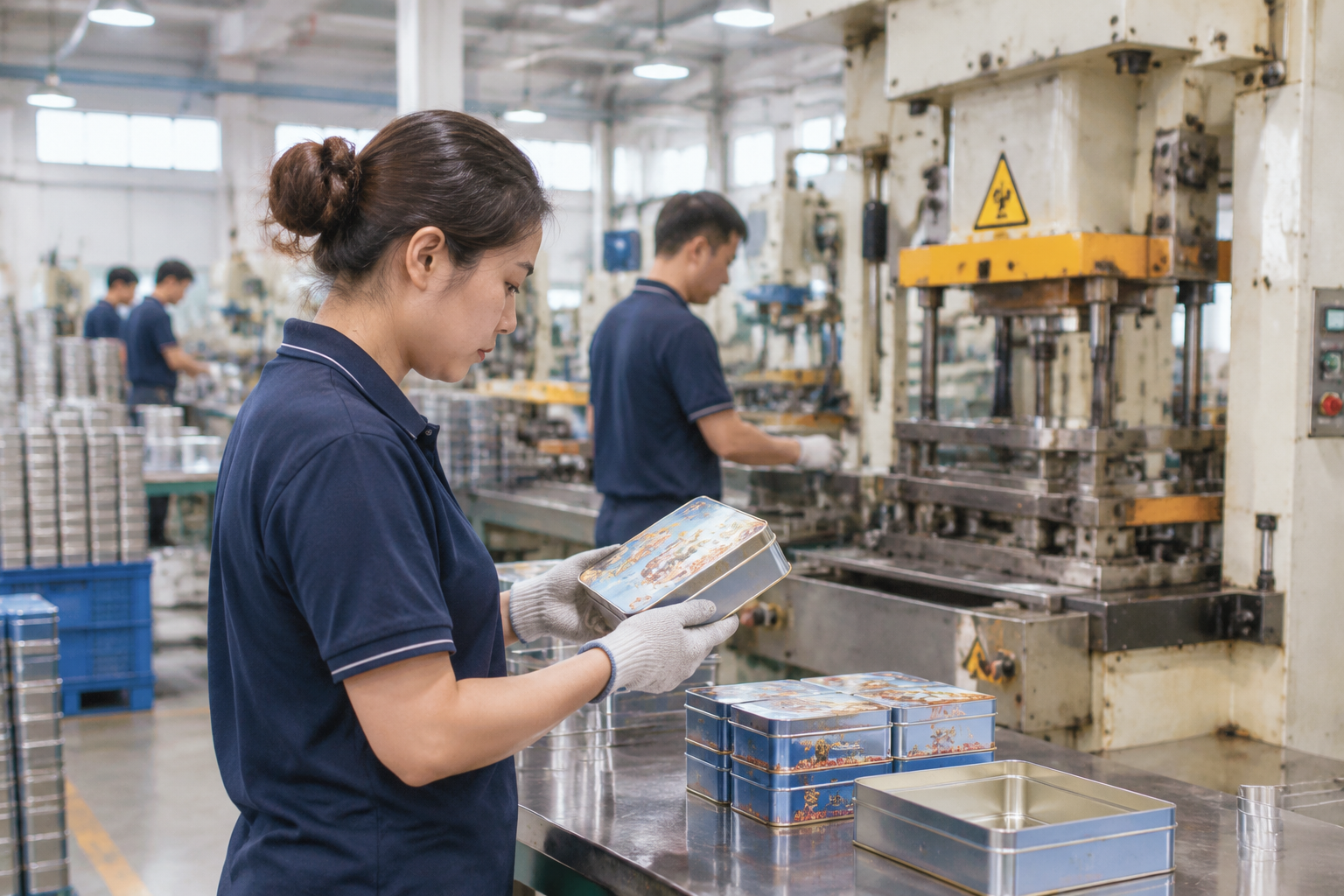
A customized tin is not a catalog item. The structure may need tooling, the artwork has to be printed on metal, and the finished tin has to be formed, assembled and inspected. Each stage can happen in one factory, be spread across several, or be arranged by an intermediary.
That affects four things buyers care about:
- Speed of change: who can adjust a tool or a print setting after sample feedback.
- Tooling: who owns it, where it is kept, and whether you can reuse it for repeat orders.
- Accountability: who answers when the bulk batch differs from the approved sample.
- Price structure: how many parties are involved between your order and the production floor.
Tin Box Manufacturer vs Trading Company: What Each Model Means
| Model | What it is | Where it can work well | What to clarify |
|---|---|---|---|
| Manufacturer | Produces tins in its own facility | Custom structures, new tooling, repeat orders | Which processes are done in-house |
| Trading company | Sources from one or more factories and manages the order | Small mixed orders, several product categories | Which factory makes your tins and who inspects them |
| Hybrid | Own factory plus partners for some processes | Projects needing inserts, accessories or special finishes | Which steps are outsourced and who is responsible |
None of these models is wrong by default. The problem is not knowing which one you are dealing with.
7 Checks to Verify Who Makes Your Tins
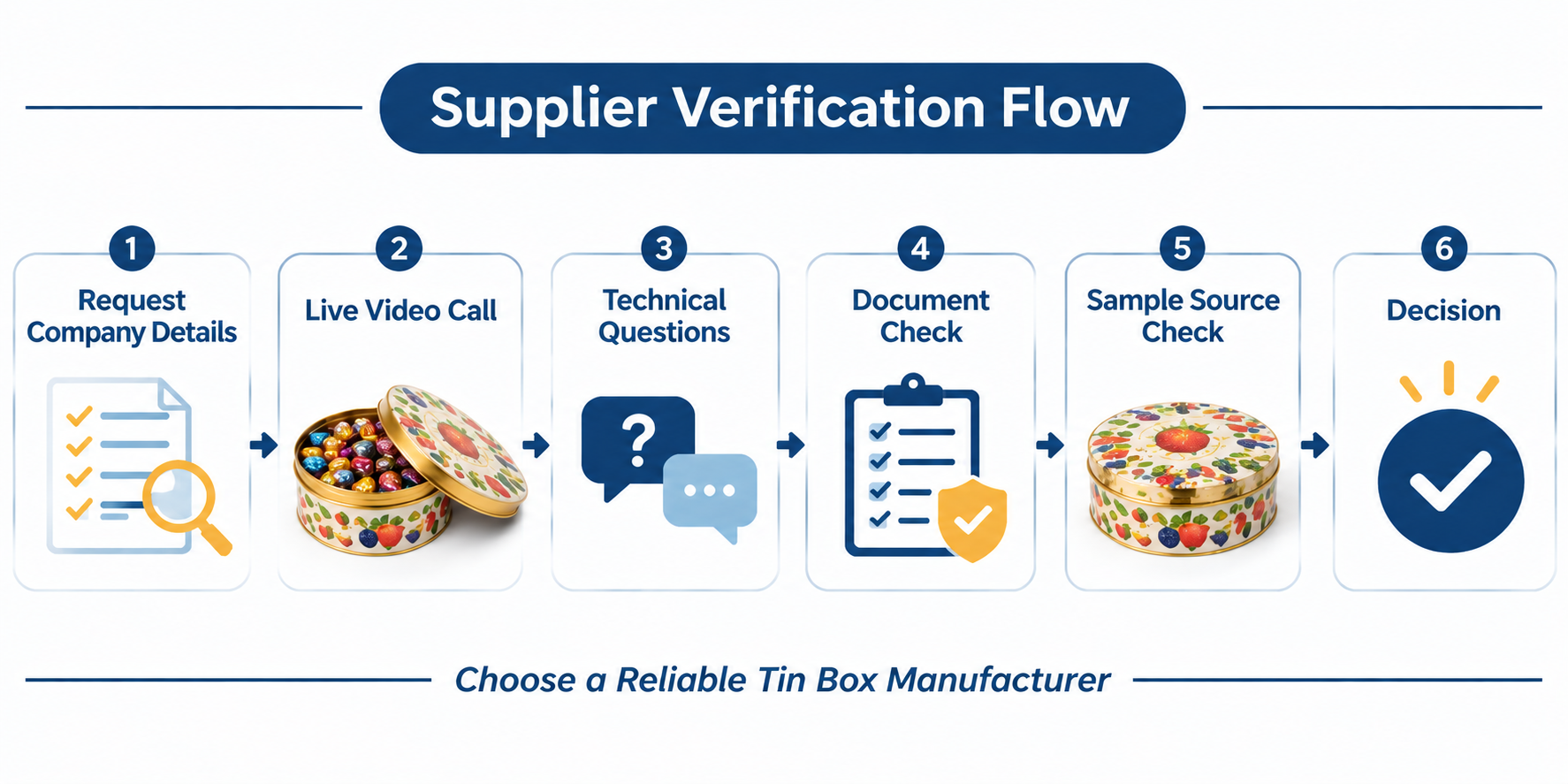
1. Ask who owns the tooling. For a custom structure, ask who pays for the tool, who owns it and where it is stored. A clear answer covers cost, ownership and reuse on repeat orders.
2. Ask for a live video of the production steps. Choose the stage you want to see, such as forming, printing or final inspection. Ask the supplier to show it live, with a handwritten note carrying today’s date next to the equipment. Pre-recorded footage can be reused from any source.
3. Ask process-specific questions. For example: where is the print done, how are the lid and body formed, what coating is used inside the tin, and how is color checked against the reference? A manufacturer can usually answer these directly.
4. Check that the company name is consistent. Compare the name on the website, the quote, the proforma invoice and the bank account. If they differ, ask why. There can be legitimate explanations, but they should be explained in writing.
5. Ask for projects similar to yours. Photos, samples or written project records for comparable structures show relevant experience. Our cookie tin case study on fixing internal height before mass production is an example of the kind of project record worth asking any supplier for.
6. Ask where the sample was made. A sample produced in the same facility as the bulk order tells you more about what to expect than one sourced elsewhere. Our guide to irregular tin box sample approval explains what to check once the sample arrives.
7. Ask how outsourcing is handled. If part of the work is done by partners, ask which steps, who inspects them, and who is responsible if there is a problem. A supplier that discloses this openly is easier to work with than one that avoids the question.
What Documents and Evidence Can You Reasonably Request?
| Request | What it shows | Limits |
|---|---|---|
| Business registration | The legal entity and its registered scope | Does not prove who produces your tins |
| Unified Social Credit Code | Lets you look the entity up in the official registry | Records are in Chinese; match the name to the quote and invoice |
| Factory photos or video | The production environment | Can be reused; prefer a live call |
| Equipment list | Production capability | Does not show the equipment is used for your order |
| Sample made to your specification | Capability on your actual product | Ask where it was made |
| Third-party inspection or audit report | An independent view | Check the date, scope and who commissioned it |
| Similar project references | Experience with comparable structures | Confirm they are real and relevant |
Registered Chinese companies have an 18-character Unified Social Credit Code, which appears on the business license. Ask the supplier for it, then search it in China’s official registry, the National Enterprise Credit Information Publicity System (gsxt.gov.cn), and confirm that the registered name matches the name on your quote. The registry is operated in China and can be slow or hard to reach from some overseas networks, so some buyers ask a local colleague or a verification service to run the check. Treat each item as one piece of evidence, not as proof on its own.
Red Flags That Deserve a Follow-Up Question
A red flag is a reason to ask, not an automatic reason to reject a supplier.
- The supplier will not do a live video call and only sends recorded files.
- The company name on the quote differs from the invoice or bank account without explanation.
- The supplier cannot say where the sample was made.
- Answers about tooling ownership and cost are vague.
- Every technical question is answered with a general statement or “we will check”.
- Contact details differ across the website, quote and documents.
When Is a Trading Company a Reasonable Choice?
A trading company can be a sensible choice when you need several different products from different factories in one order, when your quantities are small, or when you want one contact to coordinate suppliers. What matters is that the arrangement is clear: which factory makes your tins, who inspects them, and who is responsible for problems.
How Liyipackaging Describes Its Own Setup
We would rather you ask than assume, so here is what we state publicly. Our FAQ answers the question directly: we are a manufacturer with our own factory. Dongguan Liyi Packaging Products Co., Ltd. is a tin packaging manufacturer with over 10 years of company operation and more than 25 years of industry expertise, located in Qingxi Town, Dongguan, near Shenzhen. Our facility covers 3,000㎡, our team has more than 30 employees, and our products are exported to over 30 countries. We work from design and development through production to pre-shipment inspection. You can read more on our About Us page.
Apply the seven checks above to us as you would to any supplier. To start a conversation, send your product details to our contact page and ask whichever of the questions above matter most to your project. You can also browse our rectangular, round, square and irregular tin ranges, or review our custom solutions. For printing and artwork questions, see our Custom Printed Tin Packaging guide.
FAQ
How can I tell whether a tin box supplier is a manufacturer or a trading company?
No single check is enough. Combine a live video of production, answers to process-specific questions, clarity on tooling ownership, and consistency between the website, quote, invoice and bank account name.
Is a trading company always a worse choice than a manufacturer?
No. A trading company can suit small or mixed orders. The important point is knowing which factory makes your tins and who is responsible for quality.
Is a business license enough to prove that a supplier has a factory?
No. A license shows the legal entity and its registered scope. It does not show who produces your tins, so combine it with production evidence and a sample.
Can I visit the factory before ordering?
A visit is the strongest form of verification. If you cannot travel, ask for a live video walkthrough and consider a third-party inspection. Ask any supplier about visit arrangements before you commit.
What should I do if a supplier outsources part of the production?
Ask which steps are outsourced, who inspects them and who is responsible if there is a problem. Outsourcing is common and not necessarily a concern if it is disclosed and managed. For order quantities, lead times and sampling, see our FAQ page.