By Liyipackaging Packaging Team | Published and updated: October 14, 2026
Quick takeaway:
- Size a fudge tin from the piece dimensions and the layout, not from the tin’s outside measurements.
- Plan the layer separation and inner wrap at the same time as the tin size, because both take up space.
- Fudge contains sugar and often butter or cream, so test how the actual product behaves in the tin before approving production.
- Approve the sample with the real fudge, closed and handled, before mass production.
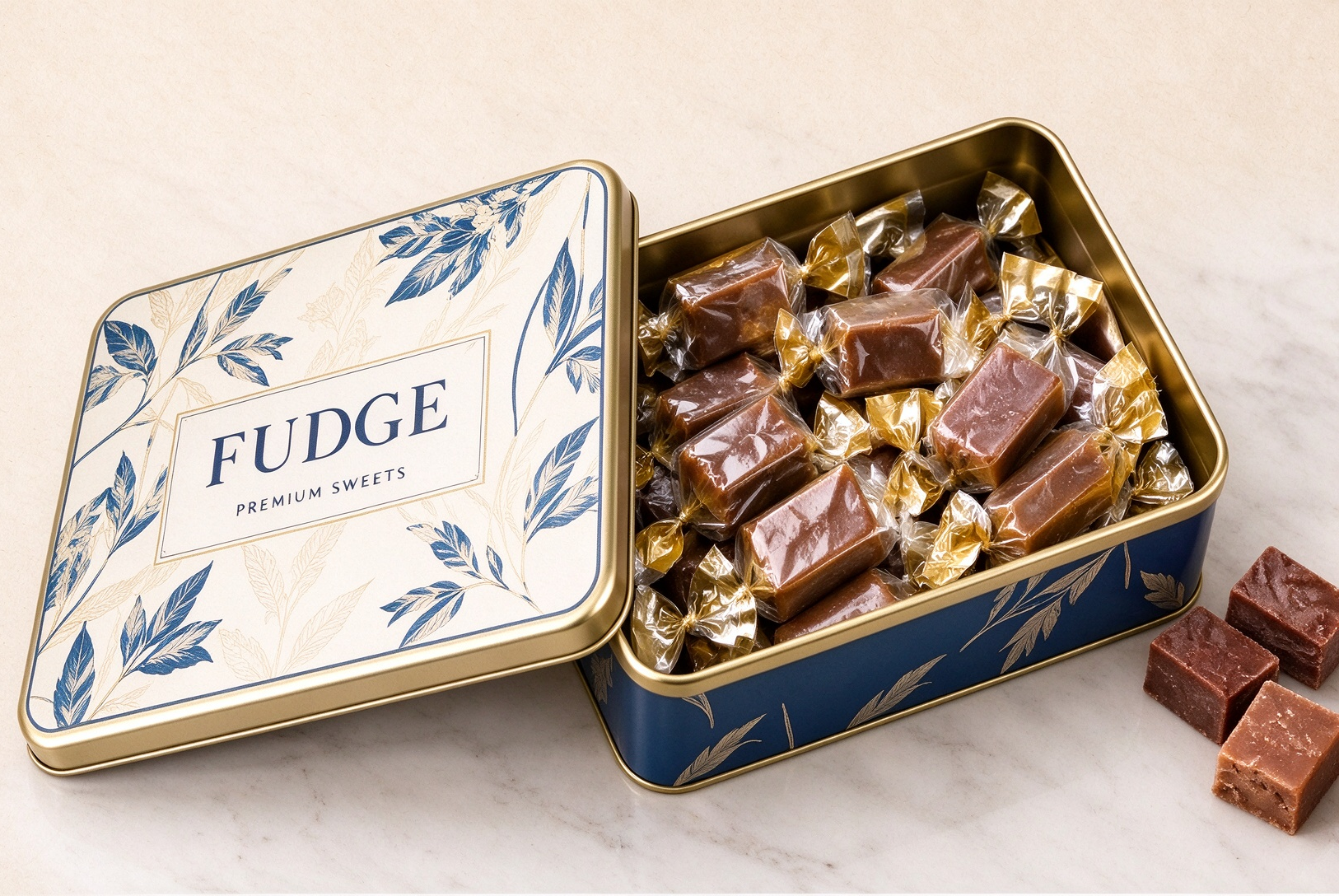
Custom fudge tins have to solve a specific packing problem: fudge is dense, can be soft, and often sticks to whatever it touches. A tin that looks right empty can fail once the pieces, the inner paper, and the lid are all in place.
At Liyipackaging, our packaging team works on tin structure, sampling, printing, and production for food brands. This guide covers the fudge-specific decisions: piece format, internal size, layering, inner wrap, and sample testing. For general tin selection across confectionery, start with our guide to choosing custom candy tins.
Which Fudge Format Are You Packaging?
Start with the piece, not the tin. The format of the fudge decides the layout, the separation method, and how much space the tin needs.
Common formats include:
- Square or rectangular cut pieces, packed in rows and layers
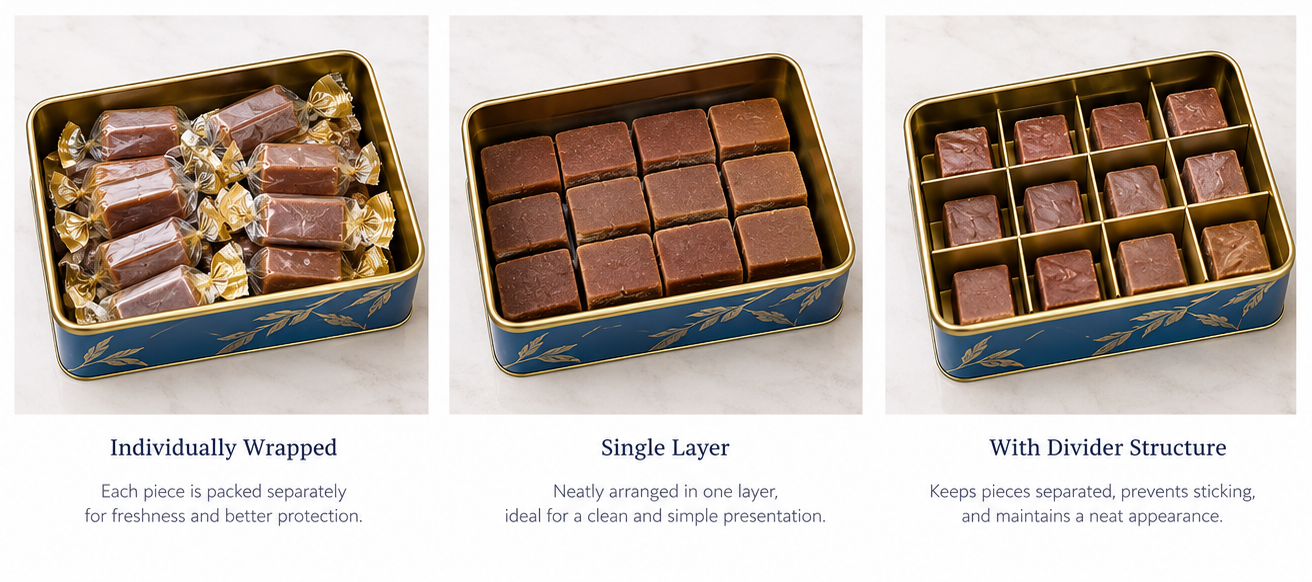
- Individually wrapped pieces, which can be packed more tightly and handled more easily
- Slab or bar portions, which need a larger footprint and fewer pieces per layer
- Irregular hand-cut pieces, which need extra clearance because sizes vary
Measure length, width, and height on a representative set of pieces, not a single best-looking one. If pieces vary from batch to batch, size the tin for the largest realistic piece.
How Do You Size a Fudge Tin From Piece Dimensions?
Multiply out the layout, then add clearance. The tin’s internal footprint must fit the rows of pieces plus the room needed to load and remove them.
Worked example: 12 pieces, each 30 × 25 × 15 mm, packed in two layers of six.
| Step | Calculation | Result |
|---|---|---|
| Pieces per layer | 12 pieces ÷ 2 layers | 6 pieces |
| Layout per layer | 3 pieces along 30 mm × 2 pieces along 25 mm | 3 × 2 grid |
| Piece footprint | 3 × 30 mm by 2 × 25 mm | 90 × 50 mm |
| Footprint with clearance | add 2 mm per side (example value) | about 94 × 54 mm |
| Stack height | 2 layers × 15 mm | 30 mm |
| Height with separation | add layer paper and lid clearance | confirm with sample |
The clearance figure is a starting point for discussion, not a rule. The right allowance depends on the wrapping, the tin construction, and how tightly the pieces should sit.
If you sell by weight, use a volume test instead: pack the intended net weight of fudge into a trial container, measure the space it occupies, then work backward to the internal dimensions. For tins with straight sides, our guide to rectangular tins with lids explains how corner radius and wall construction affect usable space.
Should You Pack Fudge in One Layer or Several?
Single layers are easier to present and access; multiple layers hold more but need separation.
A single layer lets customers see and remove each piece without disturbing the others. It needs a larger footprint for the same quantity.
Multiple layers use less shelf space per piece, but the lower layer carries the weight of the upper one. Softer fudge can deform or stick under that load, so the layers need a barrier and the stack should be tested.
If you are choosing between a taller tin and a wider one, compare how each layout holds up after handling, not just how it looks when freshly packed.
What Inner Wrap and Separation Should You Use?
Choose the inner packing together with the tin size. Individual wrapping, layer paper, and dividers each use space and each solve a different problem.
- Individual wrapping keeps pieces apart and reduces direct contact with the tin surface.
- Layer paper, such as food-grade parchment or wax paper, separates stacked layers. Confirm the paper’s food-contact suitability for your market.
- Dividers or inserts keep flavors apart and hold a defined layout, but they reduce usable space.
If the fudge is wrapped and arranged securely, an insert may be unnecessary. If you sell several flavors in one tin, a divider helps keep them from mixing and transferring flavor or color.
Which Lid and Tin Structure Suits Fudge?
A removable lid is the straightforward choice; other structures suit specific uses. The right structure depends on how customers will open, store, and re-close the tin.
- Removable lid: direct access to the contents; check that the lid closes without pressing on the top layer.
- Hinged lid: the lid stays attached, which helps when the tin is opened repeatedly.
- Compartment structure: separates varieties, but takes space from the total capacity.
Do not describe a removable-lid tin as airtight unless the complete closure and inner packing have been evaluated for that claim. For a full comparison of lid types, see our rectangular tins with lids guide.
How Do Fat, Softness, and Food-Contact Rules Affect the Tin?
Fudge that contains butter or other fats can transfer oil to paper and surfaces, and soft fudge can stick or deform. Both affect the choice of inner wrap, coating, and layout.
Check these points before approving the specification:
- Will the fudge touch the tin’s inner surface directly, or stay separated by wrapping or paper?
- If it contacts the surface, what inner coating or lining does the supplier propose, and what documentation supports it for this use?
- Does oil from the fudge mark the layer paper or wrapping during storage?
Applicable rules depend on the market. In the U.S., the FDA regulates food contact substances according to the substances used and their conditions of use. In the EU, Regulation (EC) No 1935/2004 sets the general framework for food-contact materials, Regulation (EC) No 2023/2006 covers good manufacturing practice, and Regulation (EU) 2024/3190 addresses bisphenols and certain other substances in food-contact materials.
A general claim such as “food grade” does not prove compliance for every product and market. Request the documentation that matches your fudge, your target market, and the way the tin will be used.
Regulatory information reviewed: October 13, 2026.
How Can You Brand a Fudge Tin?
Design the artwork around the finished tin, with room for the product information your market requires. Logos, flavor names, illustrations, and seasonal graphics all work, provided they stay readable on the curved or embossed surfaces of the real tin.
Confirm the tin structure before finalizing artwork, because a structural change later can force a redesign. For file preparation, color, and finishes, see our custom printed tin packaging guide and the candy tin artwork and printing guide.
How Should You Test a Fudge Tin Sample?
Test with the real fudge, packed the way you plan to ship it. An empty sample proves little about fit.
- Load the intended quantity with the planned wrap, paper, and insert.
- Close the lid and check that it does not press on the top layer.
- Handle and move the tin as it would be handled in distribution.
- Open it and inspect the arrangement, the paper, and the tin surface.
- Store it for the period you expect and check again for oil transfer or sticking.
- Review the artwork, color, and finish against the approved design.
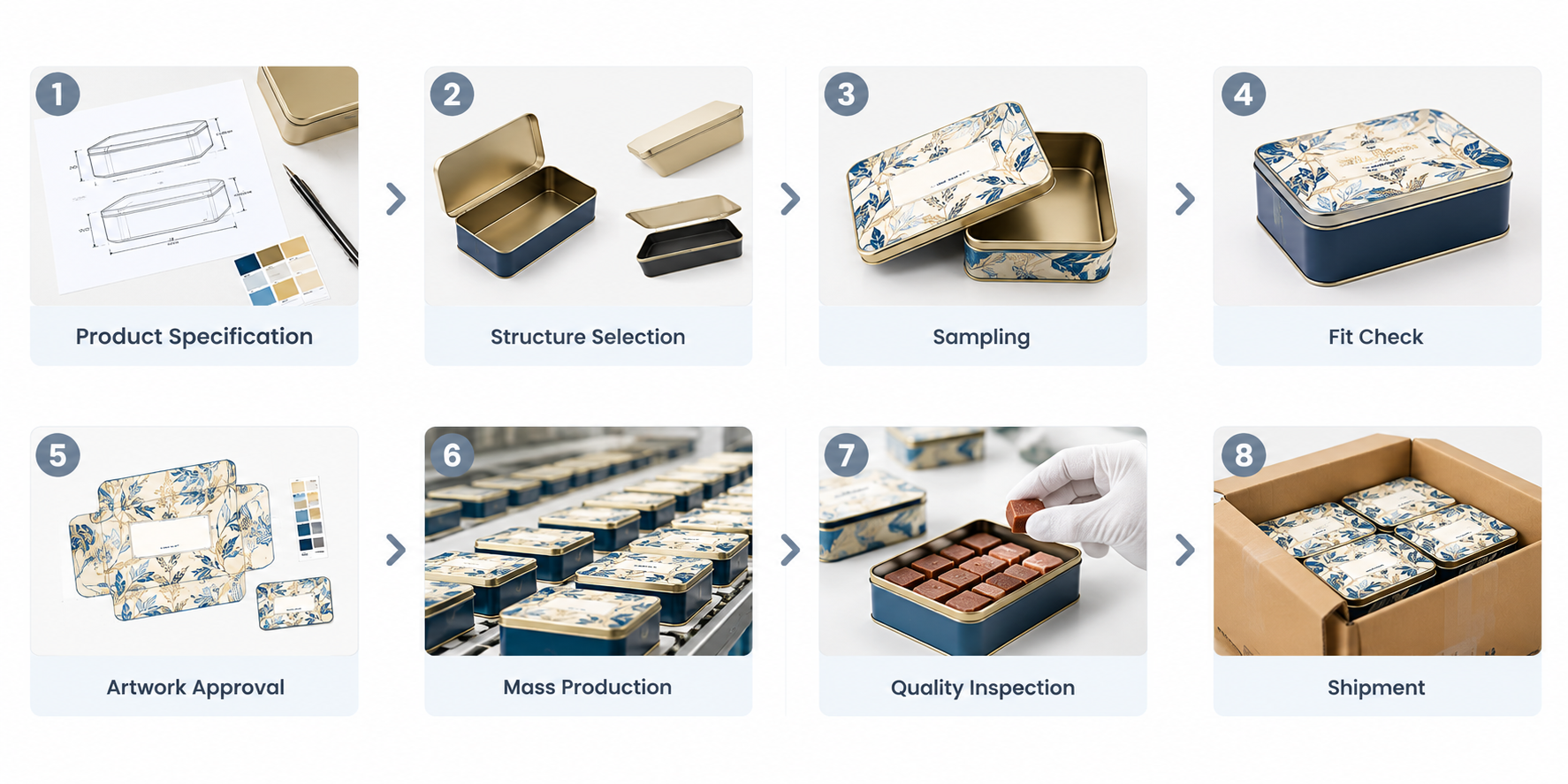
Keep structure approval, artwork approval, and sample approval as separate checkpoints. Each answers a different question: whether the tin fits the product, whether the design is correctly prepared, and whether the finished sample meets the specification.
When Should You Order Fudge Tins for a Seasonal Launch?
Work backward from the date the tins must arrive. Fudge sells heavily around holidays, and sample review, revisions, production, inspection, and shipping all need to fit before launch.
For the holiday window, see the ordering dates in our Christmas tins guide. For minimum order quantities, pricing factors, and lead times, see the custom tin box cost, MOQ and lead time guide and our FAQ.
FAQ: Custom Fudge Tins
What size tin do I need for a given weight of fudge?
Fudge density and piece shape vary, so weight alone does not set the tin size. Pack a trial quantity, measure the space it occupies, and use that volume to set the internal dimensions.
Does fudge need paper between layers?
If you pack more than one layer, a separating layer helps stop pieces from sticking together. Whether you need it, and which paper suits your product and market, should be confirmed with the real fudge during sampling.
Should I pack fudge in one layer or two?
One layer is easier to present and access but needs a larger footprint. Two layers save space but need a barrier and a stack test, especially for softer fudge.
Can fat or oil in fudge affect the tin?
Fudge made with butter or other fats can transfer oil to wrapping or paper. Check this during sample storage, and ask the supplier about the inner coating for your use.
Can I use inserts for multiple fudge flavors?
Yes. Dividers can keep flavors separate and hold a layout, but they reduce usable space and should be included in the sample test.
What do I need to send for a quotation?
Send the piece dimensions, quantity per tin, wrapping method, preferred structure, artwork status, target market, estimated order quantity, and required delivery date. Our contact page is the quickest way to start.
Related Guides
- How to choose custom candy tins
- Rectangular tins with lids
- Custom printed tin packaging guide
- Christmas tins for seasonal sales
- Custom round cookie tins
Ready to plan your fudge tin? Send us your piece dimensions and target quantity through our contact page, or browse our hot sale tin packaging range.